
The Rise of Hellenic Science: How Geography and Politics Shaped Greek Natural Philosophy
The emergence of Greek science and natural philosophy, while less mystifying today, still prompts the fundamental question: why did this theoretical enterprise arise in ancient Greece? Greece was a secondary civilization, developing on the periphery of the primary centers of Egypt and Mesopotamia, yet it existed in a radically different ecological and economic context. (See Map 4.1). Unlike the hydraulic agriculture of riverine empires, Greek city-states (poleis) relied on seasonal rainfall and mountain runoff, lacking large-scale irrigation. Neolithic deforestation and soil erosion limited agricultural output, supporting only relatively low population densities and driving colonial expansion from the eighth to sixth centuries BCE. This constrained, maritime-focused economy—dependent on trade in olive oil and wine—fostered an outward-looking, mercantile society rather than a centralized, wealth-hoarding state.
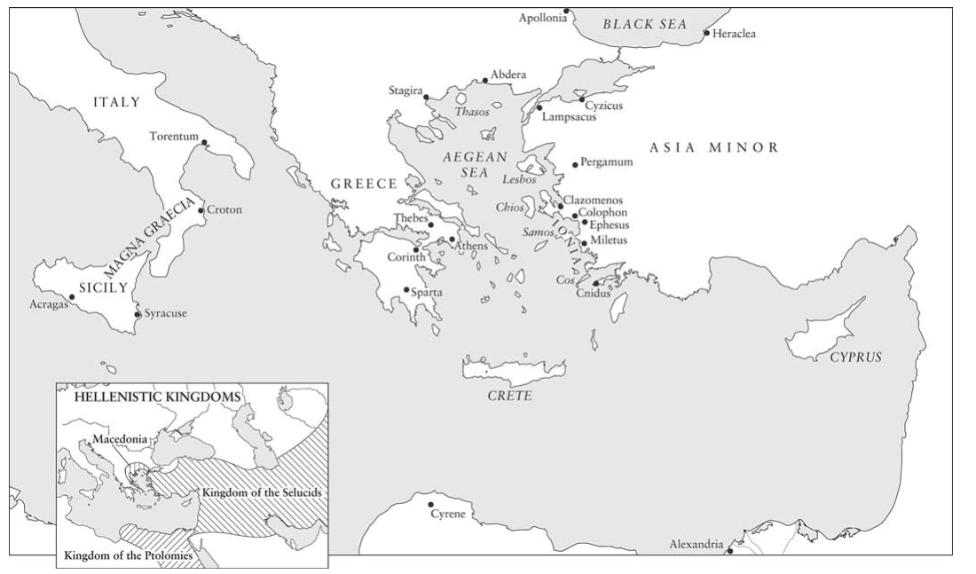
Map 4.1. The world of ancient Greece. Greek civilization originated as a cluster of small city-states around the Aegean Sea. Greek science first arose in towns along the Ionian coast of Asia Minor. After the conquests of Alexander the Great in the fourth century все the Greek world stretched from Egypt to the borders of China, forming the largest empire in the ancient world. After Alexander’s death in 323, his empire (inset) collapsed into three states: Macedonian Greece, Ptolemaic Egypt, and the Seleucid Kingdom in Mesopotamia.
The mountainous Greek geography, which compartmentalized the land into isolated valleys, directly mirrored its politically decentralized structure. Unlike an Egyptian pharaoh, the government of a small polis could not concentrate vast resources to patronize a pervasive state bureaucracy aimed at controlling all cultural activity. This fragmentation fostered intense political debate about constitutions, justice, and governance forms—from tyranny to democracy. The rational analysis of human political systems arguably provided a conceptual model for inquiring into the "constitution" of nature itself, creating a cultural environment where abstract, reasoned investigation could flourish outside of state control.
Significantly, Greek science did not originate on the mainland but in Ionia, on the fertile coast of Asia Minor (modern Turkey). In the seventh and sixth centuries BCE, Miletus and other Ionian cities were the wealthy, urbanized heart of Greek civilization. This region's relative prosperity and cosmopolitan exposure provided the material and intellectual context for the first natural philosophers, known as the Pre-Socratics (see Table 4.1). The story of Hellenic science is thus inextricably linked to the unique historical and environmental circumstances of the Aegean world, where a combination of ecological constraints, political plurality, and cross-cultural interaction created a unique niche for theoretical speculation.
Thales of Miletus and the Milesian School. Greek natural philosophy traditionally begins with Thales of Miletus (c. 625–545 BCE), a figure shrouded in later anecdote but credited with foundational insights. Reported to have traveled to Egypt, Thales is emblematic of the new intellectual type: an independent thinker making claims about nature based on his own reasoning. He proposed that the earth floats on water and that earthquakes result from its rocking, offering naturalistic explanations that sought universal causes without invoking capricious gods—a process termed the "discovery of nature." His most famous proposition, that water is the fundamental substance (arche) of all things, initiated matter theory and founded the Milesian school of philosophy.
The subsequent development of the Milesian school highlights a defining feature of Greek science: rational critique and debate. Thales's successor, Anaximander (fl. 555 BCE), rejected water as the primal element, positing instead the "Apeiron" (the Boundless)—an indefinite, eternal source from which opposites like hot and cold emerge. Anaximenes (fl. 535 BCE) later critiqued this abstract concept, proposing air (pneuma) as the fundamental substance, transformed via processes of rarefaction and condensation. This intellectual lineage culminated in the work of Empedocles (fl. 445 BCE), who synthesized earlier ideas by positing four classical elements—earth, air, fire, and water—acted upon by the forces of Love and Strife. This tradition established a dynamic of critical argument and theoretical refinement centered on explaining the constitution and transformation of the physical world.
The Pythagorean Contribution: Mathematics and Idealism. A radically different approach emerged with the Pythagoreans, a religious and philosophical brotherhood founded by Pythagoras of Samos (fl. 525 BCE). They introduced profound mathematical idealism into natural philosophy, asserting that number and mathematical relationships—not a material substance—constituted the ultimate reality. This shift was inspired by discoveries in harmonics, where musical intervals correlated with simple whole-number ratios. The Pythagoreans elevated mathematics to a theoretical, abstract discipline, pioneering the concept of mathematical proof and deductive reasoning. Their investigation led to the famous Pythagorean theorem and the troubling discovery of incommensurability (irrational numbers), which challenged their core beliefs.
The Pythagorean legacy was the potent idea that the apparent world is underpinned by a perfect, mathematical order accessible to reason. This idealist tradition created a lasting current in scientific thought, suggesting that the true essence of nature is mathematical form. Their work severed mathematics from purely practical application and established it as a central tool for philosophical inquiry into the cosmos, influencing all subsequent Greek science and, ultimately, the development of modern theoretical physics.
Diverse Currents: Atomists, Philosophers of Change, and Medicine. The pre-Socratic period was characterized by competing schools of thought. The Atomists, notably Leucippus (fl. 435 BCE) and Democritus (fl. 410 BCE), responded to Milesian matter theory by proposing that reality consists solely of atoms (indivisible particles) moving in the void. Their purely mechanical, materialist philosophy struggled to explain cosmic order and was often associated with atheism. Simultaneously, the philosophers of change—Heraclitus (fl. 500 BCE) and Parmenides (fl. 480 BCE)—engaged in a foundational debate over permanence and flux. Heraclitus insisted all is change ("you cannot step into the same river twice"), while Parmenides argued change is an illusion, raising deep epistemological questions about sensory evidence and logical truth that subsequent philosophers had to address.
Alongside these speculative traditions, the Hippocratic medical tradition offered a more practice-oriented form of natural knowledge. Associated with Hippocrates of Cos (fl. 425 BCE), this corpus emphasized observation, prognosis, and naturalistic explanations for disease, often employing theory such as the balance of the four bodily humors. While more empirical and skeptical than much natural philosophy, Hippocratic medicine operated similarly outside state control, with practitioners often being itinerant or associated with healing sanctuaries like the Asclepieions. This illustrates the pluralistic ecosystem of Greek intellectual life, where theoretical speculation coexisted with applied arts.
Conclusion: The Greek Synthesis. The rise of Hellenic science was not inevitable but the product of a singular historical convergence. The ecological constraints of the Greek world fostered a decentralized, maritime polity. This political fragmentation prevented the monopolization of knowledge by a priestly or royal bureaucracy, allowing independent natural philosophers to operate. Drawing from, but fundamentally transforming, the knowledge of neighboring civilizations, these thinkers—from the Milesians to the Pythagoreans—initiated a self-sustaining tradition of rational debate and theoretical abstraction. They established the core elements of the scientific enterprise: the search for universal natural causes, the use of logic and critique, and the powerful notion that the cosmos is intelligible to human reason. This unique Greek synthesis, born in Ionia and later systematized by figures like Aristotle, provided the indispensable intellectual foundations for the subsequent history of Western science.
Date added: 2026-02-14; views: 377;