
Tycho Brahe: The Danish Astronomer, His Observatory, and Geoheliocentric System
Meta Description: Explore the life and work of Tycho Brahe, the 16th-century Danish astronomer whose unprecedented naked-eye observations and Tychonic system challenged cosmological doctrines and advanced the Scientific Revolution.
The great Danish astronomer Tycho Brahe (1546–1601) significantly accelerated the scientific revolution quietly initiated by Nicolaus Copernicus. An aristocratic and formidable personality, Tycho ruled for two decades over the island of Hven, a fief granted by King Frederick II of Denmark. There, he constructed two magnificent astronomical centers: Uraniborg (Castle of the Heavens) and Stjerneborg (Castle of the Stars), which together formed the era's most advanced scientific installation. This complex included a printing press, a paper mill, a library, and alchemical laboratories, reflecting Tycho's diverse pursuits as an alchemist and astrologer for his patrons.
Despite his eccentric persona—marked by a prosthetic nose and a courtly entourage—Tycho Brahe was a profoundly adept and visionary scientist. He recognized that the advancement of astronomy depended on sustained, precise celestial observations, a mission he dedicated his life to fulfilling. To this end, he designed and built large, exquisitely calibrated naked-eye instruments, such as mural quadrants and armillary spheres, funded by substantial state support totaling around one percent of the Danish crown's revenue. His meticulous methodology, which accounted for instrument error and atmospheric refraction, yielded an unprecedented observational accuracy trustworthy to within arcminutes and, in some cases, arcseconds.
A pivotal moment in Tycho's career was his observation of a "new star" (stella nova) in the constellation Cassiopeia on November 11, 1572. Through precise parallax measurements, he demonstrated that this brilliant object—now known to be a supernova—was located far beyond the Moon, within the celestial realm. This discovery directly challenged the Aristotelian doctrine of an immutable and perfect heavens, proving that change could occur in the superlunary sphere. His work on the comet of 1577 further disrupted traditional cosmology, as he showed its path lay beyond the Moon and likely intersected the supposed orbits of the planets.
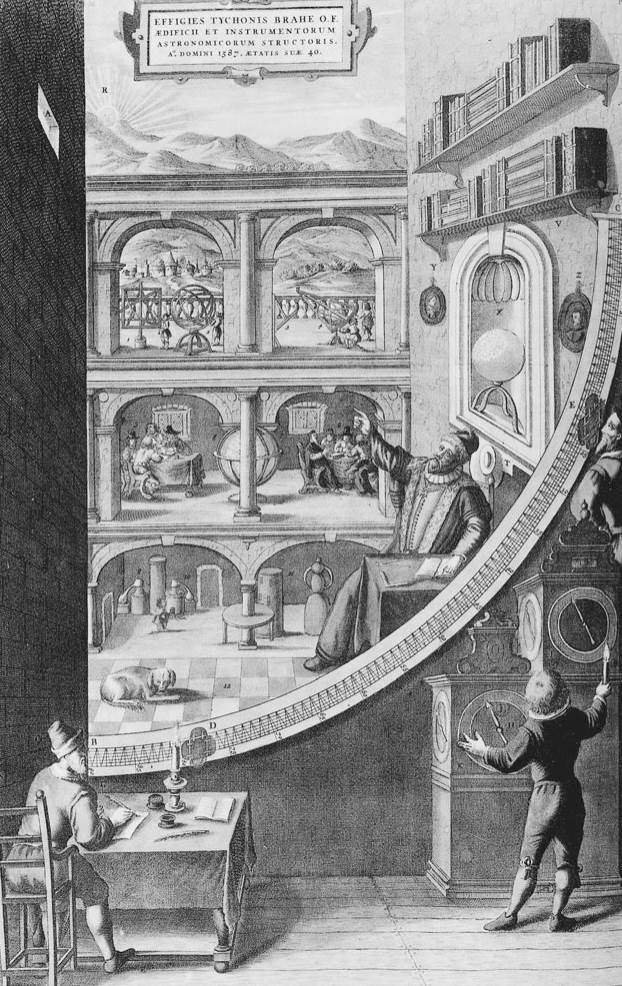
Fig. 11.4. Tycho Brahe and the mural quadrant. The remarkably accurate set of naked-eye astronomical observations compiled by the sixteenth-century Danish astronomer Tycho Brahe and his assistants depended on large instruments, such as the mural quadrant depicted here. This famous engraving also shows the other components of the research installations erected by Tycho, including an alchemical lab. No contemporary university or university professorship could have paid for Tycho’s activities. He depended on major subsidies from the Danish crown.
These observations led Tycho to conclude that the traditional crystalline spheres could not physically exist, as comets moved through these supposed planetary regions. However, despite undermining key Ptolemaic tenets, Tycho rejected the Copernican heliocentric system on empirical and philosophical grounds. He argued that the absence of observable stellar parallax implied an implausibly vast universe, and he found the concept of a rotating Earth physically unreasonable, even using contemporary ballistic arguments. Furthermore, as a Protestant, he voiced theological objections to removing Earth from the cosmic center.
In response to the shortcomings of both the Ptolemaic and Copernican systems, Tycho formulated his own compromise model in 1588: the Tychonic system (geoheliocentric system). In this innovative cosmology, Earth remained stationary at the center of the universe, the planets orbited the Sun, and the Sun itself orbited Earth. This system mathematically explained planetary motions, including retrograde motion, without epicycles, while preserving a stationary Earth and a traditionally scaled universe. It represented a scientifically robust, though conservative, solution to the astronomical crisis of the late 16th century.
Following a dispute with the new Danish king, Tycho relocated to Prague in 1597, becoming Imperial Mathematician to Emperor Rudolph II. His legacy was secured not by his own cosmological model, but by the unparalleled precision of his observational data. This treasure trove of information was later inherited by his assistant, Johannes Kepler, who used it to derive his Laws of Planetary Motion, providing the definitive evidence for a Sun-centered solar system. Thus, Tycho Brahe's meticulous work, conducted from his island fortress, became the indispensable empirical foundation for the next and conclusive stage of the astronomical revolution.
Date added: 2026-02-14; views: 348;