
Rock Deformation: Mechanisms, Structures, and Regional Tectonic Processes
Deformation in rocks is quantified through three fundamental components: strain, rotation, and translation. Strain describes the changes in both shape and volume that a rock undergoes during deformation. Rotation measures the change in orientation of a reference frame within the rock, while translation records the distance that reference frame has moved between the initial and final deformation states. Together, these three components provide a complete kinematic description of how rock bodies respond to tectonic forces.
The movement of lithospheric plates generates immense forces that deform rocks, producing major geological features such as mountain belts and large-scale fault systems like the San Andreas Fault. The concepts of stress and strain are essential for understanding how rocks respond to these forces. Stress, defined as force per unit area, is a tensor property characterized by three principal directions: maximum, intermediate, and minimum stress values. Strain represents the resulting changes in an object’s shape and dimensions, occurring as a direct consequence of applied stress.
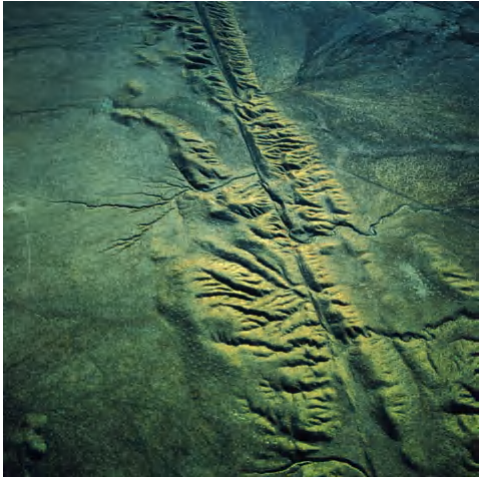
San Andreas Fault crossing Carrizo Plain in California (Bernhard Edmaier/Photo Researchers, Inc.)
Fundamental Modes of Deformation. Solids, including rocks, deform through three primary mechanisms. The first is elastic deformation, which is fully reversible; examples include a stretching rubber band or the rocks adjacent to a fault that bend elastically before suddenly snapping back during an earthquake. Most rocks can accommodate only limited elastic strain before undergoing permanent, irreversible deformation. Elastic behavior follows Hooke’s law, which states that for elastic materials, stress and strain exhibit a linear relationship, meaning strain is directly proportional to the applied stress. Under elastic conditions, the solid returns completely to its original dimensions once the stress is removed.
Permanent deformation occurs through two distinct processes: brittle failure, involving fracturing and grinding, and ductile deformation, characterized by internal flow. Fractures develop when rocks are strained beyond their elastic limit, resulting in permanent, irreversible strain through breakage. Ductile deformation also produces irreversible strain, but the rock changes shape by flowing internally, analogous to toothpaste being squeezed from a tube, without macroscopic fracturing.
When subjected to compressional forces, rocks initially undergo elastic deformation. As stress increases beyond the yield point, ductile flow commences, and with continued stress, the rock may eventually rupture. Several variables determine whether a rock deforms brittlely or ductilely, including temperature, confining pressure, time, strain rate, and composition. Elevated temperatures weaken rocks and reduce brittleness, thereby favoring ductile deformation mechanisms. High confining pressures increase rock strength while suppressing brittleness, hindering fracture formation.
Time exerts a critical influence on deformation mechanisms. Rapid deformation rates promote brittle structures, whereas slow deformation favors ductile behavior. Strain rate, which measures the amount of deformation occurring per unit time, similarly controls deformation style; slow rates encourage ductile flow, while fast rates lead to brittle failure. Composition also plays a decisive role: some minerals such as quartz exhibit relatively high strength, whereas others like calcite are comparatively weak. Under identical pressure-temperature conditions, strong minerals may deform brittlely while weak minerals undergo ductile flow. Additionally, the presence of water substantially reduces the strength of virtually all minerals and rocks, meaning even small amounts of water can significantly influence deformation mechanisms.
Bending of Rocks: Fold Structures. The bending or warping of rock layers is termed folding. Monoclines are folds characterized by horizontal limbs on both sides, often forming above deeper-seated faults. Anticlines are upward-arching folds that display the oldest rocks in their core, whereas synclines are downward-arching folds with the oldest rocks located on the outer limbs. Although numerous geometric varieties of folds exist, most represent variations of these fundamental types.
The fold hinge denotes the region of maximum curvature on a fold, while the limbs constitute the relatively planar regions between successive hinges. Folds are further classified according to hinge tightness, measured by the interlimb angle. Gentle folds exhibit interlimb angles between 180° and 120°, open folds range from 120° to 70°, close folds from 70° to 30°, tight folds display angles less than 30°, and isoclinal folds have interlimb angles approaching 0°.
Folds may be symmetrical, with limbs of approximately equal length, or asymmetrical, characterized by one limb shorter than the other. Fold geometry is also described using the orientation of the axial surface, an imaginary plane that divides the fold into two symmetric halves, and the orientation of the fold hinge. Upright gently plunging folds possess vertical axial surfaces with subhorizontal hinges, whereas recumbent folds exhibit horizontal hinges and near-horizontal axial surfaces.
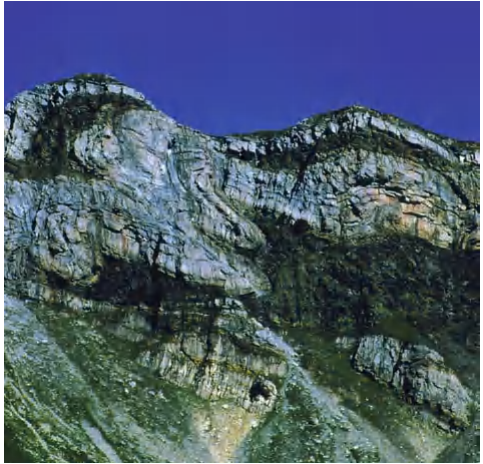
Folded rock strata in Austrian Alps (Bernhard Edmaier/Photo Researchers, Inc.)
Breaking of Rocks: Joints and Faults. Brittle deformation results in rock failure along fractures. Joints are fractures across which no appreciable movement has occurred. These structures may form tectonically in response to regional stress fields or through other processes such as cooling in igneous bodies. Columnar joints, commonly observed in igneous rocks, develop into six-sided columns as magma cools, contracts, and fractures systematically.
Fractures that accommodate measurable relative displacement are termed faults. Most faults are inclined surfaces; the block above the fault plane is the hanging wall, while the block beneath is the footwall, terms derived from historical mining practices. Faults are classified based on their dip angle and the direction of relative movement.
Normal faults occur when the hanging wall moves downward relative to the footwall, typically under extensional conditions. Reverse faults involve upward movement of the hanging wall relative to the footwall under compressional stresses. Thrust faults represent a specific category of reverse faults characterized by dip angles of less than 45°. Strike-slip faults are steeply dipping to vertical structures along which displacement is primarily horizontal. The sense of movement on strike-slip faults is described as right-lateral or left-lateral, determined by observing the direction the opposite block moves relative to a stationary block.
Regional Deformation of Rocks. Rock deformation operates across an immense range of scales, from atomic lattice distortions to the scale of continents and entire tectonic plates. Deformation at continental to plate scales produces distinctive regional structural features. Cratons are large, stable blocks of ancient crust that have remained tectonically quiescent for extended periods, typically since the Archean Era (over 2.5 billion years ago). These features form the ancient cores of continents and are characterized by thick continental roots composed of cold mantle rocks, absence of significant seismic activity, and low surface heat flow.
Orogens, or orogenic belts, are elongate regions representing eroded ancient mountain ranges that typically form belts surrounding older cratons. These belts display abundant folds and faults and commonly exhibit crustal shortening with rock unit repetition ranging from 20 to 80 percent. Young orogens, such as the Rocky Mountains, retain high topographic relief, while older ranges like the Appalachians have been eroded to lower elevations.
Continental shields are regions where ancient cratons and mountain belts are exposed at the surface, whereas continental platforms consist of younger, generally flat-lying sedimentary rocks overlying the older shield basement. Many orogens contain substantial portions of crust accreted to continental shield margins through plate tectonic mountain-building processes. Mountain belts are broadly categorized into three types: fold and thrust belts, volcanic mountain chains, and fault-block ranges.
Fold and Thrust Belts. Fold and thrust mountain chains represent contractional features formed during tectonic plate collisions, which generate large-scale thrust faults and deform metamorphic and volcanic rocks through folding. Detailed structural mapping allows geologists to reconstruct the deformation history and essentially reverse the sequence of events to understand mountain belt evolution. Such reconstructions reveal that many rocks within these belts were originally deposited in oceanic environments, including deep ocean basins, continental margin deltas, shelves, slopes, and rises. During plate collision, these sediments are scraped off and deformed, forming mountain belts that consequently mark sites where ancient oceans have closed.
The Appalachian Mountains of eastern North America exemplify a fold and thrust belt, characterized by a regional detachment surface (or décollement), extensive folds, and thrust faults. The sedimentary rocks within this belt resemble those currently accumulating off the modern continental margin, supporting the interpretation that the Appalachians represent a location where an ancient ocean basin closed through plate convergence.
Volcanic Mountain Ranges. Volcanic mountain ranges consist of thickened crustal segments formed through the accumulation of thick volcanic sequences, typically above subduction zones. Notable examples include the Aleutian Islands of Alaska, the Fossa Magna region of Japan (including Mount Fuji), and the Cascade Range of the western United States (including Mount St. Helens). These mountain belts form primarily through volcanic processes associated with subduction rather than through contractional deformation, though many do contain folds and faults, demonstrating overlap between fold-thrust belts and volcanic ranges.
Fault-Block Mountains. Fault-block mountains typically form through extensional processes that stretch and thin continental crust. Premier examples include the Basin and Range Province of the western United States and portions of the East African Rift System, including the Ethiopian Afar region. These mountain belts develop as the continental crust extends and pulls apart, creating basins bounded by tilted fault-block ranges. Such extensional terrains are associated with significant crustal thinning and may exhibit both active volcanism and ongoing extensional deformation.
FURTHER READING: Hatcher, Robert D. Structural Geology, Principles, Concepts, and Problems. 2nd ed. Englewood Cliffs, N.J.: Prentice Hall, 1995.
van der Pluijm, Ben A., and Stephen Marshak. Earth Structure: An Introduction to Structural Geology and Tectonics. Boston: WCB-McGraw Hill, 1997.
Date added: 2026-04-26; views: 254;