
Granite, Pluton, and Batholith: A Comprehensive Guide to Igneous Intrusive Geology
A coarse-grained igneous plutonic rock characterized by visible crystals of quartz, potassium feldspar, and plagioclase feldspar, along with dark minerals such as biotite or amphibole, is commonly known as granite. However, the International Union of Geological Sciences (IUGS) provides a more precise definition, classifying granite as a plutonic rock containing 10-50 percent quartz, where the ratio of alkali feldspar to total feldspar falls within the range of 65-90 percent. Granites and their related rock types are abundant components of the continental crust. They can originate from the partial melting of preexisting rocks or, to a lesser extent, through the differentiation of basaltic magma via fractional crystallization.
Numerous granites are intimately associated with convergent-margin or Andean-style magmatic arcs. These settings produce extensive plutonic bodies, such as the large plutons and batholiths exemplified by the Sierra Nevada batholith, the Coast Range batholith, and many others found along the American Cordillera. Beyond their association with convergent margins, granites also constitute a major component of Archean cratons and granite-greenstone terranes, highlighting their significance throughout geological history.
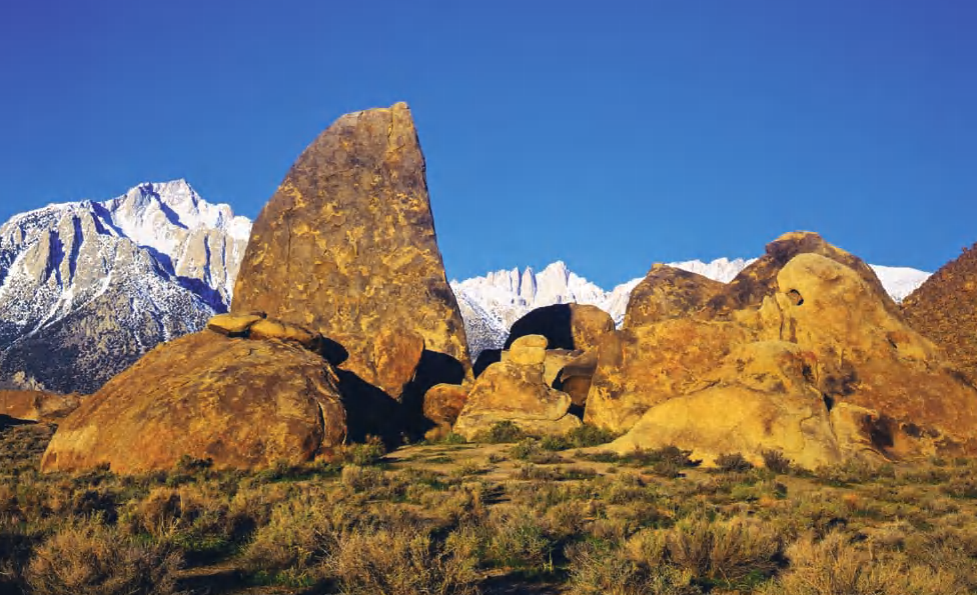
Mount Whitney and Alabama Hills outside Lone Pine, California. These mountains form part of the Sierra Nevada granite batholith
Due to their strength, durability, and low porosity, many granitic rocks are highly valued as building stones. They exhibit a wide array of colors and textural varieties, making them suitable for diverse architectural applications. In natural landscapes, granite frequently gives rise to rounded hills, often with large round or oblong boulders scattered across the hillside. These characteristic landforms result from weathering along three sets of typically perpendicular joints. Water infiltrates these joint planes, initiating chemical and physical weathering that gradually shapes the rock.
The intersection of three perpendicular joint sets defines cubes in three dimensions. Large blocks formed by these joints weather out, and their corners become rounded more rapidly than the flat surfaces due to a greater surface area exposed to weathering agents. Granite also commonly forms exfoliation domes, a process where large, concentric sheets of rock peel away and slide down mountain sides. This process can also produce inselbergs, which are isolated, steep-sided hills that remain standing on a more extensively weathered plain. Ultimately, many granitic terrains weather into flat or gently rolling plains covered by erosional detritus, including cobbles, boulders, and granitic gravels.
A pluton is a general term for a large, cooled, igneous intrusive body that solidifies within the Earth's crust. Some plutons reach such immense sizes that they are given special classifications; batholiths are defined as plutons with a surface exposure greater than 60 square miles (100 km²). Magmas, generated from melting rocks in the Earth's mantle or crust, intrude the crust in various forms, each classified as a specific type of igneous intrusion. The classification of a pluton is based on its geometry, size, and its relationship to the older, pre-existing rocks it intrudes, known as the country rock.
Concordant plutons are those with boundaries that run parallel to the layering or foliation within the surrounding country rock. In contrast, discordant plutons have boundaries that cut across this pre-existing layering. Dikes are tabular, discordant intrusions that cross-cut rock layers, while sills are tabular, concordant intrusions that inject between them. Volcanic necks, or plugs, are conduits that solidified within the vent of a volcano, connecting it to its underlying magma chamber. A prominent example of a volcanic neck is Devils Tower in Wyoming.
The characteristics and relationships between batholiths and plutons and their surrounding country rocks are largely determined by the depth at which they intruded and crystallized. Epizonal plutons are emplaced at shallow depths and typically exhibit crosscutting relationships with the surrounding rocks and tectonic foliations. They are often surrounded by a metamorphic aureole, a zone where the heat and fluids from the intrusion have altered the country rock, producing new metamorphic minerals. The hard, contact-metamorphic rocks found in these aureoles are known as hornfels.
Mesozonal plutons intrude at intermediate depths, while catazonal plutons and batholiths are emplaced at the greatest depths. Catazonal intrusions tend to have contacts that are parallel to the layering and foliation of the surrounding country rocks. Due to the high ambient temperatures at these deep crustal levels, there is a less pronounced temperature gradient between the intrusion and the country rock. Consequently, catazonal plutons often exhibit a foliated texture, particularly near their margins and contacts. Batholiths, derived from deep crustal or mantle melting processes, form substantial parts of the continental crust, are often associated with metallic mineral deposits, and serve as important sources of building stone.
Pluton Emplacement Mechanisms
The volume of magma intruded to form some plutons and batholiths is enormous, and geologists have long debated how such large bodies create space within the preexisting continental crust. Several mechanisms have been proposed to explain how these magmas ascend and make room for themselves. One mechanism is assimilation, where the rising magma melts and incorporates the surrounding country rock, altering its own composition and cooling in the process.
High pressure can also force magma into the crust. One variation of this forceful emplacement is diapirism, where the weight of the denser surrounding rocks causes a less dense, buoyant magma body to rise as a coherent mass, squeezing upward through cracks. Another process is stoping, a mechanism where thermal stress causes large blocks of the roof of the magma chamber to shatter and sink into the underlying magma, much like a glass ceiling breaking and falling into the space below. However, many plutons appear to be emplaced by utilizing pre-existing weaknesses in the crust, such as faults. In some cases, plutons are emplaced into active fault zones, intruding into spaces created by gaps that open between misaligned segments of the moving fault system.
See also CRATON; GRANITE, GRANITE BATHOLITH; IGNEOUS ROCKS; PETROLOGY AND PETROGRAPHY; STRUCTURAL GEOLOGY; WEATHERING.
FURTHER READING
Hargraves, R. B. Physics of Magmatic Processes. Princeton, N.J.: Princeton University Press, 1980.
Pitcher, W. S. “Granite Type and Tectonic Environment.” In Mountain Building Processes, edited by K. Hsu. New York: Academic Press, 1982, pp. 19-40.
Date added: 2026-04-26; views: 343;