
The Dynamics of Caesar’s Campaign for the Consulship of 59 BC
Political Campaigning and Epistolary Strategy in Late Republican Rome. In the summer of 60 BC, Gaius Julius Caesar returned from his proconsular command in Hispania. At forty years old, benefiting from the same special dispensation that had enabled him to hold earlier offices two years before the customary age, he became legally eligible to stand for the consulship of 59 BC. Having methodically prepared his candidature, Caesar faced an initial logistical barrier: being unable to canvass in person while stationed outside the city, he initiated a sophisticated epistolary campaign targeted at influential senators, including Marcus Tullius Cicero. Caesar was an exceptionally prolific letter writer, famous for his ability to dictate to multiple scribes simultaneously. Notably, historical sources mark him as the first Roman figure to regularly send written correspondence to friends and political allies while residing within Rome itself.
Electoral Alliances and Strategic Compromises. Beyond personal correspondence—which included divorcing his wife Pompeia via a written note—Caesar utilized letters to forge a crucial campaign alliance with Lucius Lucceius, a candidate possessing immense financial capital but lacking personal charisma or broad political renown. The synthesis of Lucceius’s wealth and Caesar’s widespread popularity presented a formidable electoral front. By early June 60 BC, prior to even entering Rome, Caesar was recognized as the front-runner for the consular election. Cicero observed this momentum, remarking in his correspondence to Atticus that Caesar possessed a "following wind," hoping he might sway Caesar toward supporting the Republic's traditional constitutional alignment.
Constitutional Dilemmas: The Conflict Between Triumph and Candidacy. Upon arriving at the boundary of Rome, Caesar confronted a severe constitutional dilemma. Like Pompey two years prior, Caesar remained outside the pomerium—the sacred boundary of Rome—to retain his military imperium pending a formal triumph granted for his successful military campaign in Hispania. A military triumph was the highest honor a Roman magistrate could achieve, conferring immense prestige upon the general and significantly elevating his electoral prospects among a public that deeply valued martial prowess. However, election laws required candidates to register and present themselves in person at a formal public meeting (contio) held within the Forum.
Senate Opposition and Cato’s Filibuster. Because organizing a triumph required time and Senate authorization, Caesar could not enter the city without relinquishing his military command and forfeiting the right to celebrate his military victories. Consequently, Caesar submitted a formal petition—likely via written request or intermediaries—asking permission to declare his candidacy in absentia. This petition met fierce resistance from the aristocratic conservative faction in the Senate, led primarily by Marcus Porcius Cato (Cato the Younger). Cato employed a classic obstructionist tactic: he launched a filibuster, continuously speaking until the meeting time elapsed. Because the Senate could only convene on specific calendar days and was prohibited from meeting on assembly days, Cato’s delay effectively blocked the motion before the official deadline for registering candidate lists.
Sacrificing Military Glory for Political Power. Cato’s filibuster forced Caesar into a decisive political choice. Recognizing the legislative impasse, Caesar immediately renounced his triumph, crossed the pomerium as a private citizen, and formally declared his candidacy for the consulship. Yielding a triumph was an extraordinary political sacrifice, as the honor was rare and bestowed permanent status on a family's legacy. While Pompey had achieved three triumphs due to an exceptional career, most commanders rarely celebrated more than one. Caesar’s willingness to abandon military accolades highlighted his strategic priority: securing the supreme executive office of the Roman state was a far greater political imperative.
The Political Calculus Behind Cato’s Strategy. Cato’s primary objective was to delay Caesar’s political ascent by a year, hoping that Caesar’s immense personal debts might ruin him in the interim or lead to legal prosecution in the extortion court (quaestio de repetundis). Furthermore, Cato sought to protect the electoral prospects of his brother-in-law, Marcus Calpurnius Bibulus, who was also running for the consular office. Bibulus, who had previously been overshadowed by Caesar during their joint aedileship in 65 BC and praetorship in 62 BC, stood a much higher chance of success if Caesar’s dominant candidacy were delayed or if Lucceius were removed from the race. Additionally, the Senate attempted to marginalize the political impact of the upcoming consulship by preemptively assigning the future consuls of 59 BC to the governance of rural pasture lands and forest paths (silvae callesque) under the terms of the Lex Sempronia, an intentional political insult designed to restrict their post-consular authority.
The Voting Mechanism of the Comitia Centuriata. The election was governed by the Comitia Centuriata, the voting assembly structured around wealth classes and military centuries. Voting took place on the Campus Martius inside a temporary wooden enclosure known as the saepta or oviles ("sheep-pens").
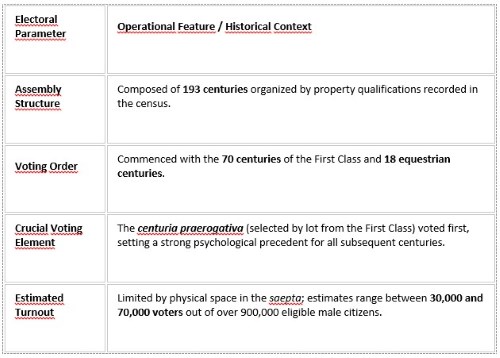
Electoral Malpractice and Caesar’s Victory. Campaign bribery (ambitus) was widely employed by all major candidates during the election of 60 BC. While Lucceius used his vast fortune to fund a joint campaign for himself and Caesar, Bibulus was heavily financed by wealthy conservative senatorial backers, a move explicitly sanctioned even by Cato to counter Caesar’s momentum. When the votes were counted, Caesar secured first place by a wide margin, gaining a decisive victory. Bibulus secured the second consular seat, leaving Lucceius defeated despite his heavy financial expenditures. With Caesar elected to the highest office of the Roman Republic, the political landscape shifted toward a decisive year of legislative struggle.
Date added: 2026-09-24; views: 5;