
Soil Texture and Structure
Soils are composed of organic material, mineral particles, air, and water. A typical mineral soil is 55 percent solid particles and 45 percent air and water. Most soils have relatively low organic matter content, ranging from 1 percent to 10 percent. These soils are known as mineral soils. In contrast, organic soils are those in which more than 80 percent of the material is organic matter. These soils develop in swamps, bogs, and marshes where waterlogged conditions inhibit decomposition. The type, abundance, and arrangement of mineral and organic particles determine heat and water flow.
Mineral particles consist of three types determined by size. Sand particles are the largest, ranging in size from 0.05 mm (very fine sand) to 2 mm (very coarse sand). They are rounded or irregular, which creates large pore spaces between particles. Sand particles have a low capacity to hold water. Clay particles are the smallest mineral particles and are less than 0.002 mm in size. Clay particles are generally flat, plate-like, and fit closely together. They have the largest surface area, which facilitates the adsorption of water to the clay particles. In between, ranging in size from 0.002 to 0.05 mm, are silt particles.
The relative abundance of sand, silt, and clay particles determines soil texture (Figure 9.1). There are three broad texture classes: sands - soils in which sand particles comprise more than 70 percent of the material by weight; clays - soils in which clay particles comprise at least 35-40 percent of the material; and loams - soils that are a mixture of sand, silt, and clay. A sandy soil has loose, individual grains that can be seen and felt. It readily falls apart when dry. If squeezed when dry, a loamy soil will form a molded shape that stays together with careful handling. When wet, the molded form is more durable and can be handled without breaking. A clay soil forms hard clumps when dry and is sticky when wet. Wet clay will form a long, flexible ribbon when squeezed.
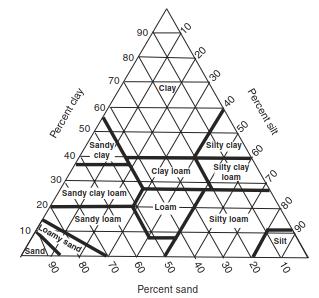
Fig. 9.1. Soil texture triangle showing the relationship between the 12 soil texture classes and percentage of sand, silt, and clay. The percentage of particles that are clay is determined by the lines running parallel to the sand side of the triangle. The percentage silt is determined by the lines running parallel to the clay side. The percentage sand lines run parallel to the silt side. For example, a soil that is 60 percent sand, 30 percent clay, and 10 percent silt is a sandy clay loam
Soil texture considers the size distribution of mineral particles. The arrangement of soil particles into large recognizable units, known as soil structure, is equally important. Loose, granular soil is much more porous than compacted soil. The development of good soil structure requires some agent that coheres and cements individual mineral particles together. Clay particles, because of their large surface area, are one such binding agent. Lack of clay is one reason why sandy soils crumble so easily. Organic matter is another cementing agent that allows individual particles to adhere to one another. Through this, organic matter has a great influence on the ability of soil to store water.
The sand, silt, clay, and organic particles that form soil lie in close contact, but because of their irregular shapes they do not fit evenly together. Instead, voids exist around the individual particles. The total volume of voids is known as pore space, or porosity. It is the volume of soil that is occupied by air and water. These pores can fill with water, such as happens when water infiltrates into the soil. Or when dry, the pores consist mainly of air. Most field conditions are in between, and the soil is a mix of solid particles, water, and air. In a typical soil, about 55 percent of the soil volume comprises solids and 45 percent of the soil volume is pore space comprising air and water.
Date added: 2026-09-24; views: 1;