
Soil Thermal Dynamics: Principles and Heat Transfer Mechanisms
Soils are a large source or repository of heat that moderates the diurnal and seasonal range in surface temperature. During the day, when solar radiation heats the surface, the surface is warmer than the underlying soil and heat flows into the soil. This transfer of heat away from the surface cools the surface. At night, the surface is cooler than the soil and heat flows out of the soil. This gain of energy at the surface warms the surface. As a result, surface air temperature shows less of a diurnal range than if no heat were stored in the soil. The same behavior occurs annually, when soil stores heat in warm months and releases heat during cold months.
Figure 9.2a illustrates a typical summer temperature profile during the day and night. At night, temperatures increase with depth. Because heat flows from high to low temperatures, heat flows upward from deeper depths to the surface. During the day, the soil profile warms, but the warming decreases with greater depth. The deep soil hardly warms at all from its nighttime temperature. As a result, daytime soil temperatures decrease with depth, and heat flows downward from the surface towards the deep soil. The diurnal cycle of soil temperature at different depths further illustrates this behavior (Figure 9.2b). The soil close to the surface, at a depth of 5 mm, warms rapidly as the Sun’s radiation heats the surface, increasing from 18°C at 0600 hours to 41°C at 1400 hours. This upper soil also cools rapidly at night. Deeper soil layers are cooler than upper layers during the day (e.g., from 1200 to 1600 hours) and warmer at night (e.g., from 0400 to 0600 hours). The diurnal range in temperature decreases with depth, and maximum temperatures occur later in the day.
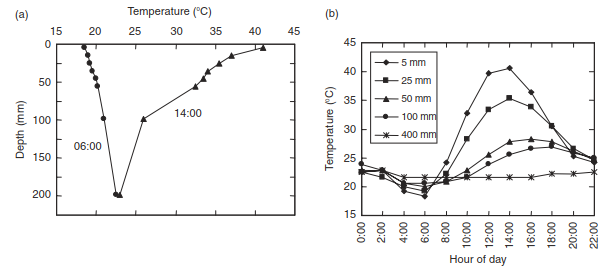
Fig. 9.2. Summer soil temperatures. (a) Typical night and day soil temperature profiles during summer. (b) Diurnal cycle of soil temperature at several depths on a typical summer day. Adapted from Hartmann (1994, p. 86)
Two soil properties (thermal conductivity, heat capacity) determine the temperature profile for a given heat flux at the surface. First, heat flows from high temperature to low temperature. The rate at which heat flows between two points separated by a distance of Δz meters is equal to soil thermal conductivity times the temperature gradient:

with F heat flux (W m-2), к thermal conductivity (W m-1 K-1), and dT / dz (K m-1, or °C m-1) the temperature gradient. This latter term is the change in temperature with depth in soil, approximated numerically by ΔT / Δz. The negative sign denotes that the heat flux is positive for a negative temperature gradient; the heat flux out of the soil is positive, and the flux into the soil is negative. Thermal conductivity determines the heat flow in unit time by conduction through a unit thickness of a unit area of material across a unit temperature gradient.
Second, if more heat enters a volume of soil than exits, the soil gains heat and warms. Conversely, net loss of heat cools the soil volume. Heat capacity is a measure of the temperature change arising from this change in heat storage. It is the amount of heat required to change the temperature of a unit volume of material by 1°C. Energy conservation requires that the difference between heat coming into the top of a slab of soil at depth z and heat exiting the bottom of the slab at depth z + Δz equal the rate of heat storage (Figure 9.3):

where pc is heat capacity (J m-3 K-1), ΔT / Δt is the change in temperature with time (K s-1, or °C s-1), and Fz and Fz+Δz are the heat flux (W m-2) into and out of the soil slab. The negative sign ensures that temperature increases when there is a net gain of heat.
Combining equations for heat flux, given by Eq. (9.1), and storage, given by Eq. (9.2), and assuming heat capacity and thermal conductivity do not change with depth gives the change in temperature over time (Figure 9.3), or in the notation of calculus:

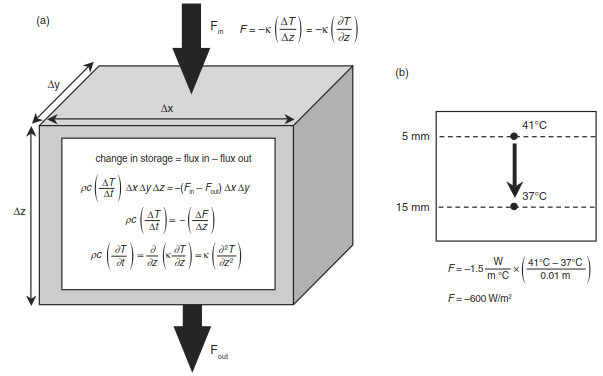
Fig. 9.3. Heat transfer in soil. (a) Heat balance of a volume of soil. equations are shown in both their numerical finite difference form and in the notation of calculus. (b) example of vertical heat transfer between two points with a temperature difference of 4°C separated by a distance of 10 mm with a thermal conductivity of 1.5 W m–1 K–1. Hanks (1992) and Hillel (1998) review soil heat transfer
The change in soil temperature over time is directly proportional to the thermal conductivity and inversely proportional to the heat capacity. Thermal conductivity determines the rate of heat transfer and heat capacity determines the temperature change as a result of this heat transfer. Soils with a high thermal conductivity gain and lose energy faster than soils with a low thermal conductivity. Soils with a low heat capacity warm and cool faster, for a given heat flux, than soils with a high heat capacity.
Thermal conductivity and heat capacity vary depending on mineral composition, porosity, organic matter content, and the water content of soils (Table 9.1). Soils consist of solid particles, air, and water. The overall thermal conductivity of a soil is a weighted average of the conductivity of its solid, air, and water fractions. Quartz has a very high thermal conductivity, and soils with high quartz content (e.g., sandy soils) have a high thermal conductivity. Clay minerals have a lower thermal conductivity, and clay soils have a lower thermal conductivity than sandy soils. Organic material has an extremely low thermal conductivity, and soils with high organic matter content have a thermal conductivity that is one-quarter to one-third that of mineral soils. Air and water occur in the voids, or pore space, around soil particles. Air and water have a lower thermal conductivity than mineral particles. Consequently, soils with a high pore space have a lower thermal conductivity, all other factors being equal, than soils that are less porous. Sandy soils are less porous than clay soils, which is another reason why they have a higher thermal conductivity. Organic soils are often extremely porous. Thermal conductivity of soil increases greatly with increasing soil water content because the thermal conductivity of water is more than 20 times that of air. Similarly, the heat capacity of water is 3500 times that of air, and the heat capacity of soil increases with water content.
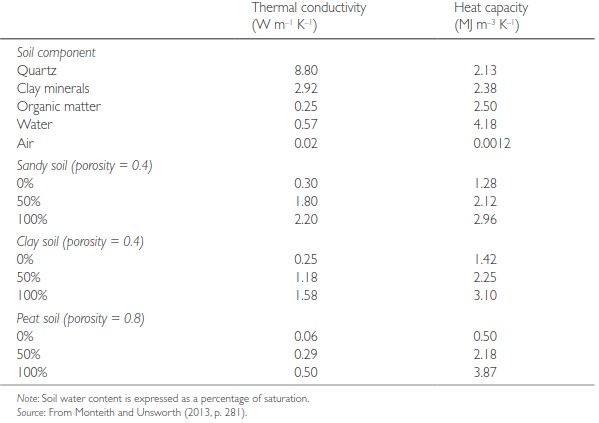
Table 9.1. Thermal conductivity and heat capacity for soil components and for sand, clay, and peat soils in relation to soil water
The practical implications of these differences in thermal properties are clearer under idealized conditions. The diurnal and annual cycles of temperature at the soil surface can be represented as a sine wave in which surface temperature varies periodically between some maximum and minimum values. Mathematically, the temperature at the soil surface at some time t is:

where p is the period of oscillation (e.g., 86,400 seconds for a diurnal cycle), Ts is the average temperature over this period, and As is the amplitude (i.e., one-half the difference between maximum and minimum temperatures) over the same time period. This periodic behavior is seen for the near-surface temperature in Figure 9.2b, which has a minimum early in the morning, a maximum in early afternoon, and decreases again during the night.
With a periodic surface temperature and if thermal properties are constant with depth, temperature at a depth of z meters is:

where  and
and  is the thermal diffusivity (m2 s-1). The term
  describes the decrease in surface temperature amplitude with depth. At depth z = D the amplitude is 0.37As. This depth is called the damping depth. The amplitude at depth z = 2D is 0.14As and at depth z = 3D is 0.05As. In other words, the temperature amplitude decreases with depth, exactly as seen in Figure 9.2b.
A typical soil diffusivity is a = 7 x 10⁻⁷ m2 s-1. Over the course of a day (p = 86,400 seconds), the damping depth is 14 cm. That is, the diurnal range in temperature at a depth of 14 cm is 37 percent that at the surface. Over the course of a year (p = 86,400 x 365 seconds), the damping depth is 2.65 m. At a depth equal to three times the damping depth, the range in temperature is 5 percent that at the surface. So at a depth of 42 cm, the temperature is approximately equal to the average daily temperature. At a depth of about 8 m, the temperature is approximately equal to the average annual temperature.
The term z / D represents the shift in time with depth when maximum and minimum temperatures occur. For example, maximum temperature at the surface occurs at t = 0.25 p, but maximum temperature at depth z = D occurs at t = 0.41p. That is, over the course of a day the maximum temperature at the damping depth occurs almost 4 hours later than the maximum temperature at the surface. With deeper depths, maximum temperature occurs later. At depth z = πD, temperature is at a maximum when surface temperature is at a minimum. Again, this is exactly what is seen in Figure 9.2b.
Soils are often covered by organic material or snow. Forests, in particular, are typically covered with a layer of decomposing leaf litter several centimeters thick. Organic material has a heat capacity similar to mineral soil, but a much lower thermal conductivity (Table 9.1). As a result, decomposing organic material acts as an insulator, preventing soil from warming in the day and from cooling at night. Snow, with its low thermal conductivity (e.g., 0.34 W m-1 K-1), has a similar insulating effect. A deep snow pack early in winter can keep soil warmer than if no snow was present.
In seasonally frozen soils, it is necessary to account for the different thermal properties of water and ice (Farouki 1981; Lunardini 1981). The heat capacity of ice (approximately 2 MJ m-3 K-1) is one-half that of water, while its thermal conductivity (2.2 W m-1 K-1) is almost four times that of water. Additionally, the change in phase of water consumes and releases heat. At 0°C, 334 joules are needed to melt one gram of water (Table 3.3). This energy (latent heat of fusion) changes the phase of water from ice to liquid rather than warming the soil. The same heat is released when water freezes. While water is freezing, its temperature remains at 0°C. The importance of phase change is seen in simulations of soil temperature with and without phase change. Without phase change, an unfrozen soil undergoing freezing cools too rapidly.
Date added: 2026-09-24; views: 2;