
Cycling of Water on Land
The cycling of water over land depicted in Figure 10.1 involves much more detail than that shown in Figure 3.4. Solar energy drives the hydrologic cycle, evaporating water from soil, lakes, and rivers. When conditions are favorable, this water vapor condenses to form clouds and eventually precipitation, which replenishes soil water and renews the cycle. Precipitation occurs when air cools and water vapor condenses to form cloud droplets or ice crystals. Cooling is caused by air rising in altitude, such as when air is lifted over mountains. This type of precipitation is known as orographic precipitation. Precipitation also occurs through frontal convergence, when a warm air mass rises over a colder air mass. In summer, thunderstorms develop when strong solar radiation heats the ground, warming the surface air and causing the less dense air to rise. This type of rainfall is known as convective precipitation.
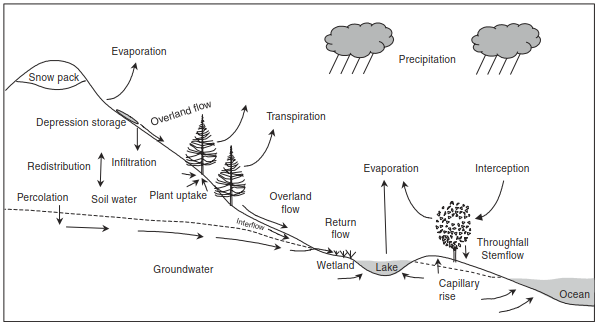
Fig. 10.1. The hydrologic cycle on land
Not all of the precipitation reaches the ground. Leaves, twigs, and branches of plants intercept rain and snow. Interception is the process by which precipitation is temporarily stored on plant surfaces. This water quickly evaporates and never replenishes the soil. The water that is not intercepted falls to the ground as throughfall or stemflow. Throughfall is water reaching the ground directly through openings in the plant canopy or by dripping down from leaves, twigs, and branches. Stemflow is water that reaches the ground by flowing down plant stems and tree trunks.
In many regions, a significant portion of winter precipitation falls as snow. If temperatures are cold enough, this water accumulates and is stored for periods of hours, days, or months before melting. Winter storage of precipitation in snow and subsequent spring snowmelt is a large source of water in seasonally-cold climates.
Liquid water reaches the ground as rainfall where vegetation is absent, as throughfall and stemflow under vegetation, or from snowmelt. Some of this water infiltrates into the soil. Infiltration is the physical process by which water moves into the soil. When the infiltration capacity of soil is exceeded, water collects as puddles in small depressions (depression storage). When these are filled, water runs off over the ground surface as overland flow. Overland flow is runoff generated when the infiltration capacity of soil is exceeded by the rainfall intensity, resulting first in ponding of water on the soil surface and then flow across the surface. It moves downhill, first in small rills and gullies and then into creeks and streams that feed large rivers.
The water that infiltrates into the soil wets the soil and is stored as soil water. Soil water is water held in the unsaturated zone between the soil surface and the water table. Soil water returns to the atmosphere through evaporation from bare ground and transpiration from plants. Evaporation is the physical process by which water changes from a liquid to vapor in the air. Transpiration is evaporation of water held inside plants.
Within the soil, water is removed during evaporation and by plant roots (plant uptake) when plants replenish water lost during transpiration. Water also moves vertically and horizontally due to internal forces determined by how wet or dry the soil is and by gravity. In most cases, gravity is the greatest force, causing water to flow downwards. This movement is known as redistribution, or more commonly percolation. If the water movement is deep, the percolating water will recharge the groundwater. On very shallow soils underlain with impermeable material (e.g., bedrock), the infiltrating water may move downhill as subsurface interflow. Interflow is the lateral movement of water in upper soil layers. For most landscapes, interflow is not thought to be important relative to overland flow.
Groundwater is the subsurface region that is saturated with water. The top is defined by the water table, which separates the saturated and unsaturated zones, and the bottom is defined by an impermeable layer (e.g., bedrock). Water moves horizontally within these aquifers, typically at a rate of about one-half to one meter per day. This lateral water flow recharges rivers, lakes, wetlands, and oceans and provides the base flow to maintain riverflow in the absence of rainfall. When this flowing water reaches the surface, it is known as return flow. Return flow is the process by which groundwater re-emerges from the soil in a saturated area and flows down- slope as overland flow. Groundwater is typically recharged by water percolating through the soil column. Water also flows upward, wetting the area of soil immediately above the water table (capillary rise). As a result, the upper boundary of groundwater (i.e., the water table) fluctuates seasonally as water enters and leaves the aquifer.
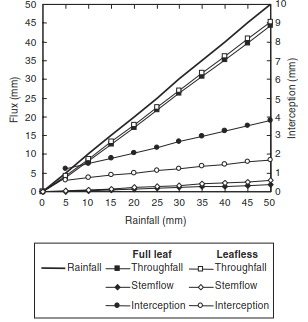
Fig. 10.2. Typical throughfall and stemflow (left axis) and interception (right axis) in relation to rainfall for a deciduous forest in full leaf and without leaves. data from Zinke (1967). See also helvey and patric (1965)
Insights to the hydrologic cycle can be gained by reducing the full cycle shown in Figure 10.1 to a more simple form, ΔS = P - E - R. In this water budget, the change in water storage on land (ΔS) is the difference between precipitation input (P), evapotranspiration loss to the atmosphere (E), and runoff to the oceans (R). The next sections examine the terms in this equation in more detail.
Date added: 2026-09-24; views: 1;