
Stable Isotopes in Hydrology: Fractionation and Environmental Signatures
Isotopes are variants of a particular element that differ in their number of neutrons. Stable isotopes do not undergo radioactive decay and are commonly used in hydrological and biogeochemical analyses. Carbon, for example, has three naturally occurring isotopes: two stable isotopes (12C and 13C) and one radioactive isotope (14C). Hydrogen has two stable isotopes, 1H and 2H (commonly called deuterium and abbreviated by the symbol D). Two stable isotopes of oxygen used in geochemical studies are 16O and 18O. The lighter isotopes are much more common than the heavier isotopes; 12C, 1H, and 16O have natural abundances of 98.89 percent, 99.98 percent, and 99.76 percent, respectively. The heavier isotopes (13C, 2H, and 18O) are much less abundant.
The isotopic composition of a sample (given by the ratio of the heavy isotope to the light isotope) is measured relative to a standard. For 18O:
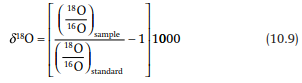
is reported as per mil (%o). The standard, by definition, has δ = 0%o. A negative value indicates a ratio of heavy-to-light isotope that is less in the sample compared with the standard. The sample is said to be lighter or depleted relative to the standard. A positive value indicates a ratio of heavy-to-light isotope that is greater in the sample compared with the standard. The sample is said to be heavier or enriched. The δ2H is based on the ratio 2H/1H, and the δ13C is based on 13C/12C.
The isotopic composition of a product can differ from the source material. The process by which this occurs is termed isotope fractionation. In general, lighter isotopes are favored in evaporation and photosynthesis, leaving the source material heavier. This isotopic fractionation, or natural variation in the isotopic composition of substances, provides mechanistic understanding of geochemical cycles. For example, three isotopic types of water are 1H2160 (>99%) and the heavier water 1H2H16O (commonly abbreviated HDO) and 1H2180. Isotopic fractionation occurs naturally through evaporation and condensation and imparts a discernible signature to the hydrologic cycle (Figure 10.11).
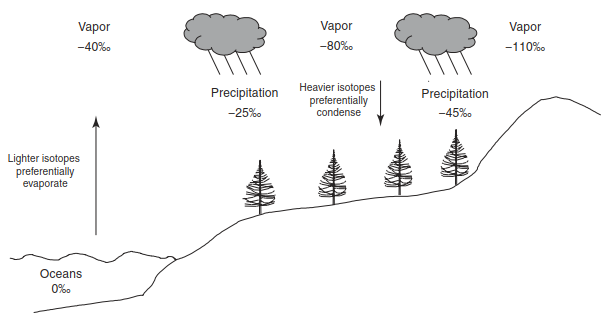
Fig. 10.11. Generalized representation of isotopes in the hydrologic cycle. Shown are representative values for δ2h with evaporation from tropical oceans and subsequent precipitation over land. adapted from dawson (1993b)
Lighter isotopes evaporate more easily than heavier isotopes and occur preferentially in the vapor phase. Heavier isotopes preferentially condense and occur preferentially in the liquid phase. Thus, water vapor that evaporates from tropical oceans is depleted in 18O or 2H (low δ18O and δ2H). Heavier isotopes condense and precipitate preferentially to lighter isotopes, so that rainfall is enriched in 18O or 2H (higher δ18O and δ2H) compared with water vapor. The air mass itself becomes further depleted in 18O and 2H as it moves inland. Temperature affects the isotopic composition of precipitation. With increasing temperature, precipitation is enriched in heavier isotopes (18O and 2H). Thus, precipitation is depleted of heavy isotopes in polar regions (low δ18O and δ2H). The effect of temperature and source region on the isotopic signature of precipitation is seen in comparison of δ18O for coastal California and inland Colorado sites (Figure 10.12). The coastal site has higher δ18O. The inland site is more depleted in 18O (lower δ18O), especially in winter.
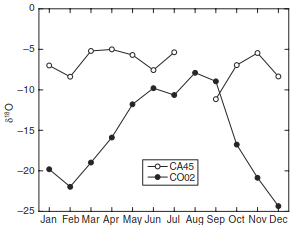
Fig. 10.12. Average monthly δ18O of precipitation for a low elevation site near the California coast (Ca45) and an inland site in the Colorado rocky Mountains (Co02). data from Vachon et al. (2010)
The isotopic composition of water can identify the source of atmospheric water (Henderson-Sellers et al. 2004; Noone et al. 2013). Isotopes can additionally discriminate among processes within a plant canopy, especially partitioning evapotranspiration into soil evaporation and transpiration (Yakir and Sternberg 2000; Yepez et al. 2003; Williams et al. 2004; Dawson and Simonin 2011; Jasechko et al. 2013). This is because evaporation enriches soil water in 18O and 2H, but transpiration does not produce similar isotopic fractionation.
Date added: 2026-09-24; views: 1;