
The Unsaturated Zone: Soil Water Dynamics and Hydraulic Redistribution
In most locations, the water table, which defines the depth at which soil is saturated, is well below the ground surface. Wetlands, where the water is perched above the ground, are an exception. Between the ground surface and the water table is a region where soil is less than saturated. This is known as the unsaturated, or vadose, zone, and water in this region is known as soil water. Plant roots are typically restricted to the unsaturated zone, which supplies plants with necessary moisture.
The unsaturated zone is divided into three zones related to the distribution of water above the water table (Figure 10.6). The first 50-100 cm of soil, where plants typically have most of their roots, is known as the rooting zone. This zone is often saturated during rainfall when water infiltrates into the soil. However, the near-surface soil quickly dries as some of the water drains downward due to the force of gravity and some evaporates to the atmosphere. In addition, plant roots extract water to meet transpiration needs. Consequently, water contents in the root zone range from saturation during infiltration to wilting point in dry periods. Immediately below the root zone is the intermediate zone.
This zone is recharged when water in excess of field capacity percolates down the soil column, eventually reaching a zone of saturation bounded by an impermeable layer (e.g., bedrock). Water contents can reach saturation during heavy storms, but mostly the water content is near field capacity. Below the intermediate zone is the groundwater, and immediately above this is a small zone called the capillary fringe, which is kept saturated by water rising from groundwater.
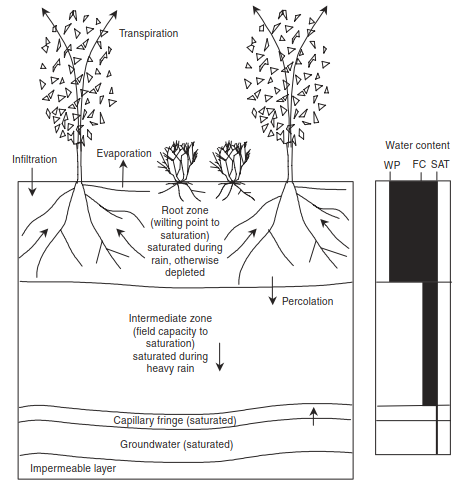
Fig. 10.6. Typical soil water zones and movements
Figure 10.7 illustrates the drainage and wetting of the unsaturated zone over a 16-day period in a Canadian pine forest. On May 30, the overall water content was high, though the near-surface soil was dry. By June 13, the upper soil had dried as a result of evapotranspiration while the deeper soil had dried from drainage. Two days later, heavy rainfall wetted the upper soil. A distinct wetting front at a depth of 50 cm is apparent.
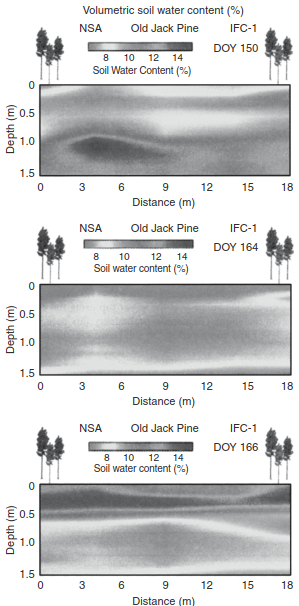
Fig. 10.7. Soil water content (%) with depth across an 18 m transect in a Canadian jack pine forest in late spring 1994. top: moist conditions on May 30. Middle: dry down on June 13. Bottom: wetting front on June 15. reproduced from Cuenca et al. (1997). See color plate section
Plant roots extract water from the soil to replenish water lost through transpiration. In some instances, plant roots can also redistribute water within the soil profile. Such activity is known as hydraulic lift or more generally hydraulic redistribution. Through this process, drier upper soil layers are moistened by water from wetter deeper layers. Hydraulic redistribution is widespread among plant species and has been observed in grasses, shrubs, and trees in deserts, temperate forests, and tropical savannas (Richards and Caldwell 1987; Caldwell and Richards 1989; Dawson 1993a, 1996; Burgess et al. 1998; Caldwell et al. 1998; Jackson et al. 2000; Meinzer et al. 2004; Domec et al. 2010; Neumann and Cardon 2012). By keeping upper soils moist, hydraulic redistribution can enhance water availability and sustain transpiration, with important effects on climate (Lee et al. 2005; Wang 2011).
Date added: 2026-09-24; views: 2;