
Mechanisms of Overland Flow: Infiltration-Excess and Saturation-Excess Runoff
Surface runoff, or overland flow, is generated within a watershed when the amount of water reaching the ground exceeds the soil’s capacity to gain water during infiltration. This type of overland flow is known as infiltration-excess runoff or Horton runoff. The local runoff rate (R) at a particular point in a watershed is the rainfall (P) in excess of infiltration capacity (i):
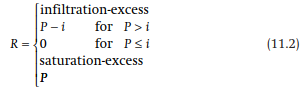
The total runoff from a catchment is an integration of local runoff across all points within the watershed.
Infiltration-excess runoff typically occurs on upslope areas of a watershed or on soils with low infiltration capacity. In many temperate forests, soils have a high infiltration capacity and precipitation rarely generates infiltration-excess overland flow. In contrast, this can be the dominant form of runoff in watersheds where the vegetation has been cleared, on construction sites where the soil is compacted, and in urban watersheds where much of the surface is impervious.
Overland flow is also generated when rain falls on saturated areas, and the water immediately runs off. This type of overland flow is called saturation-excess runoff. It is common in wetlands and low-lying areas along stream channels with shallow water tables. The amount of water from saturation-excess runoff equals the precipitation rate, and total runoff from the watershed is the precipitation rate times the area of the watershed that is saturated. Saturation-excess runoff is an important contributor to storm flow in watersheds where infiltration capacity is high and little infiltration-excess runoff is generated.
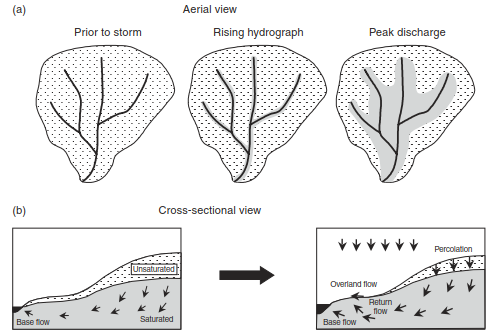
Fig. 11.5. Growth of saturated areas (shaded) along streams (black) during a rainstorm, shown as (a) aerial view and (b) cross-sectional view. Stippling denotes unsaturated areas
The saturated areas in a watershed expand in size during a rainstorm and contract during extended dry periods. The area of the watershed that contributes to streamflow through saturation-excess overland flow therefore changes over the course of a storm. Figure 11.5 illustrates this concept of variable contributing area, showing the growth of saturated areas during a rainstorm. In this example, saturated zones are restricted to the immediate stream banks prior to the storm. No runoff occurs, and streamflow is maintained by groundwater discharge. As rainfall occurs, areas along the banks begin to get saturated. All rainfall on the saturated area runs off and the streams begin to rapidly rise. At time of peak discharge, the saturated zones are extensive.
Date added: 2026-09-24; views: 1;