
Impact of Snow Cover on the Climate System and Atmospheric Circulation
Climatological Role and Global Radiative Forcing of Snow Cover. Snow cover has a pronounced annual cycle and at its annual maximum coats about 46 million km² of land in the Northern Hemisphere (Figure 26.3). The presence of snow on the ground affects climate through changes in surface albedo, soil insulation, and hydrology (Zhang 2005; Vavrus 2007; Xu and Dirmeyer 2013). Snow cover provides a significant negative radiative forcing, and the loss of snow cover over the past few decades has contributed to planetary warming (Flanner et al. 2011).
Surface Albedo and Vegetation Masking Effects. One of the primary climate effects arises from the high albedo of snow compared with snow-free surfaces. Albedos typically range from about 0.80–0.95 for fresh snow to as low as 0.10–0.20 for soil or vegetation (Table 12.1). The high albedo of snow is seen in satellite-derived maps of surface albedo, which show that snow-covered land has a higher albedo than snow-free land (Robinson and Kukla 1985; Jin et al. 2002; Barlage et al. 2005; Gao et al. 2005).
· Albedo Increases on Open Surfaces. This is particularly evident for barren land (Table 26.3). The albedo of bare surfaces increases from 0.21 without snow to more than 0.54 when covered by snow. Similar large increases in albedo with snow are seen in sparse vegetation and short stature vegetation.
· Canopy Masking Effects. In contrast, the albedo of forests increases less with snow because of vegetation masking effects. Even when the ground is covered by snow, foliage and wood effectively mask the underlying snow (Figure 17.5b).
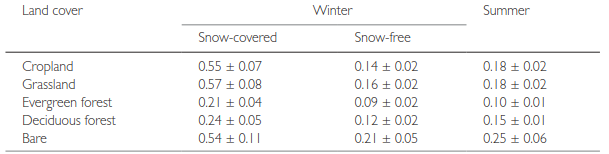
Table 26.3. Moderate Resolution Imaging Spectroradiometer (MODIS) mean surface albedo of Northern Hemisphere land cover types for winter (December–February) and summer (June–August) seasons. Note: Mean ± one standard deviation. Data for Northern Hemisphere winter are given for snow-covered and snow-free surfaces. Source: From Boisier et al. (2013).
Melting Thermodynamics and Soil Thermal Insulation. A second way in which snow influences climate is during melting. When snow covers the ground, some net radiation on warm days is used to melt snow. This prevents the surface from warming above freezing until the snow melts. For example, the heat capacity of ice is approximately 2 MJ m⁻³ K⁻¹. The latent heat of fusion at 0 °C is 334 MJ m⁻³ (334 J g⁻¹, Table 3.3), which is about 160 times that required to raise the temperature of ice by 1 °C. Until this energy is supplied, temperature remains constant.
· Thermal Conductivity of Snow. A third influence of snow is that its thermal conductivity is much less than that of soil. A typical value is 0.34 W m⁻¹ K⁻¹, which is one-third to one-fifth that of mineral soil (Table 9.1). With low thermal conductivity, less heat is transferred by conduction.
· Insulating Effects in Winter and Spring. In winter, therefore, a deep snow pack on the ground acts as an insulating blanket that prevents soil from cooling. Figure 26.4 illustrates this insulating effect of snow. Prior to the onset of snow in November, air temperature and soil temperature are similar. As the air cools, the soil tracks air temperature to within 1 °C. After a 10 cm snow pack covers the ground, the soil is several degrees warmer than air. Just as snow inhibits heat loss from the underlying soil in winter, it inhibits soil warming in spring. The low thermal conductivity of snow prevents heat gain by the soil. Once the snow is removed, the soil warms rapidly and again closely tracks air temperature.
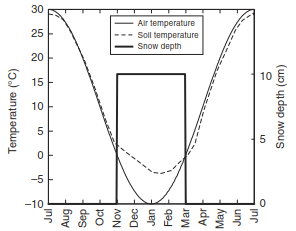
Fig. 26.4. Influence of snow cover on soil temperature from a model of soil temperature based on heat transfer and energy conservation. The left-hand axis shows air and soil temperature with no snow cover (July–November), with a 10-cm snowpack (November–March), and again with no snow (March–July). The right-hand axis shows the depth of snow on ground.
Cold Anomalies and Atmospheric Teleconnections. The presence of snow on the ground correlates with anomalously cold air temperatures (Walsh et al. 1982; Namias 1985; Leathers and Robinson 1993; Groisman et al. 1994; Mote 2008). Figure 26.5 illustrates this for a network of 91 stations in Northeast United States from Maine to West Virginia. Long-term mean climatological data show that both maximum and minimum temperatures are several degrees colder when snow is on the ground than when the ground is free of snow.
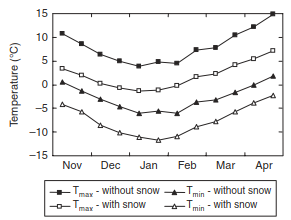
Fig. 26.5. Effect of snow cover on climatological mean daily maximum (Tmax) and minimum (Tmin) air temperature. Data from Leathers et al. (1995).
- Modeling Climate Feedbacks. The correlation between snow cover and cold temperature clearly reflects variations in large-scale atmospheric circulation; cold air masses often produce snow in winter. Climate models can be used to study the extent to which snow cover feeds back to affect climate. Similar to the idealized experiments with soil moisture, climate can be simulated by models in which snow cover is prescribed to anomalously high or low values. Such simulations show that the presence of snow lowers air temperature (Walsh and Ross 1988; Cohen and Rind 1991; Walland and Simmonds 1997).
- Impact on Asian Monsoon Dynamics. Eurasian snow cover, particularly over Siberia, also affects hemispheric atmospheric circulation and plays an important role in wintertime extratropical Northern Hemisphere climate variability (Cohen and Entekhabi 1999; Cohen et al. 2001, 2012; Gong et al. 2002, 2003a,b; Saito and Cohen 2003; Fletcher et al. 2009; Smith et al. 2011). Climate model simulations show that heavy snow cover produces a weakened Asian summer monsoon (Barnett et al. 1988, 1989; Douville and Royer 1996). Observations show that extensive snow cover in Eurasia leads to a weakened Indian summer monsoon with reduced precipitation (Hahn and Shukla 1976; Bamzai and Shukla 1999). Conversely, reduced snow cover leads to greater summer rainfall. The thermal contrast between land and ocean drives the monsoon. In summer, the Asian continent warms more than oceans. Low surface pressure over the continent draws cool, moist air inland from adjacent oceans, triggering heavy rainfall. Reduced snow cover in Asia results in a low land albedo, causing warmer land temperatures, greater land-sea temperature contrast, and a stronger summer monsoon. High snow cover leads to colder temperature, and the reduced land-sea temperature contrast weakens the summer monsoon.
- North American Monsoon Feedback Mechanisms. North American snow cover similarly has hemispheric climate teleconnections (Ge and Gong 2009; Sobolowski et al. 2010). The North American monsoon may be another example of snow feedback on precipitation. The region of southwestern United States and northwestern Mexico receives most of its precipitation during the months of July–September. Observational studies find a negative correlation between spring snow cover in the southern Rocky Mountains and summer rainfall in the United States Southwest; above-normal spring snow is followed by below-normal summer rain and vice versa (Gutzler and Preston 1997; Gutzler 2000; Zhu et al. 2005; Grantz et al. 2007). Delayed heating of land could arise from high spring albedo, more energy used to melt snow, and because of wetter than normal soil that increases evapotranspiration and cools surface temperature (Small 2001; Notaro and Zarrin 2011; Feng et al. 2013; Notaro and Gutzler 2012).
Date added: 2026-09-24; views: 2;