
Leaf Phenology and Surface Climate Dynamics
Leaf Phenology and Vegetation Dynamics. The foliage of deciduous trees, shrubs, and grasses has a pronounced annual cycle in response to temperature and precipitation. In addition, the timing of leaf emergence and senescence and the amount of leaf area can vary from year-to-year based on prevailing temperature and precipitation, as seen in satellite datasets of leaf area (Buermann et al. 2002, 2003; Stöckli and Vidale 2004; Stöckli et al. 2011). Seasonal and interannual variability in leaf area influences atmospheric seasonality, most prominently atmospheric CO₂ concentration, but also temperature (Peñuelas et al. 2009; Richardson et al. 2013).
Energy Flux Alterations. The seasonal emergence and senescence of leaves on deciduous trees alters sensible heat flux and latent heat flux (Table 17.3) and in doing so alters surface climate. In eastern United States, springtime air temperature is distinctly different after leaves emerge (Schwartz and Karl 1990; Schwartz 1992, 1996). Long-term measurements in 13 locations in north central and northeast United States show that daily maximum temperature steadily increases prior to leaf emergence, with particularly large increases in temperature during a two week period before leaves emerge (Fig. 26.6).
· Temperature increases at a rate of 0.17 °C per day well before springtime leaf emergence (46 days prior).
· Temperature attains a peak rate of 0.31 °C per day eight days prior to leaf emergence.
· After leaves emerge, the rate of temperature increase drops to less than 0.07 °C per day.
· In this region, diurnal temperature range increases for several weeks prior to leaf emergence, but is essentially unchanged for several weeks following leafing out (Fig. 26.7).
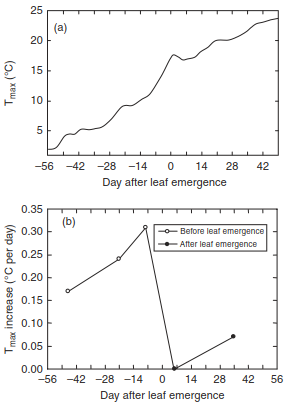
Fig. 26.6. Influence of springtime leaf emergence in eastern United States on (a) daily maximum temperature (Tₘₐₓ) and (b) rate of increase in Tₘₐₓ. Adapted from Schwartz and Karl (1990).
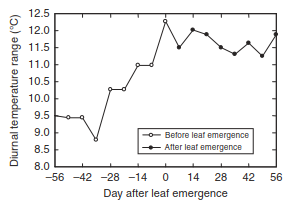
Fig. 26.7. Influence of springtime leaf emergence in eastern United States on diurnal temperature range. Adapted from Schwartz (1996).
Transpiration and Energy Partitioning. This temperature discontinuity over a period of less than a few weeks is related to increased transpiration upon leaf emergence that cools and moistens air (Fitzjarrald et al. 2001; Schwartz and Crawford 2001). The emergence of leaves in spring greatly alters the partitioning of net radiation into sensible and latent heat fluxes. Prior to leaf emergence, latent heat flux is typically a minor component of the surface energy budget, and the Bowen ratio is large. After leaf emergence, latent heat flux increases, and the Bowen ratio decreases. The data in Table 17.3 show this response.
Regional Temperature Patterns. A distinct seasonal pattern to temperature that relates to leaf phenology is seen in west central Canada (Hogg et al. 2000). Long-term mean daily temperature for nine climate stations in the Canadian prairie provinces show that air temperature in this region is 2–3 °C warmer than expected during April and October while summer temperature is up to 2 °C cooler than expected (Fig. 26.8).
· Greater sensible heat flux when leaves are absent produces the spring and autumn warming.
· Greater transpiration when leaves are present produces the summer cooling.
· A similar seasonal pattern does not occur in evergreen-dominated forests because of their low summer transpiration.
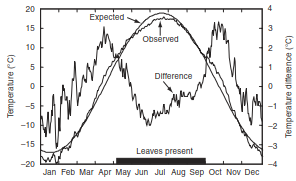
Fig. 26.8. Influence of leaf emergence on daily air temperature in west central Canada. The two thin lines show observed and expected temperature (left-hand axis). Expected temperature is from a sinusoidal curve fit to the observations. The thick line shows the difference between observed and expected temperatures (right-hand axis). The typical period in which leaves are present is also shown. Data from Hogg et al. (2000).
Prognostic Leaf Area Modeling. Levis and Bonan (2004) adapted a climate model to simulate leaf area based on prevailing meteorological conditions and applied the model to study the influence of leaf emergence on air temperature. Leaf area was simulated daily in response to air temperature for summergreen trees, and leaves emerged when accumulated growing degree-days exceeded some critical threshold.
· In one simulation, daily leaf area index was simulated interactively by the model; leaves emerge when environmental conditions allow photosynthesis so that stomata open and transpiration commences.
· In a second simulation, leaf area index was prescribed according to a climatology obtained from the first simulation; leaves emerge according to calendar date rather than meteorological conditions.
· Surface air temperature in the prognostic leaf area simulation shows a marked increase in the days preceding leaf emergence, as in the observations (Fig. 26.6). This reflects the fact that accumulated warm temperatures trigger leaf emergence in deciduous trees.
· This warm-up is absent with prescribed leaf area because there is no dependence of leaf emergence on temperature. The prognostic leaf area simulation also replicates the observed reduction in springtime warming trend after leaf emergence, but the prescribed leaf area simulation does not. In the former simulation, leaves emerge when conditions favor photosynthesis and transpiration. With prescribed leaf area, foliage may emerge when conditions such as cold air temperature or frozen soil preclude stomata from opening. The reduction in springtime warming only occurs when photosynthesis, stomatal conductance, and leaf emergence are synchronized with appropriate meteorological conditions.
Climate Model Phenology. Because of the importance of foliage in regulating surface climate, improved representations of leaf area and its phenology are included in climate models. Prognostic models of leaf area simulate the amount of foliage depending on temperature, precipitation, and plant productivity. Common predictors of leaf emergence and senescence utilize measures of accumulated springtime warmth above some temperature threshold (e.g., growing degree-days), accumulated winter temperature below some threshold (a chilling requirement), day length, and soil moisture to simulate evergreen, summergreen, and raingreen phenology. However, the phenological response to environmental drivers such as temperature, precipitation, and day length is poorly represented in models (Richardson et al. 2012, 2013).
Climate Feedback Mechanisms. Leaf phenology is likely to provide a feedback with climate change. In seasonally cold, extratropical climates, spring growth arrives earlier and autumn senescence is delayed with a warmer climate (Peñuelas et al. 2009; Jeong et al. 2011, 2013; Richardson et al. 2013). Interactive, rather than prescribed, vegetation and leaf area enhances variability in surface energy fluxes and precipitation (Delire et al. 2004, 2011; Crucifix et al. 2005; Wang et al. 2011). Vegetation can amplify the response to wet soil in a positive feedback because of greater leaf area that increases transpiration or provide negative feedback to a wet soil anomaly by depleting soil water (Kim and Wang 2007, 2012).
· Studies of European heat waves show that delayed or weak growing season green-up amplifies extreme heat waves, such as during 2003 (Lorenz et al. 2013).
· The reduced leaf area during the heat wave amplified daily maximum temperature by about 0.5 °C during the hottest period in August, about one-half of the warming caused by low soil moisture.
· In contrast, early and strong green-up contributes to enhanced evapotranspiration and surface cooling, thereby decreasing the magnitude of the warm temperature anomaly. Stéfanon et al. (2012) found similar positive and negative feedbacks in their climate simulations.
Complex Hydrological Interactions. However, soil moisture–leaf area–evapotranspiration interactions can be complex, and even counterintuitive. For example, lower leaf area can dampen heat waves if the reduced evapotranspiration prevents soil moisture depletion during the summer. Moreover, long-term observations at four central and western European headwater catchments show that evapotranspiration increases during droughts (Teuling et al. 2013). Evapotranspiration in these catchments decreases only at low available soil moisture because there is sufficient water to evaporate. Instead, the reduced cloudiness during drought increases net radiation, and there is more energy available for evapotranspiration.
Date added: 2026-09-24; views: 1;