
Biogeophysical Coupling and Terrestrial Ecosystem Feedbacks
Biogeophysical Coupling and Vegetation Dynamics. Biogeophysical coupling between terrestrial vegetation and climate regulates global land-atmosphere interactions. The Daisyworld model serves as a foundational conceptual framework illustrating the capacity of vegetation to regulate surface temperature and atmospheric conditions. Real-world climate-vegetation interactions manifest across regional gradients in precipitation and temperature. For instance, the transition from tropical rainforest to tropical deciduous forest, savanna, and desert reflects increasing aridity. This ecological gradient is both a response to soil moisture and an active driver that feeds back to affect climate, particularly precipitation patterns.
In northern and western Africa, climate model simulations indicate that vegetation expansion into desert regions, triggered by increased rainfall, creates a positive feedback that further intensifies local precipitation. Similarly, in the boreal forest-tundra ecotone, the boundary transition between forest and tundra is strongly regulated by cold temperatures. Geographic range shifts and the northward migration of trees due to global climate warming feed back to accentuate warming trends, whereas tree cover loss under cold conditions reinforces cooler temperatures. Widespread changes in vegetation structure and biogeography in response to climate change directly alter climate system trajectories, while biogeochemical feedbacks further modulate the carbon cycle.
Biogeophysical Feedbacks and Land Surface Properties. Biogeophysical feedbacks operating on seasonal to interannual timescales highlight how terrestrial ecosystems influence climate variability. Changes in ecosystem structure, plant community composition, and biogeography in response to long-term climate change feed back to alter local and global climate dynamics. These interactions originate from functional differences among vegetation types in surface albedo, surface roughness, leaf area index (LAI), rooting depth, and canopy conductance.
Surface Albedo Dynamics. Surface albedo varies significantly across different land cover types. Terrestrial vegetation generally exhibits a lower albedo than bare soil, while dense forests possess a lower albedo than pastures or croplands. Consequently, vegetation dynamics—such as grassland degradation, forest loss, woody encroachment, or ecological restoration—substantially alter surface radiative properties. An increase in surface albedo reduces net solar radiation absorption at the land surface, thereby weakening atmospheric boundary layer heating and decreasing boundary layer water vapor levels.
· A positive feedback mechanism develops when increased albedo causes a reduction in local precipitation.
· Drier soil conditions directly increase albedo, which further suppresses vegetation cover (Fig. 27.1a).
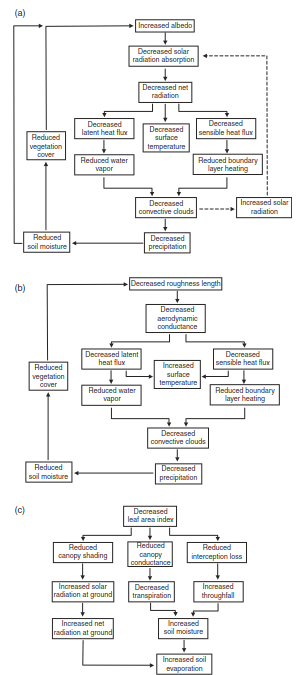
Fig. 27.1. Surface climate impacts of (a) an increase in albedo, (b) a decrease in surface roughness, and (c) a decrease in leaf area index as it affects evapotranspiration. Dashed lines represent negative feedback. Adapted from Pitman (2003).
Surface Roughness and Turbulence. Surface roughness governs turbulent energy exchange between the land surface and the lower atmosphere. Vegetation canopies exhibit a larger roughness length than bare ground, and tall forest canopies have a larger roughness length than short grasses. Aerodynamically rough surfaces generate greater atmospheric turbulence, facilitating higher rates of sensible heat flux and latent heat flux relative to smooth surfaces, all other environmental factors being equal.
· A reduction in surface roughness length decreases aerodynamic conductance across the canopy interface.
· Reduced aerodynamic conductance leads to a warmer, drier atmospheric boundary layer (Fig. 27.1b).
Canopy Processes and Evapotranspiration. Changes in leaf area index, rooting depth, and canopy conductance directly modify surface microclimate and atmospheric boundary layer development. Surface albedo varies inversely with leaf area index, while canopy conductance decreases at lower leaf area index values due to reduced surface area available for transpiration. Canopy conductance is also strongly modulated by the photosynthetic capacity of leaves, where the metabolic distinction between C₃ and C₄ photosynthetic pathways plays a critical role.
· Tree root systems extend deeper into soil profiles than those of herbaceous plants, maintaining a larger water pool to sustain transpiration during dry periods.
· Reduced canopy conductance lowers latent heat flux and elevates sensible heat flux, driving the formation of a warmer, drier, and deeper atmospheric boundary layer.
· A decline in leaf area index reduces canopy interception of precipitation, allowing greater rainfall throughfall to reach the soil and temporarily increasing soil wetness (Fig. 27.1c).
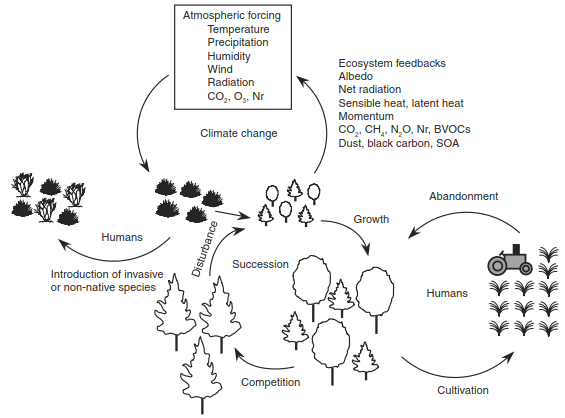
Fig. 27.2. Climate–vegetation dynamics showing the cycles of vegetation change due to climate change, succession, and human intervention.
Multidecadal Ecosystem Dynamics and Climate Modeling. Coupled climate-vegetation dynamics operate across temporal scales ranging from decades to millennia. Ecological succession and community composition shifts following natural disturbances initiate multi-stage ecosystem development cycles, such as the natural reforestation of cleared land. Long-term climate change interacts with these successional baselines: variations in temperature, precipitation, and atmospheric CO₂ concentrations alter ecosystem processes and can induce biome shifts, such as converting grasslands into forests. Furthermore, human activities disrupt landscapes through agricultural cultivation, land abandonment, and the introduction of invasive non-native species that alter competitive balance and resource utilization.
Dynamic Global Vegetation Models. Dynamic global vegetation models (DGVMs) and paired climate model simulations provide essential tools for quantifying land-atmosphere feedbacks that cannot be easily isolated through direct field observation. By replacing one vegetation cover type with another in paired numerical experiments, models demonstrate the potential climatic impacts of land surface transformations. Modern DGVMs integrate interactive coupling where temperature and precipitation govern vegetation growth, leaf area, rooting depth, and biogeography. In turn, vegetation structure influences albedo, radiative exchange, turbulent heat fluxes, and hydrology, expanding early biogeophysical feedback research to encompass major biogeochemical cycles.
Date added: 2026-09-24; views: 1;