
Land Cover Dynamics and Biogeophysical Climate Interactions
Biogeophysical Mechanisms of Land Use and Climate Change. Changes in land cover and in human uses of land can influence climate. Conversion of forests and grasslands to agricultural land alters net radiation, the partitioning of this energy into sensible heat and latent heat, and the partitioning of precipitation into soil water, evapotranspiration, and runoff. Among the surface characteristics altered by land-cover change are albedo, surface roughness, leaf area index, canopy conductance, root depth, and soil texture and structure. Land degradation in arid and semiarid climates increases surface albedo, reduces evapotranspiration, and may contribute to low rainfall in these regions. Extensive deforestation and land clearing have altered the climate of vast regions of Australia. Clearing of tropical forests for pastures creates a warmer, drier climate. Clearing of temperate forests and grasslands to cultivate crops cools climate, primarily because of higher albedo. However, the climate signal associated with crops is complicated and is related to the timing of crop planting, maturation, and harvesting relative to the phenology of natural vegetation. Irrigation leads to a cooler, moister climate. The influence of historical land-cover change on climate needs to be considered as a climate forcing in addition to traditional forcings such as greenhouse gases, aerosols, solar variability, and ozone. Climate model simulations show that the biogeophysical effects of historical land-cover change have cooled climate over large regions of North America and Eurasia. This biogeophysical cooling is comparable to, but of opposite sign, greenhouse gas warming over the same period. This cooling primarily results from increases in surface albedo with deforestation. Conversions among forests, pastureland, and cropland are thought to have decreased annual evapotranspiration. The net effect of anthropogenic land use and land-cover change is the balance between these biogeophysical changes and carbon emission from land use.
Comparative Analysis of Green and Desert Planet Models. Much of the natural vegetation of the world has been converted to cropland and rangeland (Figure 2.8). Human uses of land such as cultivation, grazing, forest clearing, and forest regrowth on abandoned farmland alter net radiation, the partitioning of this available energy between sensible heat and latent heat, and the partitioning of precipitation into runoff and evapotranspiration. These changes occur from modifications of albedo, surface roughness, leaf area index, rooting depth, and canopy conductance and also from changes in soil texture and structure that affect soil water. Soil texture determines how much water is available for evapotranspiration. Soil compaction with overgrazing alters hydraulic properties and changes the soil water balance. The changes in climate caused by anthropogenic land use and land-cover change have received considerable scientific interest (Bonan 2008; Pielke et al. 2007, 2011; Levis et al. 2010; Mahmood et al. 2014).
The role of vegetation in affecting global climate can be assessed in paired climate model simulations that, as an extreme, simulate a planet completely covered with well-watered vegetation and contrast this simulated climate with that of a planet completely devoid of vegetation. Shukla and Mintz (1982) performed such simulations in their pioneering study that demonstrated the importance of evapotranspiration for global climate. Other studies have since adopted similar methodology to quantify the maximum effect of vegetation on global climate.
A study by Fraedrich et al. (1999) and Kleidon et al. (2000) compared climate simulations with the extreme endpoints of land cover: a desert planet in the absence of vegetation and a green planet where all non-glaciated land is covered by forest (Table 28.1). The desert planet has no vegetation, high surface albedo, low surface roughness, and low soil water storage capacity. The green planet is covered by trees with high leaf area index and has lower albedo, increased surface roughness, and greater soil water storage. Soil water availability is further increased in the green planet by eliminating drainage and reducing runoff.
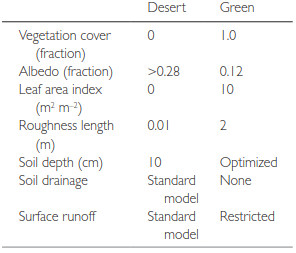
Table 28.1. Surface boundary conditions for desert and green planet climate model simulations. Source: From Fraedrich et al. (1999) and Kleidon et al. (2000).
Hydrologic and Energy Balance Modifications Under Extreme Land Cover. The green world has a cooler and moister climate compared with the desert world (Figure 28.1). Annual land evapotranspiration in the green planet more than triples compared with the desert planet while precipitation nearly doubles. The Bowen ratio decreases from 1.3 in the desert planet to 0.13 in the green planet. Despite the increase in precipitation, annual runoff decreases by 25 percent because a greater portion is recycled as evapotranspiration and because of the greater soil water-holding capacity. The geographic extent of Köppen climate types highlights changes in climate arising from the desert and green worlds (Table 28.2). About one-quarter of the total land area has a different climate, mostly due to reduction in the area of arid climate and increase in the area of temperate climate in the green planet. More recent climate simulations contrasted a maximally forested world with a grassland world (Brovkin et al. 2009). In these simulations, the presence of trees warms temperature throughout the year and increases annual precipitation while grasses cool the climate and decrease annual precipitation.
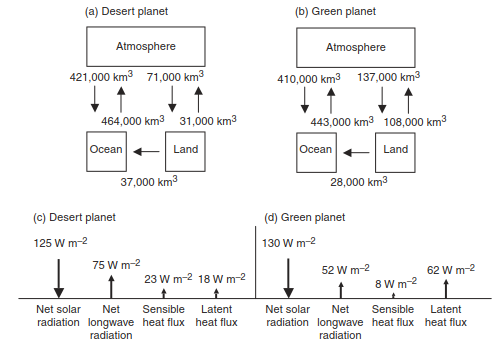
Fig. 28.1. Difference between a desert planet and a green planet. (a,b) Annual hydrologic cycle showing precipitation, evaporation, and runoff in cubic kilometers per year. (c, d) Annual surface energy fluxes over land. Data from Fraedrich et al. (1999) and Kleidon et al. (2000).
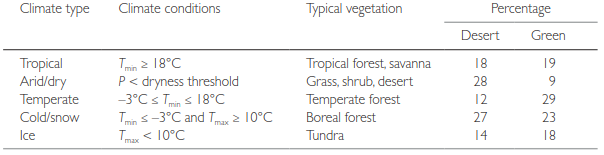
Table 28.2. Percentage of land classified by Köppen climate types in a desert planet and a green planet. Note: T_min, mean temperature of coldest month. T_max, mean temperature of warmest month. P, annual mean precipitation. Source: From Kleidon et al. (2000).
Biome-Specific Removal Effects on Global Climate Dynamics. Snyder et al. (2004) extended this approach to examine the influence of specific biomes on climate. Rather than replacing all vegetation with desert-like land cover, they systematically replaced individual biomes with bare ground. A simulation with all natural vegetation served as a control. Six experimental simulations individually replaced tropical forest, boreal forest, temperate forest, savanna, grassland, and shrubland/tundra with bare soil (Table 28.3). The presence of tropical forest creates a cooler and wetter climate compared with bare ground. Its lower surface albedo leads to warming, but this is offset by cooling from greater latent heat flux. Greater evapotranspiration contributes to high annual precipitation. Boreal forest warms the climate, primarily because trees lower surface albedo compared with snow-covered ground. Temperate forest warms temperature in winter and spring by decreasing the surface albedo of snow-covered areas. It cools temperature in summer compared with bare soil because the lower albedo is offset by a higher latent heat flux compared with bare soil. The cold season warming offsets the summer cooling so that annual mean temperature is greater with forest than with bare soil. Savanna creates a cooler, wetter climate similar to tropical forest as a result of a modest decrease in surface albedo and a strong increase in latent heat flux. Grassland has similar effect. Boreal forest has the greatest effect on annual temperature as a result of strong changes in albedo. Boreal deforestation cools temperature with small effect on precipitation. Tropical forest has the greatest effect on annual precipitation as a result of strong changes in latent heat flux. Tropical deforestation warms climate and substantially decreases precipitation.
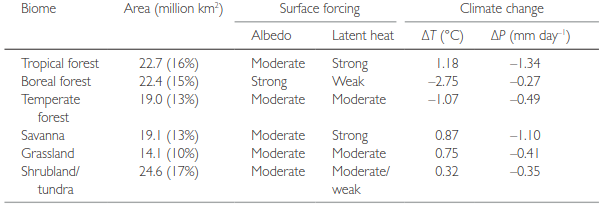
Table 28.3. Effect of vegetation removal on annual temperature and precipitation. Note: Percentages refer to the portion of total land area. Surface forcing refers to changes in albedo and latent heat flux ranked from strong to weak. Results are the difference (no vegetation minus control) spatially averaged over the biome where the vegetation was removed. ΔT, temperature. ΔP, precipitation. Source: From Snyder et al. (2004).
Forest-to-Grassland Replacement Simulations and Energy Budget Interactions. Davin and de Noblet-Ducoudré (2010) contrasted a maximally forested world with one in which all trees are replaced with grasses. One climate model simulation depicted a world with the maximum extent of forests; another simulation replaced these forests with grasslands. Three more simulations individually considered only the albedo, surface roughness, and evapotranspiration efficiency differences between forests and grasslands. This latter process represents various parameters including rooting depth, canopy water holding capacity, and stomatal conductance. In the model, trees are more efficient at transpiring water than are grasses because of their deeper roots and larger leaf area.
Global-scale replacement of forests by grasslands increases surface albedo, and the higher albedo decreases global annual mean temperature by −1.36 °C (Figure 28.2). This cooling is strongest at northern high latitudes (> 4 °C) and smallest in the tropics (1 °C). In contrast, the difference in evapotranspiration efficiency increases global temperature by 0.24 °C. This warming is largest (> 1 °C) in tropical Amazonia, tropical Africa, and Southeast Asia, occurs year-round, and is largest during the dry season (2–5 °C). Temperate regions (mainly North America and Europe) have little warming in winter, when evapotranspiration is weak, but warm by 2–5 °C in summer, when the decrease in evapotranspiration is large. Conversion from forest to grassland decreases surface roughness and reduces turbulence in the boundary layer. This change in roughness increases global temperature by 0.29 °C. The warming is about 1 °C over most land areas and is largest in the tropics. The net biogeophysical effect of replacing forests with grassland is a cooling of −1 °C. The balance among the different processes varies with latitude. The albedo effect is strongest in temperate and boreal regions of the Northern Hemisphere, where deforestation produces cooling. The net effect of deforestation in the tropics is warming, because evapotranspiration efficiency and surface roughness are the dominant influences.
Date added: 2026-09-24; views: 2;