
Vegetation Dynamics and Radiative Feedbacks in Climate Systems
Vegetation Dynamics and Radiative Feedbacks in Climate Systems. The twentieth century has seen a prominent increase in atmospheric CO₂ concentration (Figure 3.7a), and planetary temperature has increased as a result of this and other changes in radiative forcing (Figure 8.15). The increase in atmospheric CO₂ is expected to continue throughout the twenty-first century (Figure 2.11b), producing still greater planetary warming (Figure 8.16). Various socioeconomic pathways depict a future Earth with elevated CO₂ up to ~950 ppm (Figure 2.11b) and in which the planet has warmed by an additional 2–4 °C at the end of the twenty-first century (Figure 8.16). Vegetation responses to these changes in climate and atmospheric composition feed back to accentuate the changes.
Physiological Responses to Elevated Carbon Dioxide. In vegetated landscapes, canopy conductance controls the partitioning of net radiation into sensible heat and latent heat fluxes. Studies of the physiological response of plants to enhanced CO₂ concentrations routinely find reduced stomatal conductance and greater photosynthesis (Figure 16.10). Climate model simulations in which stomatal conductance decreases with a doubling of atmospheric CO₂ routinely show decreased evapotranspiration, increased sensible heat flux, and surface warming in summer. Decreased stomatal conductance may have increased continental runoff over the twentieth century (Gedney et al. 2006) and may further increase runoff over the twenty-first century (Betts et al. 2007). However, changes in leaf area and in land use also impact runoff trends (Piao et al. 2007).
Partitioning Atmospheric CO₂ Effects on Earth Climate. The effects of increasing atmospheric CO₂ concentration on climate can be partitioned into radiative and physiological effects (Sellers et al. 1996; Bounoua et al. 1999). Radiative effects consider only climate changes associated with atmospheric radiation (i.e., the greenhouse effect). Physiological effects are changes due to reduced stomatal conductance with higher CO₂. Climate model simulations by Levis et al. (2000) illustrate this approach (Table 27.8). Three simulations contrast the radiative and physiological effects of CO₂: a control simulation with present-day CO₂ concentration; a radiative forcing simulation in which atmospheric CO₂ is doubled but stomatal conductance does not respond directly to the higher CO₂; and another doubled CO₂ simulation in which stomata respond to the higher CO₂ concentration. In general, the physiological effects of doubled CO₂ amplify the warming associated with the radiative effects of doubled CO₂ (Table 27.8, RP - R compared with R - C). The radiative forcing generally increases evapotranspiration, warms surface temperature, and increases precipitation. The physiological forcing from reduced stomatal conductance reduces evapotranspiration and precipitation and further warms the surface.
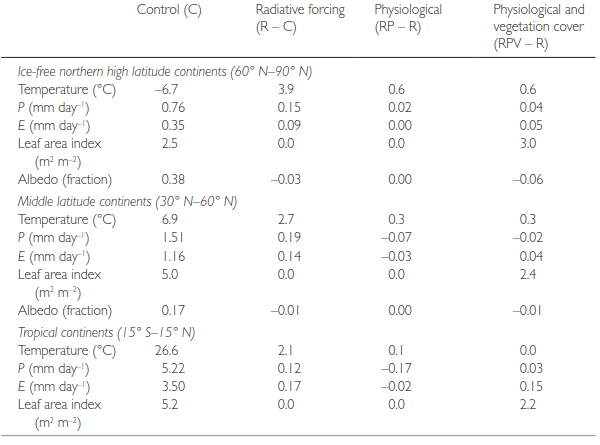
Table 27.8. Effect of doubled atmospheric CO₂ concentration on annual mean climate as determined from four climate model simulations. Note: C, control simulation with modern CO₂ (345 ppm) and vegetation. R, doubled CO₂ (690 ppm) without changes in vegetation. RP, doubled CO₂ with changes in stomatal physiology. RPV, doubled CO₂ with changes in stomatal physiology and vegetation cover. Radiative forcing is the difference between the radiative and control simulations. Vegetation forcings are the climate change in addition to the radiative forcing. P, precipitation. E, evapotranspiration. Source: From Levis et al. (2000).
Vegetation Dynamics and Coupled Climate Response. The altered temperature and precipitation in response to elevated atmospheric CO₂ changes vegetation in addition to the physiological effects of CO₂ fertilization. Simulations with coupled climate-vegetation models show large changes in climate as a result of such vegetation changes (Betts et al. 1997, 2000; Levis et al. 2000; Bala et al. 2006; O'ishi and Abe-Ouchi 2009; O'ishi et al. 2009; Jeong et al. 2011, 2014; Port et al. 2012). Vegetation enhancement of climate warming is particularly prominent in the Arctic, where greater tree cover reduces surface albedo.
Latitudinal Impacts and Vegetation Feedback Mechanisms. For example, Levis et al. (2000) used a dynamic global vegetation model coupled to a climate model to study vegetation feedback with a doubling of atmospheric CO₂ concentration (Table 27.8). The radiative effect of increased atmospheric CO₂ is overall surface warming and intensification of the hydrologic cycle with increased precipitation and evapotranspiration. The reduction in stomatal conductance with higher atmospheric CO₂ reinforces the warming, but decreases precipitation and evapotranspiration in middle to low latitudes. With dynamic vegetation, leaf area index generally increases due to expansion of forests at the expense of grasses. In northern latitudes, more extensive forest enhances the spring and summer radiative warming due to a decrease in surface albedo.
Dynamic Vegetation Feedbacks Across Latitudinal Zones
- 1st region: Ice-free land north of latitude 45° N. Without vegetation feedback, doubling atmospheric CO₂ warms temperatures over ice-free land north of latitude 45° N by 1.7–5.6 °C depending on the season. Vegetation feedback enhances this warming by 1.6 °C in spring, when the albedo feedback is greatest, and by 0.4 °C in summer and autumn, when the albedo feedback diminishes but warming persists due to the thermal inertia of the Arctic Ocean.
- 2nd region: Middle latitudes. Growth of temperate deciduous trees and grasses leads to summer cooling compared with the physiological effects as a result of greater leaf area and evapotranspiration. Spring and autumn temperatures warm due to reduced albedo as vegetation cover increases. Annual precipitation and evapotranspiration increase.
- 3rd region: Tropics. Evergreen and deciduous trees expand at the expense of grasses. This offsets the reduction in precipitation and evapotranspiration due to physiological effects.
Tundra Ecosystem Dynamics and Shrub Expansion. Coupled climate-vegetation models show that vegetation feedback with a warmer climate is especially prominent in northern high latitudes, where the northward migration of trees into tundra alters climate. A more immediate feedback is the increased abundance, extent, and productivity of woody shrubs in tundra in response to warming. Such a greening of the Arctic has been observed across Eurasia and North America over the past few decades (Jia et al. 2003; Tape et al. 2006; Beck and Goetz 2011; Post et al. 2013; Xu et al. 2013). Shrubs have a lower surface albedo than tundra, particularly during the snow melt season (Figure 27.8), and shrub expansion with a warmer climate is widely expected to augment the warming (Chapin et al. 2005; Sturm et al. 2005a; Euskirchen et al. 2009; Pearson et al. 2013). Climate model simulations do indeed show that woody shrub expansion in tundra warms climate because of lower surface albedo, but also through water vapor feedback with enhanced evapotranspiration (Lawrence and Swenson 2011; Bonfils et al. 2012).
Complex Biogeophysical Feedbacks of Arctic Shrubs. However, the climate consequences of increased shrubs are complex. The presence of shrubs also alters snow distribution and depth, the duration of snow cover, and snow thermal conductivity (Sturm et al. 2001, 2005b; Liston et al. 2002). Snow redistribution around shrubs reduces the albedo feedback by covering shrubs with snow, but also warms soil through the insulating effect of snow (Lawrence and Swenson 2011). Shrubs also shade the ground and decrease soil temperature and active layer depth compared with grassy tundra (Blok et al. 2010). This latter result suggests that shrub expansion could mitigate permafrost thaw with climate warming. Climate model simulations do indeed show a shallower active layer under shrubs, but the large-scale decrease in surface albedo with circumpolar shrub expansion warms climate and thaws the soil to deeper depths (Lawrence and Swenson 2011). Moreover, the net climate feedback in the Arctic must also include changes to carbon storage, especially permafrost thaw (Schuur et al. 2008, 2013).
Anthropogenic Land Use Versus Natural Vegetation Dynamics. Vegetation dynamics in response to climate change significantly affects the trajectory of climate change over the twentieth and twenty-first centuries, largely driven by changes in surface albedo and evapotranspiration. A much more prominent transformation of the biosphere has been brought about from anthropogenic land use and land-cover change, in particular the clearing of forests and cultivation of grasslands to raise crops. Whereas natural vegetation dynamics amplifies greenhouse gas warming over the twentieth century, historical land use and land-cover change have an opposite effect and have cooled planetary temperature (Matthews et al. 2004; Strengers et al. 2010; Lawrence et al. 2012).
Date added: 2026-09-24; views: 4;