
Biogeophysical and Biogeochemical Effects of Deforestation
Biogeophysical and biogeochemical mechanics of climate change. Land-cover change influences climate through two fundamental pathways:
· Biogeochemical processes that affect the carbon cycle via greenhouse gas emissions or uptake.
· Biogeophysical processes that regulate surface albedo, turbulent fluxes, and the hydrologic cycle at regional scales.
Greenhouse gases are well-mixed in the atmosphere, making biogeochemical feedbacks global in scale. In contrast, biogeophysical feedbacks act predominantly at regional and local scales. Climate model experiments demonstrate that the biogeochemical effects of land-cover change may either offset or accentuate biogeophysical effects.
Comparative analysis of boreal and tropical deforestation. In a foundational study, Claussen et al. (2001) contrasted the biogeophysical and biogeochemical effects of boreal and tropical deforestation. Their simulations examined changes in surface energy, moisture, and momentum fluxes (biogeophysical feedbacks), alongside shifts in carbon pools and fluxes (biogeochemical feedbacks). The complete comparative summary is detailed in Table 28.13.

Table 28.13. Contribution of biogeophysical and biogeochemical processes to changes in near-surface air temperature (annual mean, °C) as a result of boreal and tropical deforestation. Note: Temperatures are the difference from a control simulation without changes in land cover. Source: From Claussen et al. (2001).
Biogeophysical vs. biogeochemical balance in deforestation. Boreal deforestation cools climate primarily due to higher surface albedo, as tree removal unmasks the high albedo of snow, though it also warms climate through carbon loss to the atmosphere. The biogeochemical warming is insufficient to compensate for the strong biogeophysical cooling. Tropical deforestation warms climate regionally due to reduced evapotranspiration, while producing minor global cooling from decreased atmospheric moisture. Carbon released by tropical deforestation causes warming that substantially exceeds the cooling from biogeophysical processes. Simulations by Bala et al. (2007) and Bathiany et al. (2010) similarly show that boreal deforestation produces net global cooling, tropical deforestation yields net global warming, and temperate deforestation has a negligible net effect on global temperature.
Climate modeling across the industrial era. Climate model simulations have examined the importance of biogeophysical and biogeochemical feedbacks associated with land-cover change when simulating historical climate change over the industrial era. The dominant competing signals from deforestation are an increase in surface albedo in middle-to-high latitudes of the Northern Hemisphere (with loss of vegetation masking of snow albedo) and carbon emissions to the atmosphere. Brovkin et al. (2004) found that land-cover change decreased global mean temperature by 0.26 °C over the past millennium as a result of biogeophysical processes, while biogeochemical processes warmed climate by 0.18 °C. The net effect of these competing processes is minor on a global scale (0.05 °C cooling), but large in temperate and high northern latitudes where albedo-driven cooling offsets land-use CO₂ warming.
Temperature trend evaluations over the last 150 years. Matthews et al. (2004) found smaller biogeophysical cooling and larger biogeochemical warming in their model simulations. They estimated that biogeophysical processes cooled climate by 0.16 °C over the industrial era, while land-use CO₂ emissions warmed climate by 0.3 °C over the same period. The net effect of land-cover change over the past 150 years was a climate warming of 0.15 °C. Although the global response differs, regional cooling dominates the temperature signal in the Northern Hemisphere due to higher surface albedo, consistent with Brovkin et al. (2004).
Regional and global 20th-century trends. Pongratz et al. (2010) simulated small biogeophysical cooling over the twentieth century (0.03 °C), larger biogeochemical warming (0.16–0.18 °C), and net warming of 0.13–0.15 °C. Although global biogeophysical cooling is small, temperature decreases by 0.3–0.5 °C in North America, Europe, India, and China, where large land-cover changes occurred, as shown in Fig. 28.21. Biogeochemical warming encompasses most regions of the world, producing net warming in all regions. Additional simulations by He et al. (2014) also confirm a large biogeochemical warming from historical land-cover change that outweighs biogeophysical cooling.
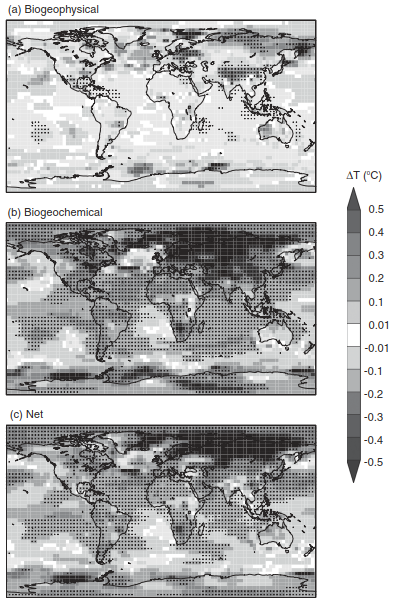
Fig. 28.21. Change in annual mean temperature due to land-cover change over the twentieth century from (a) biogeophysical effects, (b) biogeochemical effects, and (c) net effect. Areas where the change is statistically significant are dotted. Reproduced from Pongratz et al. (2010). See color plate section.
Date added: 2026-09-24; views: 1;