
Land Surface Drivers of Climate Variability and Feedbacks
Overview of Terrestrial Climate Dynamics. Atmospheric and oceanic processes and their coupling dominate much of the study of seasonal-to-interannual climate variability. However, land surface processes also contribute significantly to climate variability across multiple spatial and temporal scales. Soil moisture represents a fundamental state variable and a key aspect of seasonal precipitation forecasts. The recycling of precipitation via evapotranspiration can induce a positive feedback loop: wet soils pump additional moisture into the atmosphere, which enhances regional rainfall and further wets the surface. Conversely, dry soils exhibit lower rates of evapotranspiration, reducing atmospheric moisture supply and suppressing rainfall.
The retention of precipitation within soil layers and the subsequent influence of soil moisture on land-atmosphere flux exchanges amplify interannual precipitation variability across tropical and mid-latitude regions. Simultaneously, the presence of snow cover serves as a vital initial condition required for accurate numerical weather and climate forecasts. Due to its high surface albedo, snow-covered terrain prevents radiative surface warming during daylight hours. On warm days, a major fraction of net surface radiation is consumed by snowmelt rather than sensible heating. By cooling the land surface and reducing the land-ocean thermal contrast, snow extent directly influences summer monsoonal precipitation dynamics. Furthermore, the spring emergence of vegetation foliage imparts a clear signal on ambient air temperatures, where increased latent heat flux associated with leaf emergence acts to cool the lower atmosphere.
Soil Moisture Regulations and Atmospheric Boundary Layer Feedbacks. Soil moisture regulates planetary boundary layer dynamics through the partitioning of net radiation into sensible and latent heat fluxes (Fig. 26.1). Atmospheric model simulations routinely demonstrate the critical role of soil moisture in climate systems via its control over evapotranspiration rates (Seneviratne et al., 2010). Numerical sensitivity experiments typically alter soil moisture or broader soil wetness metrics—defined as the operational effect of soil water availability on evapotranspiration. These modeling frameworks confirm a positive feedback mechanism wherein moist soils supply water vapor to the atmosphere, enhancing localized precipitation and reinforcing soil hydration, whereas desiccated soils suppress evaporative cooling and precipitation.
Mechanistic Pathways of Soil Moisture-Climate Interactions. Decreased soil moisture initiates a cascade of land-atmosphere interactions (Fig. 26.1). A reduction in soil moisture leads to reduced canopy conductance, which directly decreases latent heat flux and increases sensible heat flux. The reduction in latent heat flux lowers atmospheric water vapor content, leading to decreased convective cloud cover and diminished precipitation. Reduced precipitation further depletes soil moisture, closing the primary feedback loop. Concurrently, the elevated sensible heat flux increases boundary layer heating and elevates surface temperatures. The reduction in convective cloud cover increases net surface radiation, which further elevates surface temperature and reinforces the transfer of sensible heat into the atmosphere.
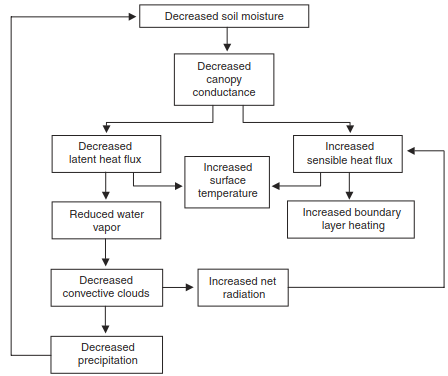
Fig. 26.1. Impacts of a decrease in soil moisture on surface climate. Adapted from Pitman (2003).
Experimental Approaches to Soil Moisture Modeling. One classical experimental approach involves artificially fixing soil wetness to prescribed, time-invariant values to contrast climate behavior over perpetually wet versus perpetually dry surfaces. Shukla and Mintz (1982) applied this methodology in a global circulation model to isolate the atmospheric impact of evapotranspiration. They contrasted a simulation featuring perpetually dry soils (where evapotranspiration was completely suppressed) against a simulation featuring perpetually wet soils (where evapotranspiration proceeded at the potential rate, representative of fully vegetated, saturated terrain). Their findings demonstrated that dry soil conditions substantially suppress July precipitation across the majority of Northern Hemisphere continental regions compared to wet soil conditions. Under dry conditions, precipitation remains relatively unaffected in moist tropical regions, but surface air temperatures across virtually all landmasses become markedly warmer due to the total absence of evaporative cooling and an increase in solar radiation reaching the surface from reduced cloud cover.
An alternative experimental strategy allows the numerical model to calculate soil water interactively, evaluating the atmospheric system's dynamic response to an initial moisture anomaly. Soil moisture is initialized with wet or dry perturbations, and the model is integrated forward in time to observe whether precipitation responds to the anomaly and whether the anomaly persists. These studies confirm that large initial wet or dry soil perturbations significantly affect subsequent precipitation, creating positive feedbacks that sustain the initial soil moisture anomaly over extended periods.
Global Hydroclimate Sensitivity and Water Vapor Dynamics. Numerical experiments conducted by Betts (2004) illustrate the forward integration approach using two 120-day global simulations performed with an atmospheric numerical model for the period May–August 1987. The two experimental runs differed solely in their initial soil moisture states: the wet simulation was initialized at field capacity in vegetated areas, whereas the dry simulation was initialized at 25 percent of total water-holding capacity. Atmospheric responses were evaluated through precipitation ($P$), evapotranspiration ($E$), and water vapor convergence ($P - E$), which measures the atmospheric import or export of moisture. Where precipitation exceeds evapotranspiration ($P - E > 0$), atmospheric water vapor converges into the region; where evapotranspiration exceeds precipitation ($P - E < 0$), excess moisture is exported via atmospheric water vapor divergence.
· 1st stage: Northern Hemisphere Land Response. Across most Northern Hemisphere continental regions, lower initial soil moisture reduces summer precipitation and evapotranspiration by 50 percent or more compared to saturated initial conditions (Table 26.1). In regions such as the United States, Central Asia, and the Amazon, water vapor export (P - E < 0) increases substantially under wet soil conditions.
· 2nd stage: Monsoonal Domain Dynamics. In monsoonal climates—including Equatorial Africa, the Sahelian zone, and India—the relative increase in precipitation and evapotranspiration under wet soil conditions is less pronounced. In these environments, high precipitation rates are primarily sustained by large-scale atmospheric water vapor convergence rather than localized surface evapotranspiration.
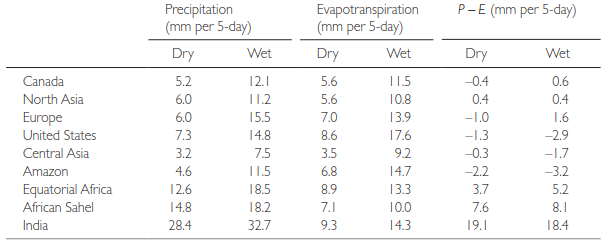
Table 26.1. Five-day mean summer precipitation (P), evapotranspiration (E), and water vapor convergence (P - E) for simulations with initially dry and wet soils. Note: Data adapted from Betts (2004).
Prescribed Climatology Versus Interactive Hydrologic Coupling. Another experimental framework evaluates the impact of prescribed soil wetness on interannual precipitation variability and forecast predictability. In these experiments, one simulation calculates soil wetness interactively, while a paired simulation prescribes soil wetness from climatological means derived from the interactive run. Prescribing soil wetness removes interactive hydrologic coupling between the land and atmosphere. Alternatively, soil wetness can be specified from offline land surface model simulations forced by observed meteorology, representing the land state under perfect atmospheric forcing. Comparative results confirm that interactive hydrologic feedbacks significantly influence interannual precipitation variability over land by retaining rainfall within the soil column and modulating subsequent evapotranspiration.
Thermodynamic Coupling and Boundary Layer Structure. The physical mechanism linking soil moisture to precipitation operates through sensible and latent heat input into the planetary boundary layer. Over dry soils, net surface radiative energy is predominantly converted into sensible heat, generating a deep, dry, and well-mixed boundary layer. Over wet soils, elevated evapotranspiration shifts energy partitioning toward latent heat, decreasing the Bowen ratio (sensible heat divided by latent heat). This produces a shallower, more humid boundary layer with a lower cloud base height. Wet soils also exhibit higher net surface radiation due to lower surface temperatures (which reduce outgoing longwave radiation) and reduced surface albedo. The combined effect of high total energy flux and a shallower boundary layer increases boundary layer convective instability, creating conditions favorable for convective precipitation.
Evapotranspiration Regimes and Model Coupling Strength. Hydrometeorological land-atmosphere coupling is governed by distinct soil moisture-evapotranspiration regimes (Koster et al., 2004, 2009, 2011; Seneviratne et al., 2006, 2010; Teuling et al., 2009):
· 1st stage: Radiation-Limited Regime. In humid climates, abundant precipitation maintains soil moisture above a critical threshold. Evapotranspiration is constrained by available net radiation rather than water availability, meaning variations in soil moisture exert minimal control on evapotranspiration.
· 2nd stage: Moisture-Limited Regime. Below the critical soil moisture threshold, water availability directly limits evapotranspiration. As soils dry, evapotranspiration declines linearly or non-linearly, making atmospheric fluxes highly sensitive to soil moisture perturbations.
· 3rd stage: Arid Hyper-Limited Regime. In extremely arid climates, soil moisture is permanently depleted, suppressing evapotranspiration to near-zero levels. Because absolute flux rates are minimal, soil moisture variations cannot meaningfully alter atmospheric processes.
Controlled multi-model intercomparisons (Koster et al., 2002, 2004, 2006a; Guo et al., 2006) demonstrate that while soil moisture anomalies induce precipitation anomalies across climate models, coupling strength varies considerably among modeling platforms. Despite these differences, models consistently identify strong land-atmosphere coupling within transitional zones between arid and humid regimes—such as the North American Great Plains, sub-Saharan Africa, and India. These hot spots arise from high evapotranspiration sensitivity to soil moisture combined with large temporal variability in soil moisture storage (Guo et al., 2006; Wei and Dirmeyer, 2012).
Observational Validation and Hydroclimatic Memory. Demonstrating soil moisture-precipitation feedbacks empirically remains challenging due to observational constraints. However, long-term observational analyses support model findings: Findell and Eltahir (1997) identified a positive correlation between early-season soil moisture and subsequent summer rainfall over a 14-year period in Illinois (Salvucci et al., 2002), while Findell et al. (2011) established that high afternoon evaporation enhances rainfall probability east of the Mississippi River.
Indirect observational support comes from climate model experiments demonstrating that observed precipitation patterns—such as the spatial variance of monthly July rainfall and sub-monthly precipitation autocorrelations across the United States—can only be reproduced when interactive soil hydrology is enabled (Koster et al., 2003, 2004; Dirmeyer et al., 2006). Observational data confirm that above-normal precipitation in one month increases the statistical likelihood of above-normal precipitation in the following month, a persistent hydroclimatic memory that requires interactive land-atmosphere coupling to be replicated in numerical models.
Soil Moisture Constraints on Thermal Extremes and Droughts. Soil moisture exerts a strong control on surface air temperature (Seneviratne et al., 2010). High evapotranspiration rates cool the planetary boundary layer by dissipating net radiation as latent heat rather than sensible heat. Conversely, low soil moisture suppresses evapotranspiration, elevating sensible heat fluxes and warming the lower atmosphere. Observational studies report strong negative correlations between summer temperature and precipitation across interior North America (Madden and Williams, 1978; Karl and Quayle, 1981; Namias, 1983; Karl, 1986; Huang and Van den Dool, 1993; Durre et al., 2000; Koster et al., 2006b, 2009), establishing that hot summers in these regions are predominantly dry.
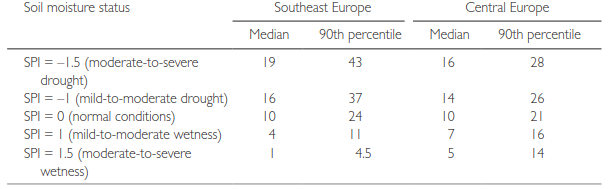
Table 26.2. Percentage of hot days during summer (June–August) in relation to soil moisture in southeastern and central Europe for the period 1961–2000. Note: The Standardized Precipitation Index (SPI) serves as a proxy for drought condition intensity. Data adapted from Hirschi et al. (2011).
Numerical simulations and observational analyses in Europe confirm that pre-summer soil moisture deficits increase the frequency and duration of summer heatwaves (Fischer et al., 2007; Jaeger and Seneviratne, 2011; Hirschi et al., 2011; Lorenz et al., 2013). As detailed in Table 26.2, the frequency of hot days in Southeastern Europe during 1961–2000 was substantially higher during drought years (SPI = -1.5) than during wet years (SPI = 1.5) for both median and 90th percentile occurrences. This temperature sensitivity is less pronounced in Central Europe, where higher baseline soil moisture keeps evapotranspiration within a radiation-limited regime (Mueller and Seneviratne, 2012). Projected 21st-century climate shifts indicate warming and drying trends across mid-latitude continents, exacerbating soil moisture-temperature feedbacks (Seneviratne et al., 2006, 2013; Collins et al., 2013).
Case Studies: Historical Extreme Events and Negative Feedbacks. Soil moisture feedbacks play a key role in modulating historical extreme weather events:
· 1st stage: The 1988 Mississippi Drought and 1993 Floods. Atmospheric circulation anomalies initiated the 1988 Mississippi basin drought and 1993 regional flooding (Trenberth et al., 1988; Namias, 1991; Trenberth and Branstator, 1992; Trenberth and Guillemot, 1996). However, persistent land surface feedbacks amplified both events: dry soils prolonged the 1988 drought by suppressing evaporative moisture supply, whereas wet soils extended the 1993 floods by enhancing regional recycling and localized precipitation (Beljaars et al., 1996; Bosilovich and Sun, 1999a,b; Viterbo and Betts, 1999; Pal and Eltahir, 2001, 2002; Sud et al., 2003).
· 2nd stage: The 1930s North American Dust Bowl. Climate modeling by Schubert et al. (2004a,b) demonstrates that while tropical sea surface temperature anomalies initiated the 1930s Great Plains drought (Hoerling and Kumar, 2003; Seager and Hoerling, 2014), dry land surface feedbacks severely exacerbated the event. Disabling interactive soil moisture coupling in climate simulations reduces the modeled summer precipitation deficit, whereas interactive hydrology accurately reproduces the observed multi-season precipitation collapse (Fig. 26.2).
· Precipitation Anomaly (mm day⁻¹) — DJF (Dec–Feb): Observed = 0.04; Full model = -0.06; Prescribed hydrology = -0.06
· Precipitation Anomaly (mm day⁻¹) — MAM (Mar–May): Observed = -0.15; Full model = -0.11; Prescribed hydrology = -0.06
· Precipitation Anomaly (mm day⁻¹) — JJA (Jun–Aug): Observed = -0.43; Full model = -0.33; Prescribed hydrology = -0.11
· Precipitation Anomaly (mm day⁻¹) — SON (Sep–Nov): Observed = -0.27; Full model = -0.20; Prescribed hydrology = -0.14
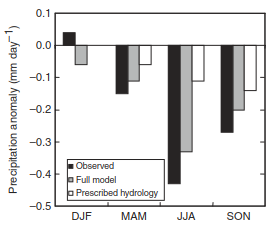
Fig. 26.2. Precipitation deficits for the period 1932–1938 averaged over the United States Great Plains. Data show the observed anomaly and anomalies simulated with and without interactive soil water. DJF, December–February; MAM, March–May; JJA, June–August; SON, September–November. Adapted from Schubert et al. (2004b).
Non-Linearities and Negative Precipitation Feedbacks. Elevated soil moisture does not unconditionally increase precipitation. Lower surface temperatures caused by enhanced evaporative cooling can stabilize the boundary layer, suppressing convective cloud development (Taylor and Ellis, 2006; Cook et al., 2006; Seneviratne et al., 2010). In semiarid regions, mesoscale circulation cells induced by spatial soil moisture gradients can preferentially trigger afternoon convective storms over drier soils relative to adjacent moist patches (Taylor et al., 2012).
Snow Cover Dynamics and Boundary Layer Physics. Snow cover acts as a critical lower boundary constraint on regional and global climate. Its exceptionally high albedo drastically reduces net surface solar radiation absorption, suppressing daytime warming and directing available thermal energy toward snowmelt rather than sensible heat exchange.
· Northern Hemisphere Snow Cover Climatology. Satellite observations from 1980 to 2005 demonstrate strong seasonal cycles in monthly snow cover extent across Northern Hemisphere landmasses (Fig. 26.3). In Eurasia, winter snow cover peaks near 30 million km² before rapidly retreating during spring thaw to near 0 million km² (Fig. 26.3a). In North America (excluding Greenland), maximum winter snow extent reaches 14 to 17 million km², retreating annually to minimal summer coverage (Fig. 26.3b).
· Eurasia Snow Cover Extent (1980–2005): Annual oscillations ranging from a winter peak of ~30 million km² to a summer minimum near 0 million km².
· North America Snow Cover Extent (1980–2005): Annual oscillations ranging from a winter peak of 14–17 million km² to a summer minimum near 0 million km².
· (a) Eurasia
o Snow cover extent ranges from approximately 0 to 31 million km² annually between 1980 and 2005.
· (b) North America
o Snow cover extent (excluding Greenland) ranges from approximately 0 to 17 million km² annually between 1980 and 2005.
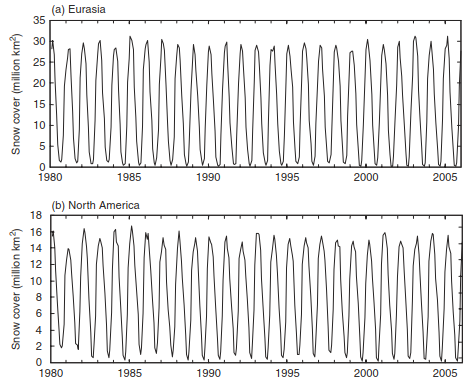
Fig. 26.3. Monthly snow cover extent during the period 1980–2005 for (a) Eurasia and (b) North America excluding Greenland. Data provided courtesy of David Robinson (Rutgers University).
Operational Implications for Climate Prediction. Accurate initialization of soil moisture and snow cover states is essential for improving sub-seasonal to seasonal climate forecasts (Koster et al., 2010, 2011; Seneviratne et al., 2010; van den Hurk et al., 2012; Kumar et al., 2014). The magnitude and regional expression of forecast skill depend on whether the target domain operates within a radiation-limited or moisture-limited evapotranspiration regime. High-fidelity representation of land-atmosphere feedbacks in Earth system models requires precise parameterization of soil physical characteristics (e.g., texture classes, porosity, water-holding capacity), hydraulic properties (e.g., matric potential, unsaturated hydraulic conductivity), and plant physiological controls over evapotranspiration.
Date added: 2026-09-24; views: 1;