
Harnessing Ocean Wave Energy: Technologies, Economics, and Impacts
Global Wave Energy Potential. A tremendous amount of energy exists in ocean waves. The power of all waves is estimated at 2.7 × 10¹² watts, which is about equal to 3000 times the power-generating capacity of Hoover Dam. Unfortunately for human needs, this energy is widely dispersed and is not constant at any given location or time. It is, therefore, difficult to tap this supply in order to produce power, except in small quantities.
Primary Harnessing Techniques. Wave energy can be harnessed in three basic ways:
- (1) using the changing level of the water to lift an object, which can then do useful work because of its potential energy;
- (2) using the orbital motion of the water particles or the changing tilt of the sea surface to rock an object to and fro;
- (3) using the rising water to compress air in a chamber.
In each case electrical energy may be produced if the wave motion is used either directly or indirectly to turn a generator.
Buoyant Float and Pumping Systems. Consider a large buoyant surface float with a hollow cylinder extending down into the sea (fig. 9.28). Inside the cylinder is a piston, which is connected to a large-diameter disk (a drag plate) at its bottom end. This disk will cause the piston to resist vertical motion, while the up-and-down motion of the surface float will cause the cylinder to move up and down over the piston. If the cylinder is equipped with inlet and outlet pipes with one-way valves, it will take in water as the surface buoy rises on the crest of the wave, causing the cylinder volume to increase, and will squirt water out as the surface buoy drops with the passing of the trough, causing the cylinder volume to decrease.
The pumped water can be used to turn a turbine, but, because wave energy is distributed over a volume of water, this mechanism does not withdraw much of the passing wave's energy. A series of float devices are being used to power a reverse osmosis desalination plant in Puerto Rico (refer to chapter 5); modified float systems are being explored in Sweden and Great Britain.
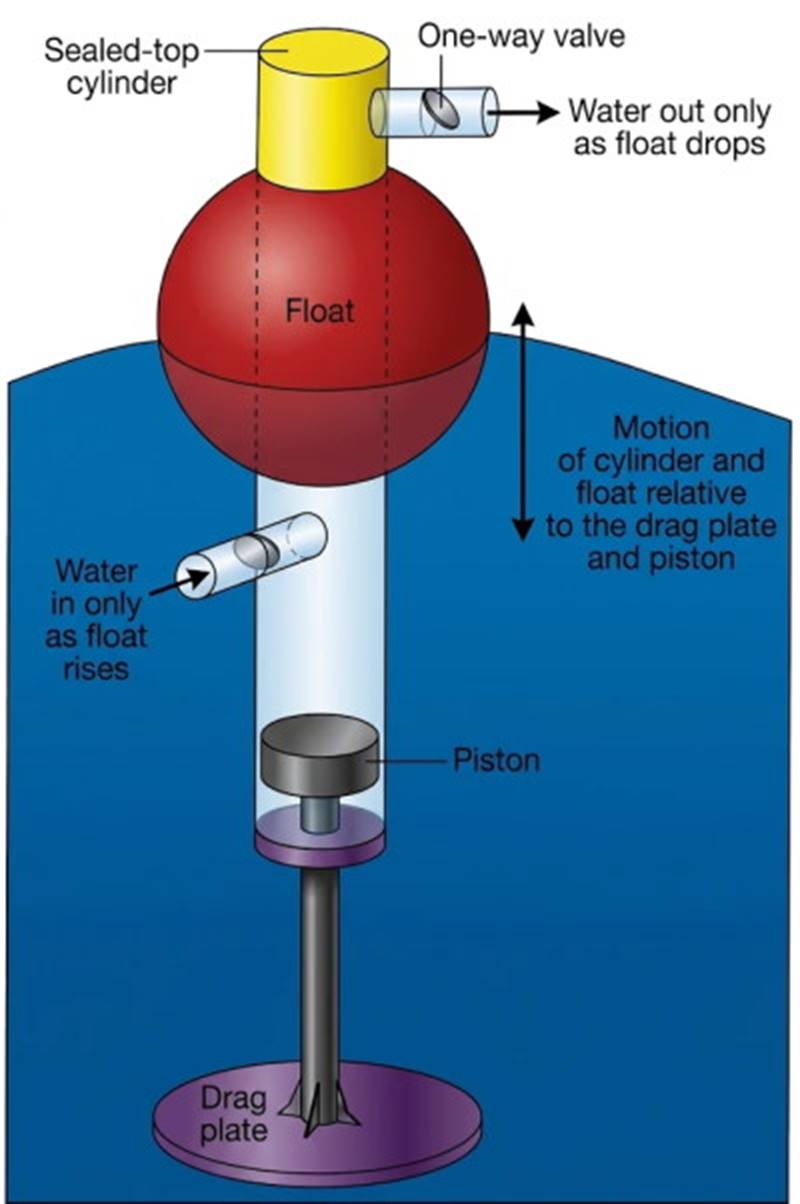
Fig. 9.28. The vertical rise and fall of the waves can be used to power a pump.
Tapered Channel and Air Trap Technologies. Another system constructs a tapered channel perpendicular to the shore. Incoming waves pile the water up 2 to 3 m (6–10 ft) in the narrow end of the channel and it spills over and down through a turbine. This system is used to generate power by a 75-kilowatt plant on Scotland's Isle of Islay, a 350-kilowatt plant at Toftestalen, Norway, and two 1500-kilowatt plants under construction, one in Java and the other in Australia.
A device called a “sea clam” has been developed by the United Kingdom's Sea Energy Associates. Like a bellows, bags of air are collapsed by wave crests; air is forced through a turbine, and the air flows back into the bags when the wave troughs pass. One-fifth-scale models have been successfully tested in Loch Ness.
Compressed Air Systems. Along a wave-exposed coast, air traps can be installed so that the crest of a wave moving into the trap compresses a large volume of air, forcing it through a one-way valve. This compressed air powers a turbine to produce energy. The trough of the wave allows more air to enter the trap, readying it for compression by the following wave crest (fig. 9.29). This system is used in northern Norway and is planned for western Ireland. Shores that are continually pounded by large-amplitude waves are most likely to be developed for wave power.
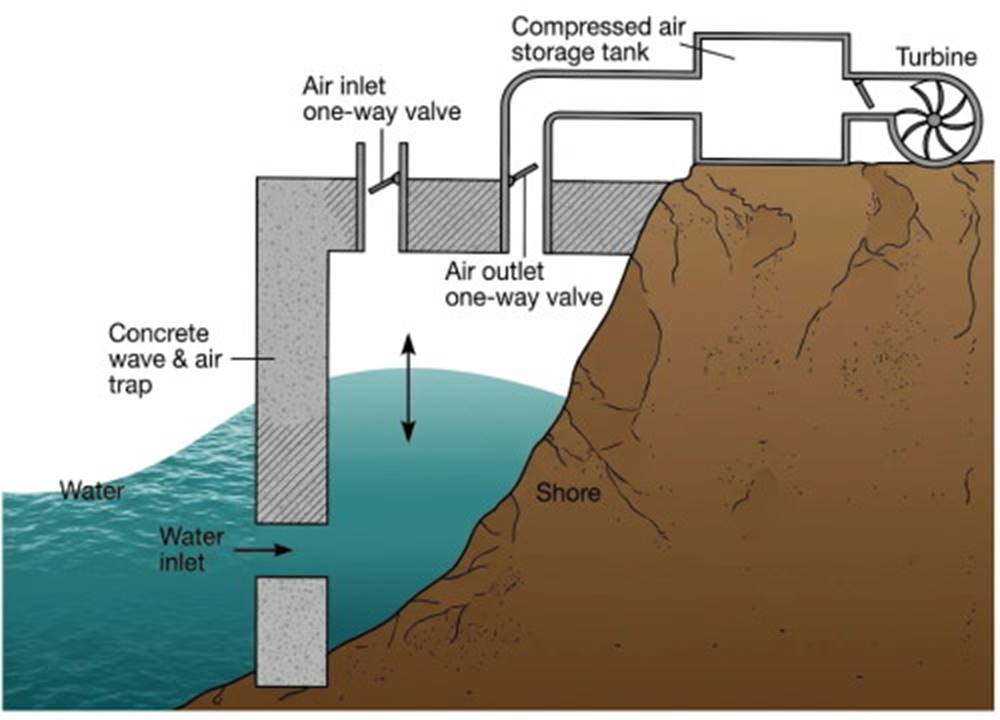
Fig. 9.29. Each rise and fall of the waves pumps pulses of compressed air into a storage tank. A smooth flow of compressed air from the storage tank turns a turbine that generates electricity.
Regional Potential and Environmental Considerations. Great Britain has a coastline with frequent high-energy waves and an average wave power of about 5.5 × 10⁴ watts (or 55 kilowatts) per meter of coastline. If the wave energy could be completely harnessed along 1000 km (620 mi) of coast, it would generate enough power to supply 50% of Great Britain's present power needs. Along the northern California coast, waves are estimated to expend 23 × 10⁶ kilowatts of power annually; it is thought that 4.6 × 10⁶ kilowatts, or 20%, could be harvested to generate electrical power. The Pacific Gas & Electric Company, a northern California utility, is considering installing a generating device in a breakwater planned for Fort Bragg, California.
Economic Comparisons and Feasibility. An estimate for total world energy produced by all operating wave energy systems is 3,500 kilowatts. Hydroelectric power from existing plants costs less than 3 cents per kilowatt-hour. Nuclear power plant costs are about 9 cents per kilowatt-hour; wood-burning plant costs are nearly 8 cents per kilowatt-hour. The cost of wave energy is estimated to be from 8.6 to 20 cents per kilowatt-hour depending on the region, while wind energy cost estimates are between 4.7 and 7.2 cents per kilowatt-hour.
When we consider wave energy systems, thoughtful consideration needs to be given to items other than cost. If all the wave energy were extracted from the waves in a coastal area, what effect would this action have on the shore area? If the near-shore areas are covered with wave energy absorbers 5 to 10 m (15–33 ft) apart, what will the effect be on other ocean uses? Since the individual units collect energy at a slow rate, can they collect enough energy over their projected life span to exceed the energy used to fabricate and maintain them? Your answers to these questions will help you understand that the harvesting of wave energy is not without an effect on the environment, that it may not be either cost- or energy-effective, and that its location may present enormous problems for installation, maintenance, and transport of energy to sites of energy use.
Fundamental Wave Mechanics. When the water's surface is disturbed, a wave is formed by the interaction between generating and restoring forces. The wind produces capillary waves, which grow to form gravity waves. The elevated portion of a wave is the crest; the depressed portion is the trough. The wavelength is the distance between two successive crests or troughs. The wave height is the distance between the crest and the trough. Wave period measures the time required for two successive crests or troughs to pass a location. The moving wave form causes water particles to move in orbits. The wave's speed is related to wavelength and period.
Deep-Water and Shallow-Water Dynamics. Deep-water waves occur in water deeper than one-half the wavelength. Wind waves generated in storm centers are deep-water waves. The period of a wave is a function of its generating force and does not change. Long-period waves move out from the storm center, forming long, regular waves, or swell. The faster waves move through the slower waves and form groups, or trains, of waves. The longer waves are followed by the shorter waves. This process is known as sorting, or dispersion. The speed of a group of waves is half the speed of the individual waves in deep water. Swells from different storms cross, cancel, and combine with each other as they move out across the ocean.
Wave height depends on wind speed, wind duration, and fetch. Single large waves unrelated to local conditions are called episodic waves. The energy of a wave is related to its height. When the ratio of the height to the length of a wave, or its steepness, exceeds 1:7, the wave breaks. The Universal Sea State Code relates wind speeds and sea-surface conditions.
Shallow-water waves occur when the depth is less than one-twentieth the wavelength. The speed of a shallow-water wave depends on the depth of the water. As the wave moves toward shore and decreasing depth, it slows, shortens, and increases in height. Waves coming into shore are refracted, reflected, and diffracted. The patterns produced by these processes helped people in ancient times to navigate from island to island. In the surf zone, breaking waves produce a water movement toward the shore. Breaking waves are classified as plungers or spillers. Water moves along the beach as well as toward it; it is returned seaward through the surf zone by rip currents.
Tsunamis and Internal Waves. Tsunamis are seismic sea waves. They behave as shallow-water waves, producing severe coastal destruction and flooding. Internal waves occur between water layers of different densities. Standing waves, or seiches, occur in basins as the sea surface oscillates about a node. Alternate troughs and crests occur at the antinodes.
It is possible to harness the energy of the waves by using either the water-level changes or the changing surface angle associated with them. Difficulties include cost, location, environmental effects, and lack of wave regularity.
Date added: 2026-11-09; views: 5;