
Dynamics of Internal, Standing Waves, and Seiches
Internal Wave Dynamics. The waves discussed to this point have all formed at the interface of the atmosphere and the ocean. This interface marks the common boundary between two fluids of different densities, air and water. Another interface between two fluids lies below the ocean surface at the pycnocline that separates the shallow mixed layer from the denser underlying water. In this case the boundary is less abrupt and the density difference is not as great as it is at the air-water boundary. The waves that form along this boundary are known as internal waves.
Internal waves are slower than surface waves; their periods are longer than most wind waves, and their height is limited by the thickness of the surface layer. When wave heights are large, internal waves may show at the sea surface as banding across the sea surface. The water over the crest of the internal wave shows ripples, but the water over the trough of the internal wave is quiet, and the surface bands move along the sea surface as the internal waves pass below. Sometimes, instead of bands, elevations and depressions of the sea surface occur as the internal waves pass (fig. 9.25).
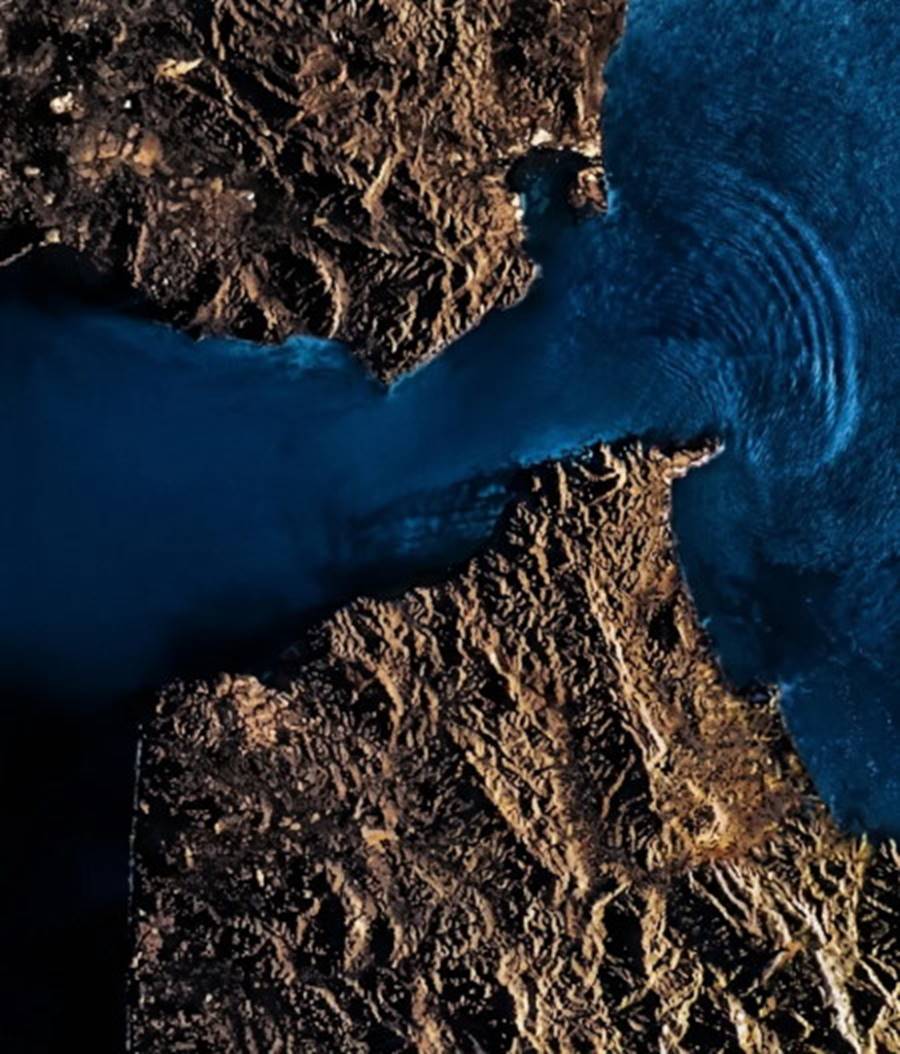
Fig. 9.25. Internal waves forming as seawater moves through the Strait of Gibraltar into the Mediterranean Sea. This satellite image shows wave diffraction as the waves move away from the strait.
Many processes are responsible for internal waves. A low-pressure storm system may elevate the sea surface and depress the pycnocline. When the storm moves away, the displaced pycnocline will return to its equilibrium level, causing an oscillation. If the speed of a surface current changes abruptly at the pycnocline, internal waves may be generated. Currents moving over rough bottom topography may also produce internal waves. If a thin layer of low-density surface water allows a ship's propeller to reach the pycnocline, the energy from the propeller creates internal waves; under this condition the ship's propeller becomes inefficient because internal waves created at the pycnocline carry energy away from the vessel instead of driving it forward.
The relationship of wave length and depth to wave speed is similar for both internal and surface waves (section 9.5). When the internal waves are short relative to the water depth, the density (rho = ρ) of both layers must be included in the equation. Wave speed squared (C²) is equal to the Earth's acceleration due to gravity (g) divided by 2π times the wavelength (L) times a ratio of densities, where ρ (rho) is the density of the lower layer and ρ′ is the density of the upper layer:
C² = (g / 2π) L [(ρ - ρ′) / (ρ + ρ′)]
When the internal waves are long relative to the water depth, it is necessary to include other relationships. For this equation see appendix C.
Standing Wave Formation. Deep-water waves, shallow-water waves, and internal waves are all progressive waves; they have a speed and move in a direction. Standing waves do not progress; they are progressive waves reflected back on themselves and appear as an alternation between a trough and a crest at a fixed position. They occur in ocean basins, partly enclosed bays and seas, and estuaries. A standing wave can be demonstrated by slowly lifting one end of a container partially filled with water and then rapidly but gently returning it to a level position.
If this is done, the surface alternately rises at one end and falls at the other end of the container. The surface oscillates about a point at the center of the container, the node; the alternations of low and high water at each end are the antinodes (fig. 9.26a). A standing wave is a progressive wave reflected back on itself; the reflection cancels out the forward motions of the initial and reflected waves. If different-sized containers are treated the same way, the period of oscillation increases as the length of the container increases or its depth decreases.
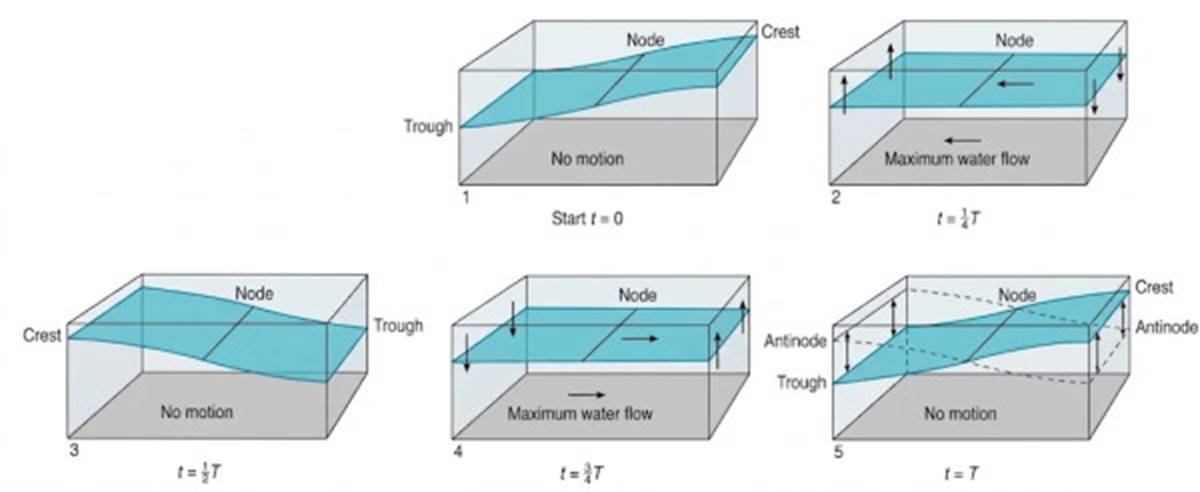
Fig. 9.26a. A standing wave oscillating about a single node in a basin. The time for one oscillation is the period of the wave, T.
Notice that the single-node standing wave contains one-half of a wave form (fig. 9.26a). The crest is at one end of the container and the trough is at the other end. As the wave oscillates, a trough replaces the crest, and a crest replaces the trough. One wavelength, the distance from crest to crest or from trough to trough, is twice the length of the container. By rapidly tilting the basin back and forth at the correct rate, one can produce a wave with more than one node, shown in figure 9.26b.
In the case of two nodes, there is a crest at either end of the container and a trough in the center; this configuration alternates with a trough at each end and the crest in the center. The two nodes are one-quarter of the basin's length from each end. In this case, note that the wavelength is equal to the basin's length. The oscillation period of the wave with two nodes is one-half of the oscillation period of the wave with a single node.
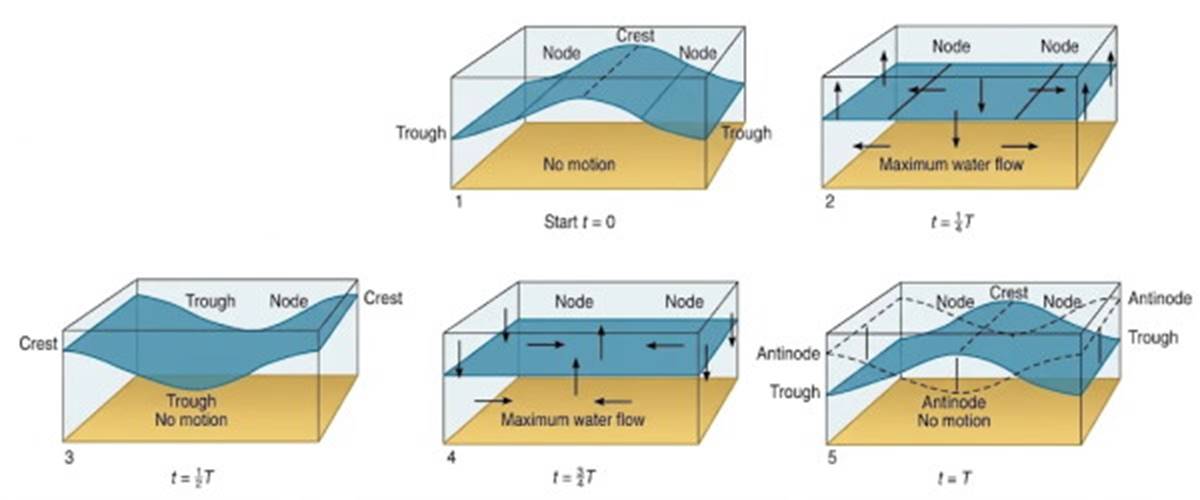
Fig. 9.26b. A standing wave oscillating about two nodes. The time for one oscillation is the period of the wave, T.
Standing waves in bays or inlets with an open end behave somewhat differently than standing waves in closed basins. A node is usually located at the entrance to the open-ended bay, so only one-quarter of the wavelength is inside the bay. There is little or no rise and fall of the water surface at the entrance, but a large rise and fall occurs at the closed end of the bay (fig. 9.27). Multiple nodes may also be present in open-ended basins.
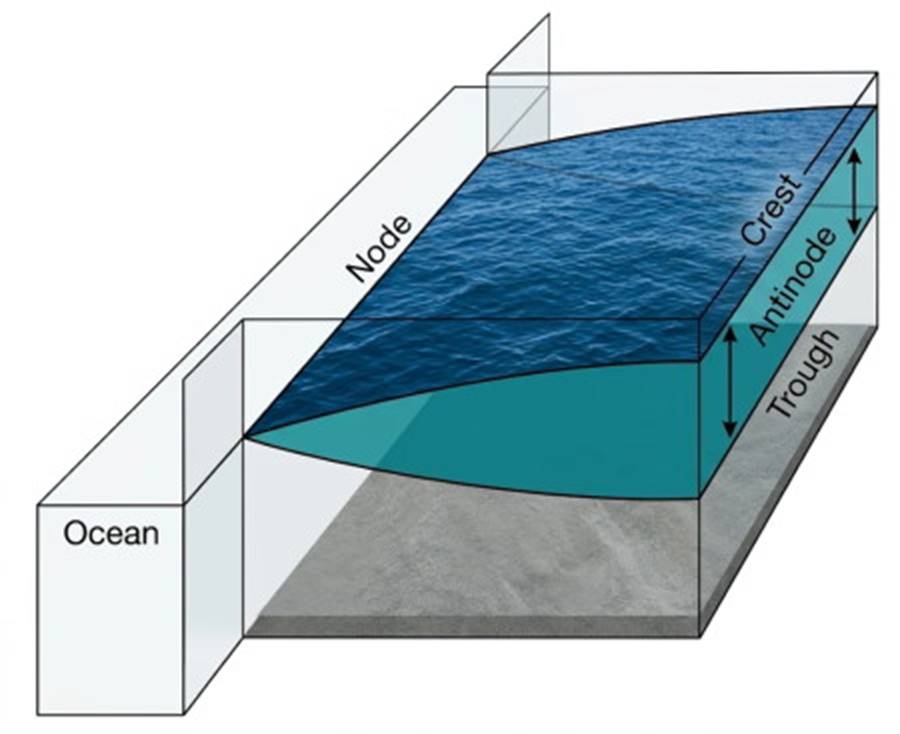
Fig. 9.27. A standing wave oscillates about the node located at the opening to a basin. The antinodes produce the rise and fall of water at the closed end of the basin. This type of oscillation is produced by alternating water inflow and outflow at a period equal to the natural period of the basin.
Seiches and Natural Oscillation. Standing waves that occur in natural basins are called seiches, and the oscillation of the surface is called seiching. In natural basins, the length dimension usually greatly exceeds the depth. Therefore, a standing wave of one node in such a basin behaves as a reflecting shallow-water wave, with the wavelength determined by the length or width of the basin. In water with distinct layers having sharp density boundaries, standing waves may occur along the fluid boundaries as well as at the air-sea boundary. The oscillation of the internal standing waves is slower than the oscillation of the sea surface.
Standing waves may be triggered by tectonic movements that suddenly shake a basin, causing the water to oscillate at a period defined by the dimensions of the basin. The same phenomenon occurs during an earthquake when water sloshes back and forth in swimming pools. If storm winds create a change in surface level to produce storm surges, the surface may oscillate as a standing wave in the act of returning to its normal level when the wind ceases. The movement of an air-pressure disturbance over a lake may also cause periodic water-level changes, reaching a meter or more in height. Tidal currents moving through an area with a sharp pycnocline and an irregular bottom topography may create internal waves that sometimes produce seiches.
If the period of the disturbing force is a multiple of the natural period of oscillation of the basin, the height of the standing wave is greatly increased. For example, if a child is riding on a swing, a gentle push timed with each swing period will force the swing higher and higher. The push may be delivered each time the swing passes, every other time, or every third time; all are multiples of the natural period of the swing. In chapter 10, we will learn that repeating tidal forces at the entrance to a bay can produce standing waves in those basins that have natural periods of oscillation approximating the tidal period.
A standing wave in a basin is like a water pendulum. The wave's natural period of oscillation is:
T = (1/n) (L / √(gD))
where n is the number of nodes present, D is the depth of water in the basin, g is the Earth's acceleration due to gravity, and L is the length of the wave. L equals twice the basin length, l, in a closed basin and four times the basin length in a basin with an open end. This equation is related to the shallow-water wave equation when the number of nodes is equal to 1:
L / T = n √(gD).
A progressive wave directly reflected back on itself produces a standing wave, because the two waves—original and reflected—are moving at the same speed but in opposite directions. The checkerboard interference pattern produced by two matched wave systems approaching each other at an angle also creates standing waves, with crests and troughs alternating with each other in fixed positions (refer to fig. 9.6).
Wave-Powered Pumping. The vertical rise and fall of the waves can be used to power a pump.
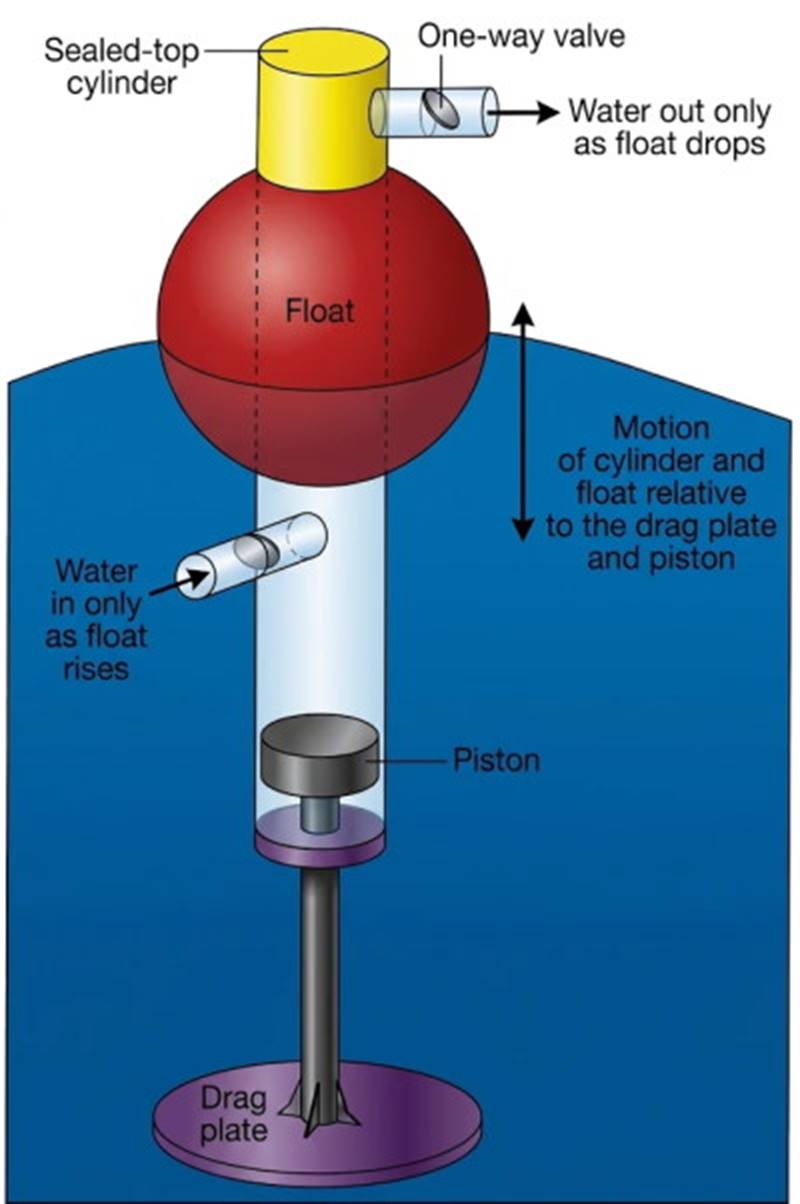
Fig. 9.28. The vertical rise and fall of the waves can be used to power a pump.
Date added: 2026-11-09; views: 8;