
Water temperature and turbidity
Temperature is a very important environmental variable, and not just seasonally—as it also fluctuates on a daily, or even hourly, basis. Because temporary waters are typically shallow, they are highly susceptible to rapid heating (from solar radiation) and cooling (at night and also from wind). Temperature inversions together with kinetic energy transfer from wind blowing over the water surface set the water column in motion, which in turn stirs up bottom materials.
Turbidity is thus a variable closely linked with temperature. Figure 3.3, shows that a section of a pond with low turbidity absorbs significantly more heat close to the bed, especially if the latter is darkly coloured, than a more turbid section. Whereas low turbidity leads to a more uniform temperature with depth, high turbidity leads to greater absorbance of heat at the surface (typically the upper 5-6 cm; Figure 3.4). The source of turbidity varies. In the Oklahoma pond it was suspended clay particles as well as microscopic organisms. Chromogenic bacteria are responsible for the red colour of many saline desert ponds, and purple, sulphur bacteria often occur in shallow, stratified waters (Cole 1968).
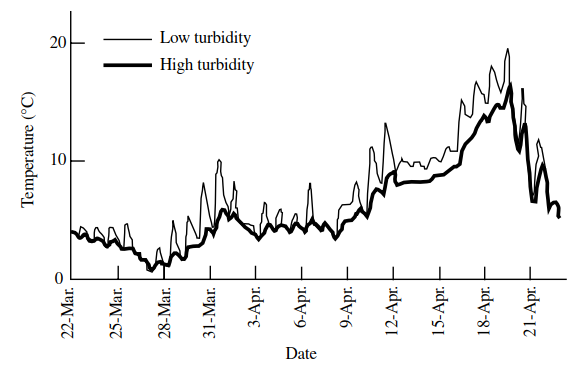
Figure 3.3. Temperature profiles for two sections of an intermittent pond (Vandorf Pond II, Ontario) that differ in turbidity level (low = 13 FTU; high = 32 FTU). Temperatures were measured close to the bed, thus readings were higher in the low turbidity section (deeper light penetration) compared with the high turbidity section. (Data from Magnusson and Williams, unpublished)
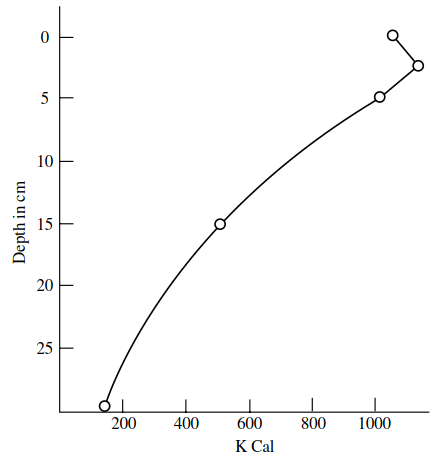
Figure 3.4. Heat absorption by 1-cm strata in a shallow intermittent pond (180 ppm (~80 FTU) turbidity) in Oklahoma (redrawn from Butler 1963)
The annual temperature regime of Sunfish Pond is shown in Figure 3.2. Temperature increases from a post-snowmelt value of around 8°C to a maximum of 27°C in mid-summer. There is little evidence of stratification in this clear-water pond, with surface water only ever being a degree or two warmer than that near the bed. Some shallow waterbodies experience a daily temperature turnover similar to that seen annually in permanent lakes (Eriksen 1966). Figure 3.5 shows the broad seasonal temperature profile of an intermittent, temperate pond, together with the diel variation measured at three points in its hydroperiod. While mean temperature from early April to late June ranged from around 4 to 19°C, the diel fluctuations were 2-20°C (early April), 10-28°C (midMay), and 17-24°C (mid-June).
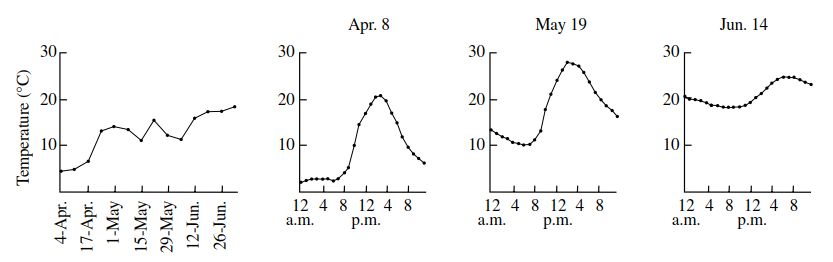
Figure 3.5. Comparison of seasonal (mean values) vs. diel (measured on 3 separate days) temperature fluctuations in an intermittent pond (Vandorf Pond I, Ontario) (data from Magnusson and Williams, unpublished)
The biological consequences of such massive, short-term temperature changes are poorly understood. To take an extreme example, the surface water of shallow ponds in temperate regions may, on occasion, approach 40 °C in mid-afternoon in summer. This is very near the thermal death point of most insects. Young and Zimmerman (1956) found many aquatic beetles active in such ponds in Florida even though the predominant aquatic vegetation (Chara spp.) was dead. Typically, however, these insects do not stay near the water surface, but congregate under debris or burrow in the bottom mud. They return to the surface at night and in the early morning, to forage, when the water is cooler. Among dytiscid beetles, species composition is known to change as pond temperatures rise (Nilsson and Svensson 1994). Eisenberg et al. (1995) have suggested that populations of the mosquito Culex tarsalis from different ponds in southern California have evolved separately to maximize survival in their respective temperature regimes by adapting to different optimal larval survival temperatures and egg- development rates.
In arctic and alpine regions, the effect of temperature is also marked but the conditions produced are quite different. Daborn and Clifford (1974) found that the first persistent ice cover in autumn, in a pond in western Canada, significantly reduced the normal close correlation between water and air temperatures. Initially, diurnal changes disappeared but subsequently reappeared as soon as the pond had frozen to the bottom. This was thought to be a function of lower thermal conduction across an ice-water interface than through ice alone, and of variation in snow depth on top of the ice. Ice temperatures as low as —8°C were recorded and aquatic invertebrates, such as damselfly nymphs, survived embedded in the ice.
Date added: 2026-07-14; views: 146;