
Dissolved oxygen and carbon dioxide
Dissolved oxygen in temporary waters may fluctuate diurnally as a result of photosynthesis and respiration. Whitney (1942) found this oxygen pulse to be at a maximum just after dark, when the day's photosynthesis had ended, but thereafter it fell gradually due to overnight respiration. He concluded that, in many cases, absorption of oxygen from the air was of relatively minor importance, as often absorption values were far below the air saturation value for a particular temperature. Further, the oxygen content of the water frequently changed during a period when a uniform temperature prevailed. Schneller (1955) found that during the low flow stages of Salt Creek, Indiana, large quantities of decaying leaf matter were sufficient to cause an oxygen depletion combined with an increase in free carbon dioxide from the activities of decomposers.
Surprisingly, few mortalities among the fish species present were reported. In contrast, George (1961), in a study of the diurnal variation of oxygen in two shallow ponds in India, found that, in one, the levels varied between 4.5 and 9.9 ppm, being maximal at 5:30 p.m. and minimal at 5:30 a.m.; these times agree closely with the 6:00 a.m. minima and 4:00 p.m. maxima measured in a pond on the Ivory Coast (Guiral et al. 1994). In the other Indian pond, the corresponding variation was from 0.1 to 28.2 ppm. These increases were attributed to photosynthesis, and the quantity of oxygen removed at night by community respiration (mostly due to the blue-green alga Microcystis aeruginosa) was sufficient to cause a fish kill. Podrabsky et al. (1998) similarly measured oxygen maxima (e.g. 256% saturation) in mid- to late-afternoon, with minima (e.g. 2%) between 9 and 10 a.m., in rainwater pools in Venezuela. Annual killifish (Austrofundulus spp., Pterolebias spp., and Rachovia spp.) embryos living in these pools were thought to be exposed, both intermittently and chronically, to hypoxic or anoxic conditions.
Decreased oxygen, alongside increased water temperature, has been shown to increase the level of brooding behaviour in the amphipod Crangonyx pseudogracilis. This species is a common inhabitant of temporary waters and its response to oxygen stress consists of increasing embryo ventilation within the brood pouch together with selective ejection of non-viable eggs. Some other amphipods that live in harsh environments show similar behaviours (Dick et al. 1998).
Cerny (cited in Vaas and Sachlan 1955) found that in some small ponds in Europe, the amount of daily photosynthesis could completely exhaust all of the available carbon dioxide. pH may rise as a result of this depletion—although the magnitude of pH change would depend not only on the intensity of the photosynthesis, but also on the degree of buffering available, for example, from surrounding alkaline soils. Eriksen (1966) showed that turbidity could cause stratification in the above parameters, as suspended material limits the penetration depth of sunlight thus restricting photosynthesis to the upper layers. This, in turn, might lead to oxygen, carbon dioxide, and pH stratification. Decreasing depth as the hydroperiod progresses may increase insolation which, again through changes in primary production, but also wind-induced aeration, may change the concentrations of dissolved gases in the water.
In various temporary waters, oxygen levels are also know to become depleted rapidly soon after inundation, as basin sediments and soils become flooded. Renewed microbial activity removes the oxygen, creating a reduced redox state in the bed (Sposito 1989).
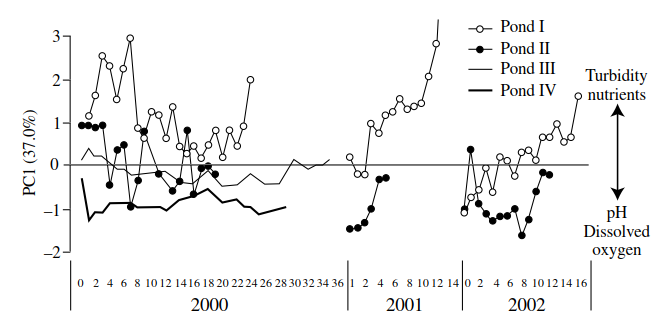
Figure 3.6. Plot of Principal Components Analysis-scores for the physicochemical parameters in four intermittent ponds in southern Ontario, over the period 2000–2002 (the most important eigenvector coefficients are given on the right-hand side of the graph; ponds III and IV show the smallest fluctuations along the axis, indicating more stable conditions in these two ponds; data from Magnusson and Williams 2006)
In a study of the physicochemical properties of four intermittent ponds in southern Ontario, Magnusson and Williams (2006) determined that, overall, dissolved oxygen, along with pH, turbidity, and nutrients (nitrate, ammonia, and total phosphorus) showed large fluctuations seasonally, among ponds, and between years. However, these parameters were more stable in ponds III and IV, which had longer hydroperiods (Figure 3.6).
Date added: 2026-07-14; views: 109;