
City of Philippi, Greece. 14 km. (8.4 miles) north of Kavalla (Neapolis)
The city bears the name of Philip II of Macedon, who in 357/356 b.c. brought the then gold-mining town under Macedonian hegemony. Under Roman rule after 167 b.c., it became a Roman colony in 42 b.c. following the defeat of Caesar's assassins at the Battle of Philippi. The city's prosperity in Roman times was due to its position on the Via Egnatia, the east-west highway that linked the Bosporus and Asia with the Adriatic coast and Italy.
Within the walls outlining a roughly trapezoidal area, with an acropolis at its northern tip, the city was organized in the characteristically Greco-Roman orthogonal plan. By the end of the prosperous second century, Philippi exhibited most of the civic amenities found in Roman provincial cities, such as a forum surrounded by temples, municipal offices, a library and shops; a theater tucked—in Greek fashion—into a hillside; public baths; and a gymnasium for the training of youth of the privileged class.
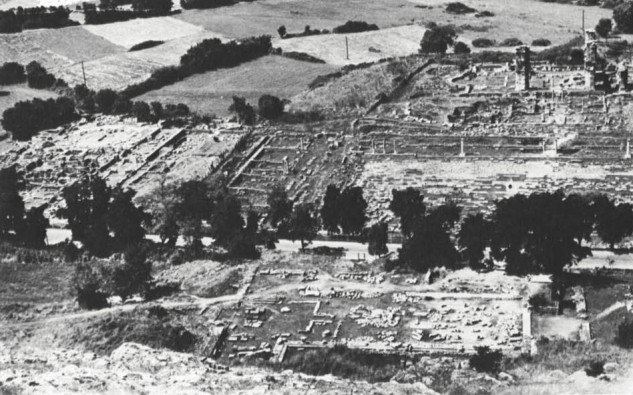
The low, unexciting profile of the pagan cityscape was broken, after the triumph of Christianity, by a succession of large, elaborately decorated, and diversely designed churches. Philippi was the first city in Europe in which St. Paul preached the gospel (about A.D. 50); he revisited it several times. His Epistle to the Philippians is testimony to his concern for the Christian community, which by the time of Constantine must have been large. Even had not the modern excavations at Philippi by French and Greek archaeologists concentrated on its churches, they would be its most conspicuous features. On the hill to the north of the main east- west street were two large basilicas; the better known, Basilica A, was of the timber-roofed, crosstransept type preceded by a forecourt and an atrium with an elaborately colonnaded fountain for ablutions. Both basilicas were probably built around 500.
South of the high street and east of the forum, an octagonal church, of only slightly later date, has recently been discovered. Replacing an apparently three-aisled basilica of the early fifth century, it was part of a larger complex, comprising a pedimented propylon on the high street, an inner colonnaded street leading to the Octagon, a baptistery, a bath, and what its excavator identifies as the episcopal palace.
Finally, south of the forum, Philippi's largest church, Basilica B, was built shortly before 540 on the site of the earlier gymnasium and a market. A cross-transept basilica, it was covered by a brick dome and vaults. This feature and its architectural sculpture link it with Justinianic buildings in Constantinople.
The Christian buildings of the fifth and sixth centuries mark the city's short-lived apogee. Basilica A was destroyed by earthquake, perhaps as early as the sixth century, and the vaults of Basilica В collapsed soon after their construction and were never restored. Philippi passed out of history in the tenth century.
bibliography: Lemerle, 1945, pp. 284-513; Pelekanides, 1958-1974.
Date added: 2026-07-14; views: 146;