
Soil Solution, Cation Exchange, and Organic Dynamics
Understanding the biogeochemical mechanics of the soil solution is fundamental for soil science, plant physiology, and ecosystem ecology. Soil solution acts as the primary liquid medium through which terrestrial vegetation acquires mineral nutrients essential for cellular maintenance, vegetative growth, and reproductive development.
1. Plant Essential Elements and Nutritional Dynamics. Plants require numerous chemical elements for survival, which are categorized into macronutrients and micronutrients based on their required concentrations within plant tissue.
Carbon, oxygen, and hydrogen serve as the basic structural constituents of organic compounds, comprising approximately 94% of the total dry mass of plants. The remaining essential elements are absorbed primarily as dissolved inorganic minerals from the soil solution.
Among these mineral nutrients, nitrogen, phosphorus, and potassium are recognized as the primary macronutrients due to their high physiological demand:
· Nitrogen is a fundamental component of proteins, chlorophyll, and enzymes critical to photosynthetic biochemical reactions.
· Phosphate compounds function in cellular energy transport (e.g., ATP), while phosphorus forms a structural backbone of nucleic acids (DNA and RNA).
· Potassium regulates stomatal movement (opening and closing), osmotic potential, enzymatic activation, and carbohydrate biosynthesis.
Secondary macronutrients and micronutrients (required in trace amounts) mediate processes such as enzyme co-factor activation, electron transport, and chlorophyll synthesis.
Essential Mineral and Non-Mineral Nutrients. Table 21.3 summarizes the primary forms of absorption and concentration ranges of essential elements in plant dry tissue.
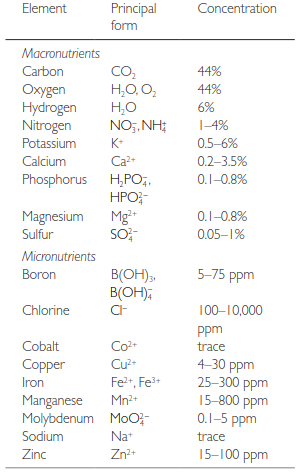
Table 21.3. Elements essential for plant growth and development, the principal form in which they are absorbed, and their usual concentration in percentage of dry weight or parts per million (mg per kg). (Source: Adapted from Barbour et al., 1999, p. 335)
2. Soil Cation Exchange Capacity (CEC) and pH Interactions. Mineralized elements dissolved in the soil solution are directly accessible for root uptake, but they are also susceptible to environmental loss through leaching. The retention and mobility of these ions depend on the physical-chemical properties of soil colloids.
The Physics of Cation Exchange. Negatively charged surfaces on clay particles and humus (termed micelles) bind positively charged ions (cations), preventing them from washing away. Cations bound to these exchange sites exist in dynamic equilibrium with ions in the liquid phase and can be replaced via cation exchange.
Cation adsorption strength follows an affinity hierarchy governed by ionic radius and valence charge:
Al³⁺ > Ca²⁺ > Mg²⁺ > K⁺ = NH₄⁺ > Na⁺
For instance, a divalent calcium cation adsorbed on a clay micelle can be displaced into the soil solution by two monovalent hydrogen ions:
[micelle]Ca²⁺ + 2H⁺ (solution) ⇌ [micelle]H⁺₂ + Ca²⁺ (solution) (21.4)
Soil pH and Base Saturation. The balance between hydrogen ions (H⁺) and hydroxyl ions (OH⁻) determines soil pH, which typically ranges from 3 in acidic peat soils to 10 or higher in strongly alkaline soils.
· High Base Saturation: Indicates that exchange sites are dominated by basic cations (Ca²⁺, Mg²⁺, K⁺, Na⁺), signaling high soil fertility.
· Low Base Saturation: Indicates acidic conditions where H⁺ and Al³⁺ occupy most exchange sites, displacing essential plant nutrients into solution where they are vulnerable to leaching.
Soil pH directly affects nutrient bio-availability in two key ways:
1. Colloidal Charge: Higher pH increases net negative charges on clay and humus particles, expanding the total cation exchange capacity (CEC).
2. Element Solubilities: Near-neutral pH (pH = 7) offers optimal availability for most macronutrients. Highly acidic conditions (pH < 5) cause toxic solubilization of iron, manganese, zinc, copper, and cobalt, while curtailing macronutrients, molybdenum, and boron.
3. Modeling Soil Carbon Dynamics: The CENTURY Model Framework. Organic matter turnover and carbon fluxes across soil pools are routinely quantified using biogeochemical modeling frameworks such as the CENTURY model.
Fig. 2.17 illustrates how surface and belowground litter components decompose through structural, metabolic, active, slow, and passive organic matter pools.
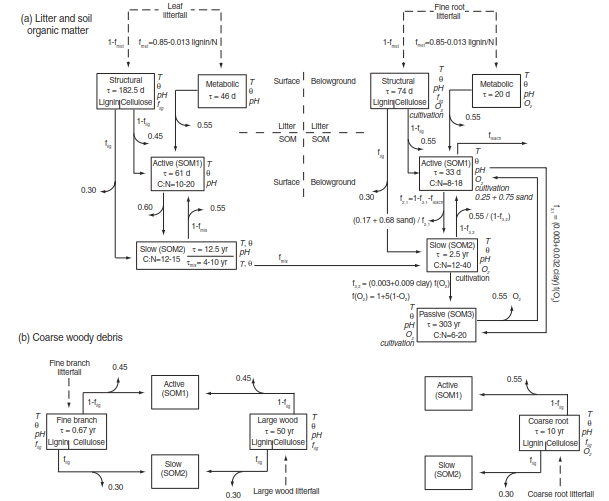
Fig. 2.17. Litter and soil organic matter pools and carbon flows represented in the CENTURY model. (a) Decomposition of leaf and fine root litter. Surface material (shown on the left) is represented by two litter pools (metabolic and structural) and active (SOM1) and slow (SOM2) organic matter pools. Belowground material (shown on the right) is represented by two litter pools (metabolic and structural) and active (SOM1), slow (SOM2), and passive (SOM3) organic matter pools. Shown is the base decomposition rate of each pool, given here as a turnover time (τ) ranging from days (d) to years (yr). The actual decomposition rate varies with soil temperature (T), soil moisture (θ), and pH. Belowground decomposition additionally varies with anaerobic conditions (O₂) and cultivation. Structural litter decomposition also depends on lignin fraction (f_lg). The C:N ratio of organic matter differs among pools and varies with soil mineral nitrogen. Shown is the minimum and maximum value for each pool. Solid lines indicate decomposition pathways, with curved arrows denoting heterotrophic respiration fluxes for each pathway and numbers denoting the respiration fraction. Shown also is the fraction of the total carbon flow represented by a pathway. (b) Decomposition of fine branch and large wood litter into surface pools and coarse root litter into belowground pools. Adapted from Bonan et al. (2013).
Carbon Pool Characteristics
1. Metabolic Pools: Rapid turnover times (τ = 20 to 46 days), consisting of readily decomposable soluble organics.
2. Structural Pools: Slower turnover (τ = 74 to 182.5 days), constrained by lignin and cellulose content (f_lg).
3. Active SOM Pool (SOM1): Microbial biomass and metabolites (τ = 33 to 61 days, C:N ratio = 8–20).
4. Slow SOM Pool (SOM2): Chemically protected or resistant structural matter (τ = 2.5 to 50 years, C:N ratio = 12–40).
5. Passive SOM Pool (SOM3): Highly recalcitrant, mineral-associated organic matter (τ = 303 to 1000 years, C:N ratio = 6–20).
Decomposition turnover rates vary dynamically as a function of soil temperature (T), soil moisture (θ), pH, oxygen availability (O₂), and human land management practices such as cultivation.
Date added: 2026-09-24; views: 1;