
Ecosystem Dynamics under Elevated Carbon Dioxide and Thermal Warming
Long-Term Plant Acclimation and Methodological Approaches. Though short-term photosynthetic enhancement with higher atmospheric CO₂ concentrations is well documented, less is known about the long-term acclimation of plants to elevated carbon dioxide environments. Understanding how elevated CO₂ influences fundamental physiological mechanisms—such as carbon allocation patterns, soil nitrogen availability, and plant nitrogen use efficiency—is essential for predicting ecosystem trajectory. Furthermore, researchers must determine how these individual physiological changes alter stand structure and community composition, and whether expected growth increases will materialize in real-world field conditions where air temperature, soil water availability, and nitrogen supply strongly limit plant growth.
Early research investigating the physiological impacts of elevated CO₂ relied heavily on controlled environment facilities, including glasshouses and growth chambers. In these setups, individual plants were typically cultivated in pots under artificial environmental conditions. However, the ecological relevance of these early studies was frequently questioned because potted plants experience root restriction and are isolated from prevailing meteorological dynamics, realistic soil nutrient cycles, stand competition, and natural community dynamics. Subsequent field research employed open-top chambers (OTCs) to expose vegetation to elevated carbon dioxide. While OTCs represented an improvement over indoor facilities, they still altered the local microclimate (e.g., elevated internal temperature and reduced wind speeds) and could not enclose mature, full-scale forest canopies or large ecosystem plots.
To overcome the constraints of enclosures, scientists developed Free-Air CO₂ Enrichment (FACE) technology. Uniquely, FACE systems release controlled amounts of CO₂ directly into the ambient air via a perimeter ring or lattice of vertical pipes surrounding intact ecological plots. This experimental framework allows whole, undisturbed ecosystems—including mature trees, understory vegetation, soil microbes, and fauna—to grow under elevated CO₂ regimes without modifying light, precipitation, wind, or humidity. FACE technology has since been deployed across a wide spectrum of terrestrial biomes, including temperate forest stands, grasslands, deserts, and agricultural crops.
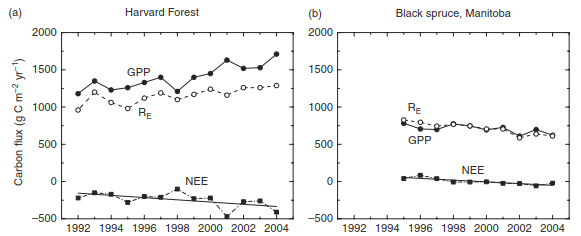
Fig. 20.22. Annual gross primary production, ecosystem respiration, and net ecosystem exchange at (a) Harvard Forest (1992–2004) and (b) an old black spruce forest, Manitoba (1995–2004). Harvard Forest data from Urbanski et al. (2007). Black spruce data from Dunn et al. (2007). See also Figure 20.20b,c for monthly fluxes.
Primary Productivity and Water-Use Efficiency Responses. Syntheses of FACE experiments reveal consistent physiological responses across plant functional types, including enhanced photosynthetic assimilation, reduced stomatal conductance, and overall increases in plant productivity. For instance, a 13-year-old loblolly pine (Pinus taeda) stand at the Duke Forest in North Carolina was exposed to a 200 ppm enrichment above ambient levels (increasing from approximately 370 ppm to 570 ppm CO₂) beginning in 1996. DeLucia et al. (2005) contrasted this pine forest response with a 10-year-old deciduous sweetgum (Liquidambar styraciflua) stand near Oak Ridge, Tennessee, exposed to similar CO₂ enrichment starting in 1998. Net primary production (NPP) increased significantly under elevated CO₂: by 14–26% over 1997–2002 in the loblolly pine stand, and by 16–38% over 1998–2002 in the sweetgum stand.
Subsequent multi-site evaluations confirmed that ecosystem water-use efficiency (WUE) increased in both forest types. This gain in WUE occurred because NPP rose substantially while annual plant transpiration rates remained constant or decreased due to partial stomatal closure.
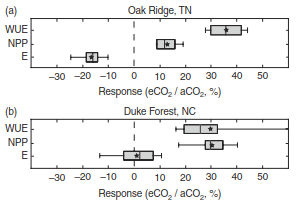
Fig. 20.23. Box and whisker plots showing the mean annual response of water-use efficiency (WUE; NPP/E), net primary production (NPP), and transpiration (E) to CO₂ enhancement at (a) Oak Ridge for the years 1999, 2004, 2007, and 2008 and (b) Duke Forest between 1996 and 2007. Shown is the elevated CO₂ response as a percentage of the ambient CO₂ measurement. The ends of the boxes show the lower (25th) and upper (75th) quartiles. The horizontal whiskers show the full range of the data. The lines in the boxes are the medians and stars are the means. Data from De Kauwe et al. (2013).
Broad-scale meta-analyses demonstrate that the stimulation of primary productivity by elevated CO₂ is widespread across terrestrial ecosystems. Norby et al. (2005) integrated data from the Duke and Oak Ridge studies with additional FACE sites, including young, mixed-species forest stands dominated by aspen in Wisconsin and poplar in Italy. Across diverse climates, soil types, and plant functional groups, raising CO₂ from ambient values of 376 ppm to 550 ppm sustained a mean NPP increase of 23% based on median site responses, or 17% on average across a synthesis of 12 FACE studies incorporating over 40 species. Similarly, Ainsworth and Long (2005) reported that elevated CO₂ increased aboveground production, while Nowak et al. (2004) synthesized 16 FACE sites (spanning forests, grasslands, deserts, and bogs) and documented an average 19% increase in aboveground biomass and a 12% increase in total net primary production.
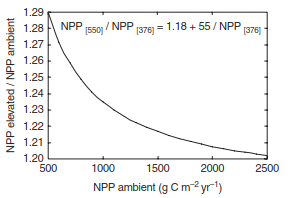
Fig. 20.24. Relationship between net primary production (g C m⁻² yr⁻¹) at ambient CO₂ concentration (376 ppm) and elevated CO₂ concentration (550 ppm) observed for four young loblolly pine, sweetgum, aspen, and poplar temperate forests. Data from Norby et al. (2005).
Nutrient Constraints and Progressive Nitrogen Limitation. Despite initial productivity gains, the degree to which elevated CO₂ can sustain enhanced ecosystem productivity over decadal timescales remains constrained by soil nutrient availability. Studies by Oren et al. (2001), Reich et al. (2006a, 2014), Norby et al. (2010), and Reich and Hobbie (2013) demonstrate that growth responses diminish when soil nitrogen availability is low.
In the Oak Ridge sweetgum experiment, severe nitrogen limitation gradually suppressed CO₂ stimulation over an 11-year period (Norby et al. 2010). During the first 6 years, elevated CO₂ increased productivity by 13–33% relative to control plots. However, this stimulation declined to 24% between 2001–2003 and dropped to just 9% by 2008. This phenomenon is driven by progressive nitrogen limitation (PNL), wherein enhanced tree growth sequesters nitrogen into long-lived plant biomass and recalcitrant soil organic matter, gradually depleting the bioavailable soil mineral nitrogen pool (Luo et al. 2004; Reich et al. 2006b). Conversely, the loblolly pine stand at Duke Forest sustained an average 28% NPP stimulation over 8 years without exhibiting a similar drop (McCarthy et al. 2010). Furthermore, long-term CO₂ enrichment crossed with nitrogen fertilization experiments in perennial grasslands confirmed that low ambient nitrogen availability constrains plant biomass accumulation (Reich and Hobbie 2013; Reich et al. 2014).
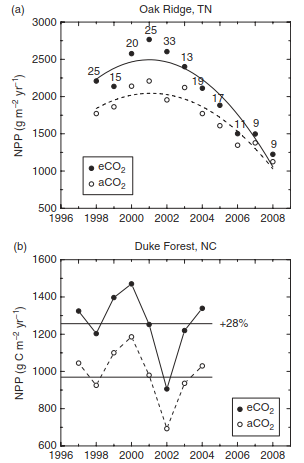
Fig. 20.25. Annual net primary production for FACE experiments at (a) Oak Ridge, Tennessee sweetgum (Norby et al. 2010) and (b) Duke Forest, North Carolina loblolly pine (McCarthy et al. 2010). Shown are data for ambient CO₂ (aCO₂) and elevated CO₂ (eCO₂). Note that the Oak Ridge data are reported as dry matter (biomass) while the Duke data are reported as the mass of carbon. Numbers for Oak Ridge show the percentage increase relative to the control. The Duke Forest did not have a similar temporal trend. Shown are the 8-year means (solid horizontal lines) and the percentage increase from the control.
As emphasized by Norby and Zak (2011), long-term carbon fate depends on allocation patterns. If extra carbon is partitioned into rapidly decomposing tissues (e.g., fine roots or foliage), long-term soil carbon storage remains low; allocation to slow-turnover woody biomass enhances long-term carbon residence time.
Soil Warming Dynamics and Biogeochemical Feedbacks. Climate change modifies global carbon storage by simultaneously altering carbon input via NPP and carbon loss via soil microbial decomposition. Soil warming can accelerate soil organic matter decomposition, thereby releasing stored carbon while enhancing net nitrogen mineralization and relieving nutrient limitations (Melillo et al. 2002, 2011).
A 7-year soil warming experiment conducted in a deciduous forest in central Massachusetts illustrates these coupled biogeochemical dynamics. Artificially elevating soil temperature by 5 °C increased both carbon loss from soil respiration and carbon gain in tree biomass. Cumulative soil organic matter carbon loss (1300 g C m⁻²) exceeded total vegetation carbon gain (700 g C m⁻²), resulting in a net ecosystem carbon loss of 600 g C m⁻² over the 7-year period. Increased tree growth occurred because soil warming enhanced soil organic matter decay, increasing net nitrogen mineralization rates by 45%. In response, trees incorporated more nitrogen into their foliage, boosting photosynthetic capacity and growth rates (Butler et al. 2012).
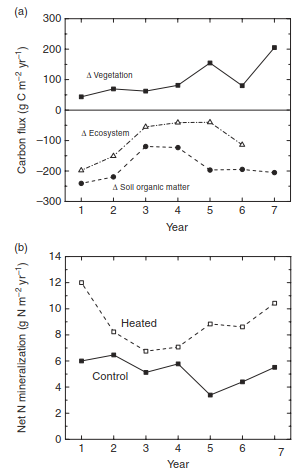
Fig. 20.26. Effect of soil warming on the biogeochemistry of a temperate deciduous forest in Massachusetts. (a) Annual change in vegetation carbon, soil organic matter, and ecosystem carbon in the heated plot relative to the unheated control. (b) Net nitrogen mineralization in the control and heated areas. Adapted from Melillo et al. (2011).
Similar soil warming experiments across forest, shrubland, grassland, and tundra biomes demonstrate comparable short-term enhancements of soil carbon loss, increased nitrogen mineralization, and elevated net primary production (Rustad et al. 2001; Wu et al. 2011; Lu et al. 2013).
Date added: 2026-09-24; views: 1;