
Nitrogen Dynamics and Primary Productivity in Forest Ecosystems
Feedback Mechanisms Linking Nutrient Availability and Primary Production. Ecosystem production and nutrient cycling are intrinsically linked dynamics that regulate forest ecosystem function. High nutrient availability in the soil matrix leads to elevated nutrient uptake by vegetation during growth cycles. Increased concentration of key nutrients—most notably nitrogen (N)—within foliar tissue supports higher rates of photosynthetic assimilation. Consequently, net primary production (NPP) expands, returning larger quantities of nutrients to the soil substrate via litterfall. High-quality leaf litter decomposes and mineralizes rapidly, thereby reinforcing elevated nutrient availability through a positive feedback loop.
Conversely, environments characterized by low nutrient availability initiate a self-reinforcing oligotrophic cycle. Reduced root uptake lowers foliar nitrogen concentrations, suppressing photosynthetic efficiency and overall net primary production. The resulting organic debris features a high carbon-to-nitrogen (C:N) ratio, which decays slowly. Low rate of nitrogen mineralization restricts bioavailable nutrient pools, further reinforcing reduced plant productivity.
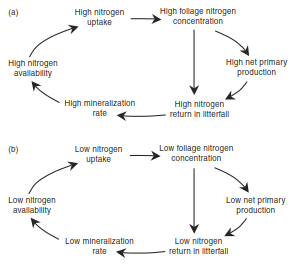
Fig. 20.15. Feedback between nutrient availability and net primary production showing that (a) high nitrogen availability reinforces high production and (b) low nitrogen availability reinforces low production.
Edaphic Controls and Ecosystem Functioning in Wisconsin Hardwood Forests. Research conducted by Pastor et al. (1984) in the northern hardwood forests of Blackhawk Island, Wisconsin, demonstrates the strong interplay between soil texture, species composition, and nitrogen dynamics. Forest composition across the island aligns closely with physical soil properties:
· Silty clay loam: Supports highly productive sugar maple (Acer saccharum) stands.
· Sandy clay loam: Occupied by moderately productive white oak (Quercus alba) and red oak (Quercus rubra) stands.
· Sandy soil: Dominates low-productivity stands of needleleaf evergreens, including eastern hemlock (Tsuga canadensis), red pine (Pinus resinosa), and eastern white pine (Pinus strobus).
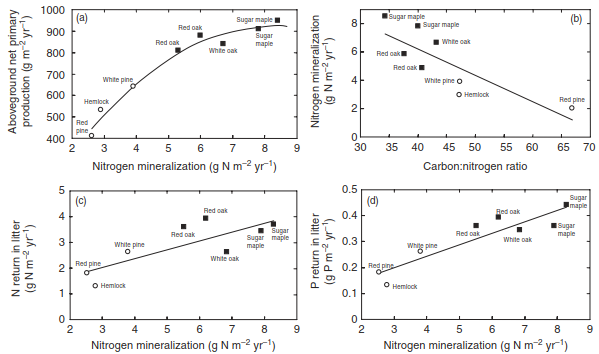
Fig. 20.16. Forest production and nutrient cycling on Blackhawk Island, Wisconsin: (a) Annual aboveground net primary production in relation to annual nitrogen mineralization; (b) Annual nitrogen mineralization in relation to litter C:N ratio; (c) Annual nitrogen return in litterfall in relation to annual nitrogen mineralization; (d) Annual phosphorus return in litterfall in relation to annual nitrogen mineralization. Data from Pastor et al. (1984).
Annual aboveground net primary production correlates positively with annual nitrogen mineralization rates. Broadleaf deciduous species produce high-quality litter characterized by low C:N ratios, resulting in elevated rates of nitrogen mineralization and annual phosphorus (P) return. Conversely, needleleaf evergreen stands generate low-quality detritus with high C:N ratios, suppressing microbial decay, elemental return, and primary yield.
Biogeochemical Cycles and Thermal Regimes in Alaskan Boreal Ecosystems. Studies across boreal landscapes near Fairbanks, Alaska, reveal critical interactions between thermal conditions, permafrost, and biogeochemical cycles (Van Cleve et al., 1983a,b, 1986, 1991; Viereck et al., 1983; Bonan, 1989, 1990; Bonan and Van Cleve, 1992; Chapin et al., 2006a). Topographic variation and fire disturbance create a mosaic of black spruce, white spruce, quaking aspen, paper birch, and balsam poplar forests.
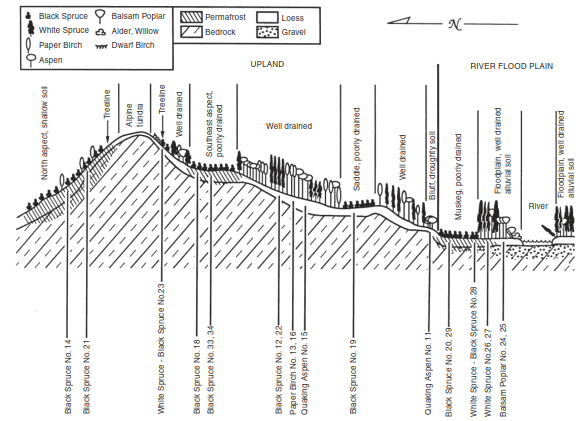
Fig. 20.17. Distribution of black spruce, white spruce, paper birch, quaking aspen, and balsam poplar forest stands near Fairbanks, Alaska, in relation to topography. Redrawn from Viereck et al. (1983).
White spruce (Picea glauca), balsam poplar (Populus balsamifera), paper birch (Betula papyrifera), and quaking aspen (Populus tremuloides) inhabit warm, well-drained, nutrient-rich soils along floodplains and south-facing upland slopes. In contrast, black spruce (Picea mariana) dominates cold, wet, nutrient-poor sites underlain by permafrost.
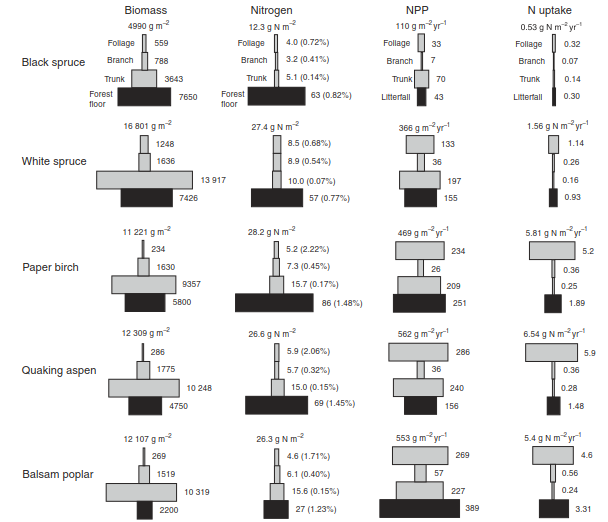
Fig. 20.18. Biomass, net primary production, and nitrogen cycling for black spruce, white spruce, paper birch, quaking aspen, and balsam poplar forests near Fairbanks, Alaska. Shown are average aboveground biomass, nitrogen content of biomass (and as a percentage of biomass, in parentheses), aboveground net primary production, and nitrogen uptake for each forest type. Also shown are forest floor biomass, forest floor nitrogen, litterfall, and nitrogen return in litterfall. Boxes are proportional in size to pools and fluxes. Data from Van Cleve et al. (1983b).
Deciduous stands accumulate less organic mass on the forest floor (2.2–5.8 kg m⁻²) than spruce stands (~7.5 kg m⁻²), but maintain higher nitrogen concentrations (1.2–1.5% versus 0.8%). Annual nitrogen requirements in productive deciduous stands are 10–12 times higher than in black spruce (0.53 g N m⁻² yr⁻¹).
Thermal Controls and Chemical Composition of Forest Floor Debris. Interactions between soil temperature, organic horizon thickness, and chemical composition determine nutrient cycling rates:
1. Insulation Effects: Thick forest floor organic layers (12–38 cm in black spruce) have low thermal conductivity. This insulation prevents summer soil warming, promoting shallow active layer depths above the permafrost table.
2. Thermal Suppression: Cold soil temperatures suppress microbial respiration, delaying organic decomposition and nitrogen mineralization.
3. Lignin Ingestion: Black spruce litter exhibits high lignin concentrations and low nitrogen content, making the organic matrix resistant to enzymatic hydrolysis.
4. Deciduous Acceleration: Deciduous canopy species produce litter low in lignin and rich in nitrogen, accelerating organic turnover on warmer, permafrost-free soils.
Date added: 2026-09-24; views: 2;