
Soil Weathering Pathways and Geochemical Dynamics in Ecosystems
Fundamentals of Soil Formation and Weathering. Soils serve as the central domain for complex geochemical and biological activity, forming through the combined actions of physical and chemical weathering. Physical weathering involves the mechanical disintegration of rocks into smaller fragments without altering their internal chemical identity. Chemical weathering occurs concurrently when water, acids, and reactive dissolved substances alter or dissolve parent minerals.
The progression of weathering breaks down rock masses into sand, silt, and clay fractions. Silicate clays along with iron or aluminum oxide clays constitute the highly resistant end-products of long-term chemical transformation. As minerals break down, essential elements release into the soil solution for plant uptake or hydrological transport. Simultaneously, the decomposition of plant detritus mineralizes organic nutrients into inorganic forms. The overall rate of organic decomposition depends on soil temperature, soil moisture, and the chemical composition of plant litter, accompanied by the release of trace nitrogen gases. These mechanisms jointly drive soil profile development over time across 12 distinct soil orders, governed by parent material, time, topography, climate, and vegetation.
Mineral Transformations and Weathering Pathways. The mineralogical composition of parent rocks transforms continuously during weathering, forming primary minerals and secondary minerals. Primary minerals originate directly from igneous or metamorphic rocks, resist chemical alteration, and dominate the sand and silt fractions of soil. Secondary minerals form through the chemical breakdown or re-crystallization of less resistant primary minerals and dominate the fine clay fraction.
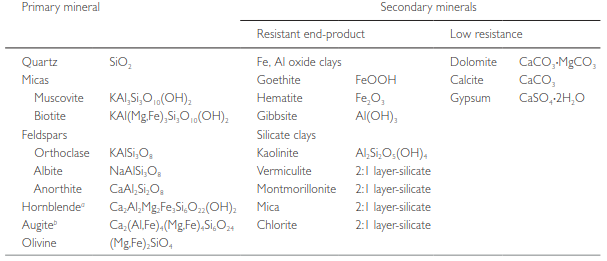
Table 21.1. Primary and secondary minerals commonly found in rocks and soils (adapted from Brady and Weil 1999).
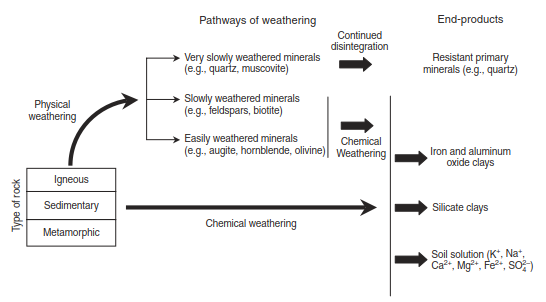
Fig. 21.1. Pathways of physical and chemical weathering. Rocks are broadly classified as igneous, sedimentary, and metamorphic, which differ in origin and chemical and mineralogical properties. Three groups of minerals remain in well-weathered soils: resistant primary minerals such as quartz; iron and aluminum oxide clays; and silicate clays. Elements in solution are taken up by plants or lost in leaching. Adapted from Brady and Weil (1999).
Physical mechanisms—such as scouring by water, wind, or ice, continuous freeze-thaw cycles, wetting-drying expansion, and root growth—fracture intact rocks and increase total surface area. This expansion directly accelerates chemical weathering rates across exposed mineral faces.
Chemical Weathering Dynamics and Nutrient Kinetics. Chemical weathering proceeds via mineral dissolution and structural alteration. A major agent of chemical weathering is carbonic acid (H₂CO₃), generated within the soil profile through the hydration of carbon dioxide (CO₂) in water (H₂O):
CO₂ + H₂O ⇄ H⁺ + HCO₃⁻ ⇄ H₂CO₃ (21.1)
Carbonic acid reacts with carbonate minerals such as calcite (CaCO₃), a key component of limestone and marble, releasing soluble calcium ions (Ca²⁺) and bicarbonate (HCO₃⁻):
CaCO₃ + H₂CO₃ ⇄ Ca²⁺ + 2HCO₃⁻ (21.2)
This reaction forms part of the global geological carbon cycle, transporting dissolved weathering byproducts via river systems to oceans (Montgomery et al. 2000).
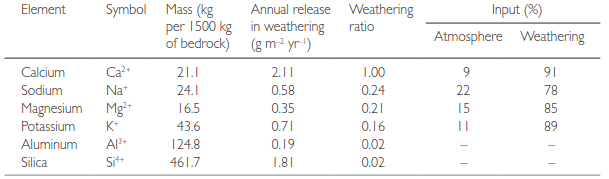
Table 21.2. Chemical weathering of elements at the Hubbard Brook Experimental Forest, New Hampshire (adapted from Likens et al. 1977 and Schlesinger 1997).
Long-term field data from the Hubbard Brook Experimental Forest in New Hampshire highlight the magnitude of element release via chemical weathering. In this cool, humid continental environment, silica and aluminum constitute the largest bedrock mass fraction. However, base cations (Ca²⁺, Na⁺, Mg²⁺, K⁺) exhibit substantially higher weathering ratios (defined as the ratio of annual element release relative to bedrock mass, normalized to Ca²⁺). Consequently, bedrock weathering supplies the majority of essential calcium (91%), sodium (78%), magnesium (85%), and potassium (89%) to this forest ecosystem.
Date added: 2026-09-24; views: 1;