
Pedogenesis, Soil Classification, and Organic Carbon Dynamics
The structural, physical, chemical, and mineralological properties of a soil profile reflect its degree of weathering and overall state of pedogenic development. Pedogenesis occurs through complex, multi-scale interactions between geological substrates, atmospheric drivers, topographic gradients, and biological activity over extended temporal scales.
1. The Five State Factors of Pedogenesis. As established in the classical state-factor model of soil formation (Jenny, 1980), pedogenesis is governed by five fundamental environmental factors: parent material, climate, vegetation (biota), topography, and time.
Parent Material Diversity and Weathering Susceptibility. Parent material constitutes the baseline geological substrate from which soil develops. Its primary mineral composition dictates the physical texture, nutrient availability, and type of secondary clay minerals generated during weathering:
· Residual Material: Formed in situ via the direct weathering of underlying bedrock.
· Colluvial Material: Composed of coarse rock fragments detached and transported downslope under the force of gravity.
· Alluvial Deposits: Fine-grained sediments deposited along river floodplains and deltas.
· Marine Sediments: Unconsolidated coastal plain deposits derived from marine environments.
· Glacial Drift: Till and outwash sediments left behind by retreating ice sheets.
· Eolian Materials: Wind-transported particles, including dune sand, loess, and atmospheric dust.
Quartz-rich parent materials (such as granite or sandstone) predominantly yield sandy soils with low chemical buffering capacity.
Temporal Dynamics and Chronosequences. Because chemical and physical weathering proceed over thousands of years, the duration of exposure determines profile maturity. Soils developing on young glacial debris or recent alluvial floodplains exhibit substantially less profile differentiation than unglaciated, geologically ancient upland soils.
Topographic Controls on Hydrology and Soil Thickness. Topography—defined by site elevation, slope gradient, and landscape position—modifies pedogenesis by directing water movement and mass transport:
· Erosional Uplands: Convex upper slopes experience rapid surface runoff, yielding the shallowest profiles.
· Depositional Lowlands: Concave depressions accumulate translocated sediment, fine clays, and organic debris.
· Poorly Drained Basins: Topographic low points collect standing water, creating anaerobic conditions that impede organic decomposition.
Climatic Regimes and Weathering Mechanisms.Climate, driven primarily by temperature and effective precipitation, regulates the rate and nature of physical and chemical weathering:
· Physical Weathering: Prevalent in seasonally cold or humid environments via freeze-thaw cycles or shrink-swell wetting-drying dynamics.
· Chemical Weathering: Accelerates exponentially in warm, humid regions through hydrolysis, hydration, and organic acid leaching.
Consequently, chemical weathering is far more pronounced in tropical rainforests than in temperate forests, and significantly faster in moist forest biomes than in arid grasslands or deserts.
2. Soil Profile Differentiation in Forest and Grassland Ecosystems. The nature of native plant communities dictates organic inputs and profile architecture, leading to structural differences between forest and grassland ecosystems (as illustrated in Fig. 21.11).
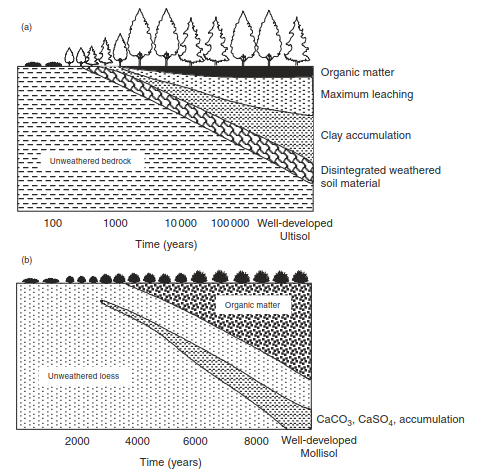
Fig. 21.11. Idealized temporal sequence of soil development from unweathered parent material. (a) Forest with ultisol soil. (b) Grassland with mollisol soil. Adapted from Brady and Weil (1999, p. 57).
Grassland Pedogenesis: Mollisol Formation. Grassland soils develop under semi-arid to sub-humid conditions, characterized by extensive, deep root networks that continually contribute organic matter at depth. This produces a thick, dark A horizon rich in humus. Due to lower effective precipitation, soluble weathering products are not completely leached; instead, secondary minerals such as calcium carbonate (CaCO₃) and calcium sulfate (CaSO₄) accumulate in lower horizons.
Forest Pedogenesis: Podzolization and Acid Leaching. Forest ecosystems deposit organic residues as surface leaf litter and woody debris, forming distinct surface O horizons:
· Boreal and Cool Temperate Coniferous Forests: Coniferous litter produces strong organic acids during slow decomposition. These acids drive intense illuviation, translocating iron (Fe) and aluminum (Al) oxides to lower horizons to form Spodosols via podzolization.
· Tropical Forests: Rapid microbial decomposition prevents thick O horizon accumulation, while intense leaching translocates clay and free oxides deeper into the profile over time.
3. Profiles of Soil Organic Carbon Distribution. The vertical distribution of soil organic carbon (SOC) varies systematically between forest and grassland biomes, reflecting differences in root allocation and litter deposition (as shown in Fig. 21.10).
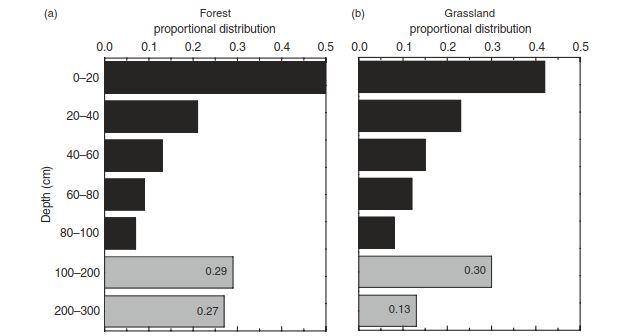
Fig. 21.10. Profiles of soil organic carbon distribution for (a) forest and (b) grassland. Black bars show the proportional distribution of soil organic carbon in the first meter of soil and sum to one. Gray bars show the additional carbon at depths of 100–200 cm and 200–300 cm, relative to the first meter. Data from Jobbágy and Jackson (2000).
Depth-Wise Carbon Proportions
- Top 20 cm Depth: Stores 50% of top-meter SOC in forest ecosystems, compared to 42% in grassland systems.
- Subsurface Depth (20–100 cm): Contains 50% of top-meter SOC in forests and 58% in grasslands, driven by deep fibrous grass roots.
- Deep Soil Carbon (100–300 cm): In forests, additional organic carbon stored between 100–300 cm equals 56% (29% at 100–200 cm + 27% at 200–300 cm) of the carbon present in the top meter. In grasslands, deep carbon equals 43% (30% at 100–200 cm + 13% at 200–300 cm) of top-meter stocks.
4. Taxonomic Classification: The 12 Global Soil Orders. Soil taxonomy categorizes world soils into 12 soil orders differentiated by profile morphology, degree of weathering, mineral composition, climate, and associated vegetation regimes (as mapped in Fig. 21.12).
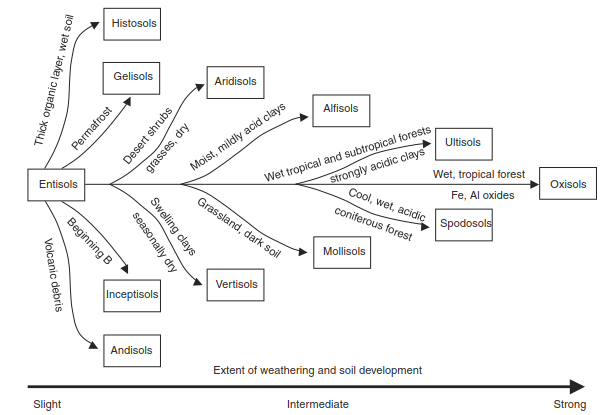
Fig. 21.12. Soil orders in relation to degree of weathering, climate, and vegetation. Adapted from Brady and Weil (1999, p. 82).
Characterization of Soil Orders
1. Entisols: Soils showing minimal pedogenic horizonation, typical of rocky outcrops, deserts, and recent alluvial deposits.
2. Inceptisols: Weakly developed soils exhibiting the inception of a B horizon, common on young landforms.
3. Andisols: Weakly to moderately weathered soils formed specifically on volcanic ejecta and ash deposits.
4. Gelisols: Cold-climate soils underlain by permafrost, often waterlogged with surface organic matter accumulation across Arctic tundra.
5. Histosols: Organic soils formed under wet, saturated conditions without permafrost, leading to peat formation in bogs and marshes.
6. Aridisols: Alkaline soils of arid environments featuring low organic content, minimal leaching, and soluble salt accumulations.
7.Vertisols: Clay-rich soils in warm, seasonally dry climates dominated by swill-shrink clays that crack during dry periods.
8. Mollisols: Dark, highly fertile prairie soils rich in organic matter and base cations, typical of grassland biomes.
9. Alfisols: Forest soils of humid temperate to sub-humid regions featuring a clay-enriched argillic B horizon and moderate base saturation.
10. Ultisols: Strongly weathered, acidic forest soils of warm to tropical climates with intense clay translocation.
11. Spodosols: Highly acidic, leached soils of cool, humid coniferous forests, marked by sub-surface accumulations of humus, iron, and aluminum.
12. Oxisols: Highly weathered, ancient soils of tropical rainforests dominated by kaolinite clay and residual iron and aluminum oxides.
Date added: 2026-09-24; views: 1;