
Ecological Succession Dynamics: Models, Mechanisms, and Traits
Theoretical Debates and Historical Perspectives in Ecological Succession. Much of the debate among ecologists regarding ecological succession has centered on whether it is a directional, predictable process of community change. This debate has its origins in the contrasting views of plant communities and ecosystems developed by ecologists in the early 1900s that saw either the community and ecosystem as the essential ecological unit of study or individuals and species as the essential units. The holistic school held that a community or ecosystem is an integrated entity equivalent to a superorganism. An alternative view was that plant communities and ecosystems are not superorganisms with emergent properties but rather are assemblages of individual plants and species. Attributes such as community structure and succession arise from the ecology of individuals and species interacting with one another. Much of the history of ecology has been an evaluation of these two theories (McIntosh 1981, 1985; Golley 1993).
In the holistic view, succession is orderly, predictable, and consists of discrete stages of development driven by vegetation itself (Clements 1916, 1928; Odum 1953, 1969, 1971). Succession culminates in a stable community composition, called the climax community, that is expected for a region. This view of succession is known as relay floristics or facilitation because groups of plants relay dominance to others by facilitating their entry into the community (Egler 1954; Connell and Slatyer 1977). Succession is characterized by the successive appearance and disappearance of groups of species (as shown in Figure 22.12a). Each group invades the site at a certain stage, making conditions unsuited for their own regeneration but paving the way for invasion by the next group of species. With the advent of ecosystem ecology, the superorganism concept was extended to see succession in terms of ecosystem functions independent of the underlying plant populations. The climax ecosystem represents an equilibrium balance of functions, and succession is the process by which equilibrium is achieved.
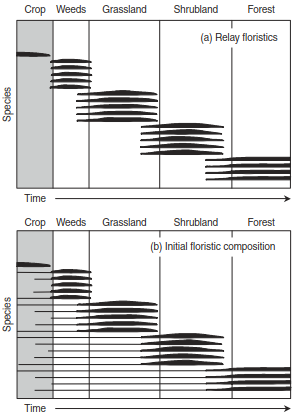
Fig. 22.12. Contrasting models of forest succession following farm abandonment illustrating (a) relay floristics and (b) initial floristic composition. Species importance at a given time increases with thicker lines. Adapted from Egler (1954).
In the individualistic alternative view, succession is seen as a population process that emphasizes individual plants and the response of species, through their various life history patterns, to environmental change (Cowles 1899; Gleason 1917, 1926, 1927, 1939). Succession occurs as a result of the differential growth, longevity, and colonizing ability of plants, expressed in the preemption of resources, canopy space, and root space. It is neither fixed nor predictable. Chance, especially the presence of seeds or sprouts to colonize a site, plays a large role in determining community composition. This view of succession is epitomized by Egler's initial floristic composition model of succession following farm abandonment (as shown in Figure 22.12b). Succession unfolds from the initial flora present in the seed bank at the time of abandonment. Seeds or vegetative parts of future dominant species are present at the time of abandonment. Progressive development relates to particular life histories. As each successive group dies out, another group of species, present from the start, assumes dominance.
Modern Synthesis of Successional Mechanisms and Population Processes. These two contrasting theories have grown into a broader conceptualization of succession. No one single theory sufficiently explains all the patterns of succession found in nature (Connell and Slatyer 1977). Clementsian concepts such as facilitation can be found in various successions. Others fit an overall pattern in which community dynamics are determined by inhibition of new species until early dominants die or by tolerance of low levels of resources in later stages of succession. However, the prevailing opinion emphasizes succession as a population process (Egler 1954; Drury and Nisbet 1973; Horn 1974; Pickett 1976; Connell and Slatyer 1977; Peet and Christensen 1980, 1987; West et al. 1981; Shugart 1984, 1998; Huston and Smith 1987; Bazzaz 1996). It is a result of the different life histories of species operating in a gradient of environmental change. Succession is a consequence of differential growth, survival, and colonizing ability of species adapted to different points in an environmental gradient. Individual species colonize where conditions are favorable, die out of the community when the environment is no longer favorable, and grow in company with other species with similar environmental requirements. Seed rain and the chance that seeds or sprouts encounter a suitable safe site play a large role in vegetation development.
The prevailing view of succession emphasizes the attributes of species — their physiology, morphology, and life history — as adaptations to different environmental conditions encountered during community development. Autogenic changes during succession in the availability of light, water, and nutrients create shifting patterns of dominance as a result of tradeoffs in the ability to effectively compete for above- and belowground resources. These tradeoffs result in a suite of traits that represent adaptation to a particular environment. Moreover, there is a tradeoff between tolerance to low resource conditions and maximum potential growth rate under high resource conditions. These tradeoffs and correlations among traits limit the ability of any one species to dominate all environmental conditions. There is an inevitable shift in the competitive ability of species over the course of succession due to these tradeoffs.
Physiological Differentiation and Shade Tolerance in Successional Dynamics. One trait that has received much attention is the different physiology of early and late successional plants (Bazzaz 1979, 1996; Huston and Smith 1987). This relates to shade tolerance. Shade tolerant trees photosynthesize at low light levels found in the understory of old-growth forests. Photosynthetic rates of shade intolerant species are not as high at low light. These species need full sunlight to have positive carbon gain. The physiological distinction between shade tolerant and intolerant species is part of a larger overall life history difference between early and late successional species.
Resource-Ratio Theory and Plant Strategy Classifications. One theory of community structure and dynamics, known as the resource-ratio theory of succession, is based on resource acquisition and tradeoffs in characteristics that allow plants to effectively compete for above- and belowground resources (Tilman 1985, 1988). Species with high allocation to production of leaves and stems are effective competitors for light, an aboveground resource. Species with high allocation to root production are good competitors for belowground resources such as nitrogen. Resource supply and acquisition determine which morphologies are viable in different environments. Root specialists are favored where aboveground resources are abundant but belowground resources are limiting. Shoot specialists are favored as light becomes more limiting. Succession is a result of autogenic changes in the availability of above- and belowground resources over time that favor different allocation patterns (as shown in Figure 22.13). During the initial stages of succession, light is readily available but nitrogen availability is low. Short, leafy species with high leaf allocation, low stem allocation, and moderate root allocation grow best. As the community develops, the canopy closes and light availability declines. Nitrogen supply increases with the introduction of nitrogen-fixing species, production of leaf litter, and accumulation of plant detritus. This environment favors tall species with greater allocation to stem and less to foliage and roots. The actual sequence of dominant morphologies differs depending on soil fertility, though all sites converge on a similar morphology because they are assumed to attain the same final nitrogen availability.
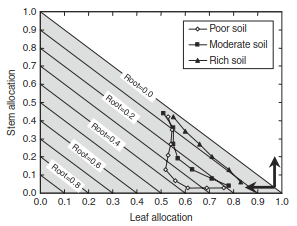
Fig. 22.13. The resource-ratio theory of succession. Allocation to leaves, stems, and roots is represented as a triangle. Each point within the triangle represents a unique plant morphology. Morphologies near the origin have a high proportion of their biomass in roots. Those near the upper left corner have a high proportion of stem while those in the lower right corner are primarily foliage. Successional changes in foliage, stem, and root allocation are illustrated for three levels of soil fertility. The two large arrows indicate the general trends in stem and foliage allocation. Adapted from Tilman (1988, p. 233).
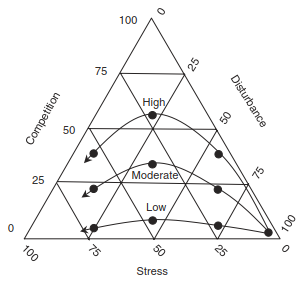
Fig. 22.14. Grime's plant strategies showing successional changes in ruderal, competitor, and stress tolerators under conditions of high, moderate, and low resource availability. Adapted from Grime (1979, p. 151).
An alternative view of succession is based on Grime's (1979) classification of species into life history patterns of competitor, ruderal, and stress tolerator (as shown in Figure 22.14). This classification arises from tradeoffs among a broad range of traits including reproductive effort, dispersal, ability to capture resources, and ability to tolerate stress. It invokes disturbance, stress, and competition as opposing forces selecting for particular traits. Succession is a result of the interplay between these different life history patterns and changing environmental conditions. Ruderal species, with their rapid ability to colonize disturbed sites, are favored in open sites with abundant resources (light, space). As vegetation develops and biomass accumulates, competition for resources increases and selects for competitive species. Depletion of resources in late stages of succession leads to replacement by stress tolerators. This view of succession is driven by autogenic decreases in resource availability as succession progresses. On less productive sites, earlier onset of resource depletion limits the appearance of highly competitive species. On unproductive sites, succession moves directly from ruderal to stress tolerator. Grace (1991) compares this model with the resource-ratio model.
Vital Attributes, Life History Tradeoffs, and Empirical Models. Another theory of succession emphasizes vital attributes (Noble and Slatyer 1980). The concept of vital attributes combines life history patterns, resource utilization, and response to disturbance. These vital attributes are:
· Method of arrival or persistence during and after disturbance.
· Ability to establish and grow to maturity in the developing community.
· Time required for an individual to reach critical life stages such as seed production.
These three attributes combine to produce numerous life histories. In general, life history patterns are related to a tradeoff between an ability to rapidly colonize and dominate a site versus slow growth and ability to compete in a resource limited environment. There is a fundamental physiological tradeoff between characteristics that allow either high photosynthesis and rapid growth under high light or the ability to grow and survive in shade. This dichotomy is seen in the broad classification of plants into categories such as:
· r-selected and K-selected species (MacArthur and Wilson 1967; Gadgil and Solbrig 1972).
· Shade intolerant and tolerant (Huston and Smith 1987).
· Early and late successional (Bazzaz 1979, 1996; Huston and Smith 1987).
· Ruderal and competitor (Grime 1979).
· Exploitive and conservative (Bormann and Likens 1979).
· Gap and non-gap (Shugart 1984, 1987, 1998).
Regardless of what they are called, species that dominate communities in the early stages of succession produce prolific crops of small, widely dispersed seeds, grow rapidly to maturity, but are short lived and unable to survive in the light-depleted understory of a dense canopy. These species have traits that take advantage of the temporary nature of disturbance. They maintain their abundance in the landscape through rapid colonization and dominance of disturbed sites enriched in light, water, and nutrients. In contrast, species that dominate during the late stages of succession have lower rates of dispersal and colonization, grow slowly, and are long lived. They maintain their presence by surviving in the intense competition for limited resources.
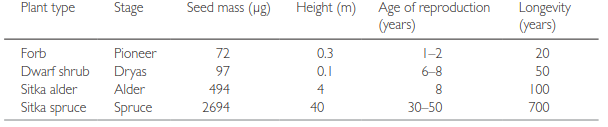
Table 22.2. Life history patterns of plants that dominate different successional stages at Glacier Bay, Alaska. Source: From Chapin et al. (1994).
Life history patterns such as seed size, maximum height, age of reproduction, and longevity explain succession at Glacier Bay (as shown in Table 22.2). For example, the order in which species colonize newly exposed glacial till correlates with seed size and dispersibility. Seeds of early successional species are lighter than those of later stages of succession. Early successional species also have a shorter lifespan and mature earlier than mid- and late successional species. These reproductive traits are critical to successional changes in community composition. Long-distance seed dispersal and short generations are necessary to establish and maintain plants in early successional communities far removed from seed sources. The low density of alder and spruce in pioneer communities reflects low seed rain rather than inability to germinate and establish on newly exposed sites. Alder and spruce are slower to arrive on recently deglaciated terrain than pioneer species because their heavier seeds and older age of reproduction limit seed sources.
Facilitation and inhibition among species can also be seen in the succession (Chapin et al. 1994). The change from Dryas to alder involves competitive displacement as the taller alder shrubs shade the shorter Dryas. Similarly, slow-growing, long-lived spruce trees overtop and displace alder. Hence, height and longevity, which increase throughout succession, are major factors determining community change. The progressive addition of organic matter and soil nitrogen facilitates rapid community development. Conversely, Dryas and alder inhibit the establishment of alder and spruce seedlings, respectively. Alder and spruce must disperse to the site before the prior colonizers modify the environment to inhibit seedling establishment. Inhibition of seedling establishment and growth by other species prevents late successional species from dominating more quickly.
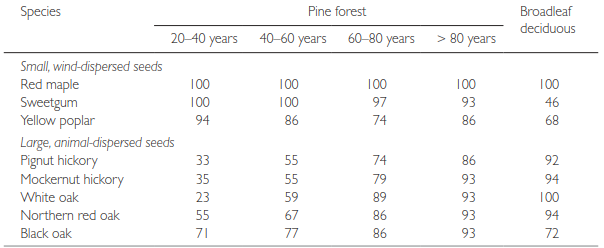
Table 22.3. Percentage of stands sampled within which a species occurs in relation to successional age. Source: From Christensen and Peet (1981).
Old-Field Succession Dynamics in the North Carolina Piedmont. In old-fields in the North Carolina Piedmont, sequential change in the dominance of herbaceous annuals and perennials to pine trees and then oaks and hickories relates to life history patterns such as time of seed dispersal and germination, environmental requirements for germination, and type of seed dispersal. Pine trees gain early dominance because their seeds are light and widely dispersed by wind and because their seedlings germinate and grow rapidly in the high light environment of old-fields. Variation among stands in the initial stocking of pine seedlings relates to the proximity of seed trees and the quality of seed. Pines lose dominance to broadleaf deciduous trees because they are relatively short-lived and because pine seedlings germinate and establish poorly in shade. Broadleaf deciduous trees are tolerant of shade and can survive and grow better in low light. Among broadleaf deciduous trees, seed size and dispersal accounts for much of the temporal variation in species abundance. Tree species with small, wind-dispersed seeds occur in stands of all ages, though with greatest frequency in young stands (as shown in Table 22.3). In contrast, oak and hickory, with large nuts, are relatively infrequent in young pine stands and increase in frequency throughout succession. Presence of these species in young stands reflects proximity to seed trees while their abundance in late stages of succession is ensured through the growth of large canopy dominants.
Pin cherry, which contributes greatly to the rapid recovery of northern hardwood forests following disturbance, is an example of an exploitive life history (Marks 1974). Its life history is suited for efficient colonization of large gaps in the canopy. The combination of buried seeds that are viable in the soil for 15 years or more and dispersal by birds ensures a large seed bank well after disappearance from a particular site. Once established, pin cherry grows rapidly. By age 25–30, when pin cherry trees rapidly die, sufficient seeds have been produced and disseminated to ensure renewal after the next major disturbance.
Date added: 2026-09-24; views: 2;