
Landscape Ecology Dynamics: Patches, Non-Equilibrium, and Gap
Ecological Landscape Organization and Patch Structure Dynamics. Landscapes represent another distinct level of ecological organization, effectively merging the concepts of populations, communities, and ecosystems. A landscape is a mosaic of communities and ecosystems formed by a gradient of environmental conditions. The overall pattern of vegetation across a landscape arises due to gradients in temperature, soil moisture, and other environmental factors. It also arises from disturbances such as fire, forest clearing, or farm abandonment that initiate secondary succession. Post-disturbance succession creates a mosaic of communities and ecosystems in various stages of development.
These communities and ecosystems occur as distinct patches across the broader landscape. Patches are homogenous units of land characterized by similar topography, soil, microclimate, and vegetation structure. Patches function as the individual structural elements of the landscape and are embedded within a matrix of other patches, which collectively forms the overarching pattern of the landscape. Wildfire and human uses of land are particularly important processes creating pattern in landscapes. Shifts or alterations in the disturbance regime fundamentally alter the structure and species composition of a landscape, thereby altering exchanges of energy, water, and chemical constituents with the atmosphere.
Non-Equilibrium Theory and Disturbance Regimes in Plant Communities. Many ecologists long viewed natural systems as being in balance and in equilibrium with the surrounding environment. The Clementsian view of plant succession held that succession is an orderly, predictable change that culminates in a stable, climax ecosystem representing an equilibrium balance of system functions. However, this equilibrium view of nature is fundamentally flawed. Natural events such as fires, floods, hurricanes, herbivores, insect outbreaks, and human activities regularly disturb plant communities, repeatedly initiating the successional cycle.
In this non-equilibrium view, the landscape is viewed as a mosaic of successional communities whose composition and structure are directly determined by the type and severity of disturbance. Disturbance and the resulting successional development of communities and ecosystems are the fundamental processes giving rise to the mosaic pattern of vegetation observed in the landscape (Watt 1947; Pickett 1976; Whittaker and Levin 1977; Bormann and Likens 1979; Shugart 1984). These disturbances can range widely in magnitude, being as small as a 100 m² gap in the canopy created by the death of a single large dominant tree or as large as hundreds of square kilometers following an extensive forest fire.
Disturbance functions by removing existing vegetation and creating a localized environment characterized by high sunlight and reduced competition for limited resources. These altered environmental conditions strongly favor the germination, establishment, and growth of early successional species. Early successional plants are maintained across the landscape by a fugitive life history paired with recurring disturbance events. Their population abundance is strictly limited by the availability of an open site to colonize and the availability of seed, which must be dispersed onto the site from other stands or be stored within the soil seed bank from prior colonization. In contrast, a long time interval between disturbances systematically promotes the abundance of late successional species.
Forest Gap Dynamics and Shifting Mosaic Steady-State Models. The smallest operational scale of disturbance is the death of a individual large tree, which creates small-scale cyclic dynamics within a community associated with gaps in the forest canopy (as shown in Fig. 23.1). Treefalls are common occurrences in forest ecosystems (Runkle 1981, 1982, 2000; Runkle and Yetter 1987). The death and uprooting of a tree creates a discrete gap in the canopy proportional to the size of the tree. If the opening is large enough for sufficient light to reach the ground floor and conditions are favorable, numerous seedlings quickly colonize the site.
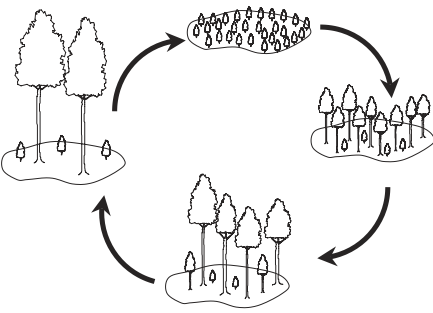
Fig. 23.1. Cyclic growth and thinning of trees in a forest patch during gap dynamics.
Many of these establishing seedlings die over time, while some successfully grow into saplings, which subsequently thin out over time into a mature stand of a few large trees. Eventually these mature trees die, initiating a new cycle of growth and community development. Consequently, the forest landscape exists as a mosaic of individual patches in different stages of developmental age (Watt 1947; Bray 1956; Bormann and Likens 1979; Shugart 1984). Within each individual patch, the sequential processes of establishment, self-thinning, and gap formation cyclically repeat. Although the developmental state of an individual patch changes from year to year, the overall proportion of patches in the landscape occupying various developmental stages remains relatively constant. The systemic result of this process is a shifting mosaic steady state. Gap dynamics have been observed in prairie, desert, and tundra communities, but are most evident in forest ecosystems.
Mathematical Modeling of Biomass Accumulation in Forest Patches. The concept of gap dynamics and the shifting mosaic steady state can be mathematically illustrated with a simple model of tree growth. The accumulation of biomass in a small patch on the order of 100 m² can be described by the differential equation:
· dM / dt = a - bM
where M is the total biomass at time t. Given an annual net primary production rate of a = 1000 g m⁻² yr⁻¹ and an annual loss of biomass due to mortality of b = 0.025 yr⁻¹, a maximum asymptotic biomass of 40 kg m⁻² accumulates within the patch. This biomass accumulation is achieved after approximately 200–250 years of growth. If individual trees lived indefinitely, biomass accumulation would saturate at 40 kg m⁻² and remain completely constant. However, the trees within a patch possess an annual probability of mortality. Assuming mortality occurs independently of age, the probability p that a tree will survive to age n is expressed by:
· p = (1 - c)ⁿ
where c represents the annual probability of mortality. For long-lived tree species such as oak or hickory, which have a maximum age of roughly 300 years, a mortality rate of c = 0.015 means that 1 percent of the trees survive to an age of 300 years. Thus, if mortality is independent among patches, trees in 1.5 percent of the total patches die each year, effectively resetting biomass accumulation to zero and restarting patch dynamics.
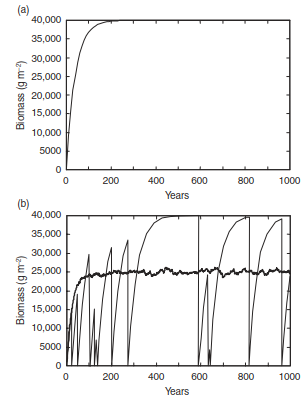
Fig. 23.2. Cyclic biomass accumulation and shifting mosaic steady state from gap dynamics. (a) Deterministic accumulation of biomass in a single patch in the absence of mortality. (b) Biomass accumulation with recurring mortality for a single patch (thin line) and averaged over a landscape of 500 patches (thick line).
In a modeled landscape comprising 500 individual patches, each patch undergoes cyclic dynamics driven by deterministic tree growth coupled with stochastic mortality (as shown in Fig. 23.2). However, when the biomass of the landscape is averaged across all patches, it equilibrates after a short period. At this equilibrium point, the landscape consists of a structural mosaic of patches, featuring some with high biomass and others with low biomass.
Post-Clear-Cutting Recovery and Structural Transition in Forest Stands. The concept of a shifting mosaic steady state is clearly demonstrated in empirical models of biomass accumulation following clear-cutting in the Hubbard Brook Experimental Forest (as shown in Fig. 22.8a). A large-scale disturbance such as a clear-cut imposes an even-aged structure on the regrowing forest stand. The developmental dynamics of most patches remain synchronized for approximately 100 to 150 years. These patches accumulate biomass in a few large trees as they undergo competitive self-thinning.
At the end of this aggradation phase, the majority of patches support a few even-aged trees of large size. A period of biomass decline follows this peak, occurring when the old canopy dominants begin to die and understory trees replace them. Tree death is not synchronized across the landscape, but varies randomly among individual patches. This transition and decline to a steady state represents a structural change from an even-aged to an all-aged forest. At steady state, the landscape becomes a mosaic of patches of all ages ranging from recent canopy gaps to mature trees.
Mechanisms of Tree Species Coexistence and Cyclic Microsuccession. Gap dynamics influence not only overall stand biomass but also community species composition, creating complex spatial patterns of species abundance across the landscape. One central theory of forest dynamics holds that treefall gaps promote the ecological coexistence of species exhibiting different resource-use patterns, dispersal mechanisms, and competitive abilities (Shugart 1984, 1987, 1998). For example, shade-intolerant species require a canopy gap for successful regeneration, but many are small-stature trees that do not achieve sufficient size to create a large opening in the canopy upon dying. Other species—generally shade-tolerant trees along with some shade-intolerant species—are longer lived, grow to large sizes, and create large canopy gaps upon death. Canopy gaps created by these larger trees maintain the persistence of small, gap-requiring species in the ecosystem.
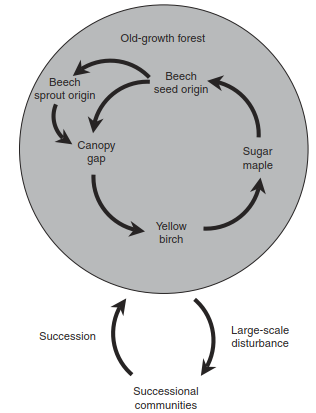
Fig. 23.3. Cyclic microsuccession among American beech, yellow birch, and sugar maple from gap dynamics in an old-growth northern hardwood forest. Adapted from Forcier (1975).
Cyclic microsuccession resulting from gap dynamics is clearly observed in old-growth northern hardwood forests (as shown in Fig. 23.3). Sugar maple, American beech, and yellow birch almost exclusively comprise the canopy of old-growth stands in the Hubbard Brook Experimental Forest. All three species have relatively long lifespans, but display distinct reproductive patterns that allow them to stably coexist:
· Yellow birch (Betula allegheniensis): Functions as an exploitive species that produces prolific crops of light, wind-dispersed seeds. It is the least tolerant of shade and possesses the lightest seeds among the three species. Yellow birch seeds disperse widely and germinate best in high light conditions on exposed mineral soil inside a gap. Canopy gaps created by the death and uprooting of isolated large trees maintain its presence in the landscape. Subsequent canopy closure precludes further yellow birch seedling establishment.
· Sugar maple (Acer saccharum): Highly tolerant of shade. Sugar maple saplings grow slowly beneath the yellow birch canopy, eventually entering the upper canopy upon the death of the yellow birch.
· American beech (Fagus grandifolia): Highly shade tolerant. The dense shade cast by sugar maple creates conditions that favor beech. Beech seeds are large, providing substantial nutrient reserves to successfully establish in the deep shade of the forest floor. Beech also reproduces via root sprouts, providing a competitive advantage.
The death of a large beech tree opens a canopy gap that restarts this microsuccessional cycle. This process of cyclic tree replacement ensures the perpetual co-occurrence of these three species with differing life histories in old-growth forest ecosystems.
Date added: 2026-09-24; views: 1;