
Succession and Dynamics in Boreal Forests of Interior Alaska
Topographic Controls on Boreal Forest Succession. In the boreal forests of interior Alaska, forest communities form a successional mosaic of broadleaf deciduous and needleleaf evergreen trees that reflects recovery from recurring floods and fires (Van Cleve and Viereck 1981; Van Cleve et al. 1983a,b, 1986, 1991; Bonan 1989, 1990, 1993; Bonan and Van Cleve 1992; Chapin et al. 2006). Topographic location has a large role in determining community composition and the pathways of succession (Figure 22.10). Floodplains along rivers are a successional mix of willow and alder shrubs and highly productive balsam poplar and white spruce forests. Quaking aspen, paper birch, and white spruce form productive stands on warm, well-drained, south-facing slopes. Black spruce forms open stands with low productivity on cold, wet soils underlain with permafrost.
Primary Succession Dynamics along River Floodplains. Along river floodplains, recurring floods initiate succession (Figure 22.10a). For the first one or two years, large floods deposit sediments and form terraces along river banks. As the terraces rise, flooding is less frequent and willow, alder, and balsam poplar invade the exposed sites. Shrubs increase rapidly in cover before being overtopped by trees about 20–30 years after establishment. With the formation of a closed balsam poplar canopy, the pioneer shrubs decline in abundance. Further buildup of the terrace from sediment deposits and litterfall prevents additional flooding. This allows for the invasion of white spruce seedlings. The shift in dominance from balsam poplar to white spruce is gradual and takes about 100 years. The buildup of moss and a thick layer of organic matter on the ground is a prominent feature of this change.
· 0–1 years: Bare surface - initial stage
· 1–2 years: Bare surface - salt crust
· 2–5 years: Open shrub
· 5–10 years: Closed shrub
· 20–40 years: Young balsam poplar
· 80–100 years: Mature balsam poplar - young white spruce - alder
· 125–175 years: Old balsam poplar - young white spruce
· 200–300 years: Mature white spruce
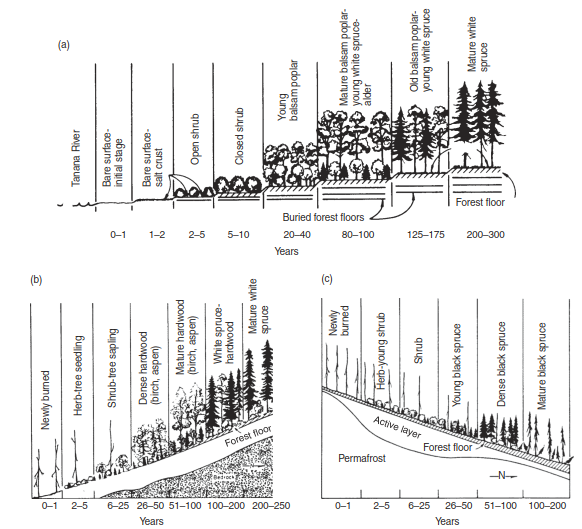
Fig. 22.10. Succession in relation to topographic location in the boreal forests of interior Alaska. (a) Primary succession along the Tanana River floodplain. (b) Post-fire secondary succession on upland south-facing slopes. (c) Post-fire secondary succession on upland north-facing slopes. Adapted from Van Cleve and Viereck (1981).
Post-Fire Secondary Succession on Upland South-Facing Slopes. On upland sites, recurring fires initiate succession (Figure 22.10b). Warm, dry sites are initially colonized by herbaceous plants, shrubs, and trees. Shrubs, primarily willow, and tree saplings dominate until about 25 years following fire, when the saplings grow into a dense stand of birch and aspen. These deciduous trees dominate for the next 50 years, though white spruce seedlings and saplings grow in the understory. After about 100 years, white spruce grows into the canopy and is the dominant tree. Similar to floodplain succession, invasion of mosses and the accumulation of a thick forest floor accompany the development of a white spruce stand.
· 0–1 years: Newly burned
· 2–5 years: Herb-tree seedling
· 6–25 years: Shrub-tree sapling
· 26–50 years: Dense hardwood (birch, aspen)
· 51–100 years: Mature hardwood (birch, aspen)
· 100–200 years: White spruce - hardwood
· 200–250 years: Mature white spruce
Post-Fire Secondary Succession on North-Facing Slopes and Ecosystem Controls. Post-fire succession on poorly drained upland sites and north slopes involves the recovery of black spruce (Figure 22.10c). During the first few years following fire, herbaceous plants and black spruce seedlings colonize the site. Many shrubs regrow from root sprouts. These shrubs grow rapidly and dominate the vegetation. A tree canopy begins to form 25–30 years after fire. Mosses invade at about this time, and a thick organic layer develops on the forest floor. This organic layer has a low thermal conductivity, insulating the soil and cooling soil temperatures. As a result, productivity declines and tree density decreases.
· 0–1 years: Newly burned
· 2–5 years: Herb-young shrub
· 6–25 years: Shrub
· 26–50 years: Young black spruce
· 51–100 years: Dense black spruce
· 100–200 years: Mature black spruce
The general trend in community composition during succession is from deciduous forest to spruce forest with declining tree productivity and less vigorous nutrient cycling (Figure 22.11). This shift in community composition is accompanied by accumulation of organic material on the forest floor. Soil temperatures decline, slowing the rate of decomposition and further promoting the accumulation of organic material. Soil moisture increases with buildup of the forest floor. This promotes the establishment of mosses. In addition, the chemical quality of the forest floor declines with the shift from deciduous trees to spruce, further reducing decomposition rates. Nutrients accumulate in the undecomposed material on the forest floor. Tree growth declines.
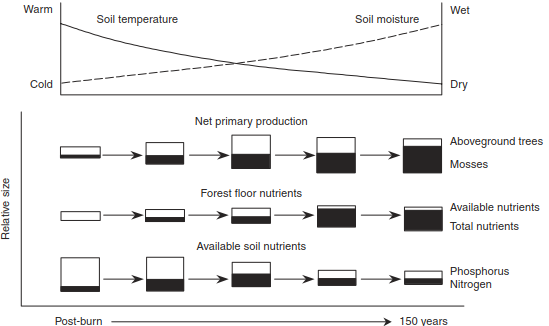
Fig. 22.11. Changes in soil moisture, soil temperature, net primary production, and nutrient cycling in a black spruce forest over 150 years following fire. Adapted from Van Cleve et al. (1983a).
Fires reset the system to earlier stages of succession. Forests older than 200–250 years are rare in the uplands around Fairbanks. Fires act as a rapid decomposer, consuming all or portions of the forest floor and replenishing the supply of nutrients. This is especially important in black spruce succession (Figure 22.11). Fires open the canopy and remove the forest floor. As a result, the soil warms. Over time, however, as mosses invade and the thick organic layer accumulates, soil temperature declines. Nutrient availability declines as mineralization rates decrease. Tree growth also declines, and in some old black spruce stands the net primary production of mosses exceeds that of trees.
Date added: 2026-09-24; views: 2;