
Ocean Salinity: Composition, Distribution, and Biogeochemical Cycles
Ocean Salinities. In the major ocean basins, 3.5% of the weight of seawater is, on the average, dissolved salt and 96.5% is water, so a typical 1000 g or 1 kg sample of seawater is made up of 965 g of water and 35 g of salt. Oceanographers measure the salt content of ocean water in grams of salt per kilogram of seawater (g/kg), or parts per thousand (‰) or in practical salinity units (PSUs). For most purposes ‰ and PSU are numerically equal.
The total quantity of dissolved salt in seawater is known as salinity, and the average ocean salinity is approximately 35‰. The salinity of ocean surface water is associated with latitude. Latitudinal variations in evaporation and precipitation, as well as freezing, thawing, and freshwater runoff from the land, affect the amount of salt in seawater.
The relationship between evaporation, precipitation, and mid-ocean surface salinity with latitude is shown in figure 5.1. Notice the low surface salinities in the cool and rainy 40°–50°N and S latitude belts, high evaporation rates and high surface salinities in the desert belts of the world centered on 25°N and S, and low surface salinities again in the warm but rainy tropics centered at 5°N. Sea-surface salinities during the Northern Hemisphere summer are shown in figure 5.2.
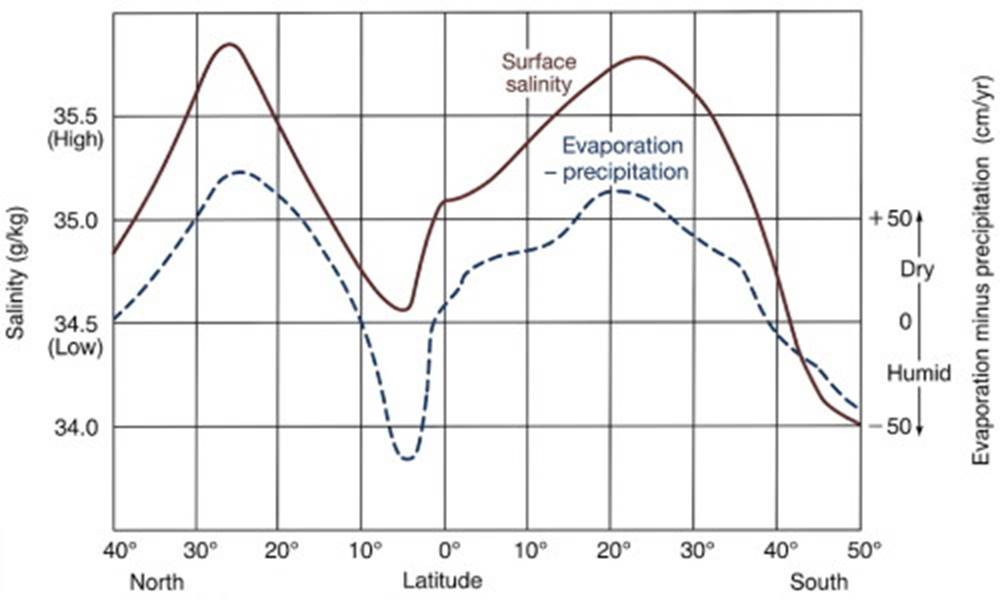
Fig. 5.1. Mid-ocean average surface salinity values match the average changes in evaporation minus precipitation values that occur with latitude. Source: From A. N. Strahler, Physical Geography, 1960, John Wiley & Sons, Inc., New York, N.Y.
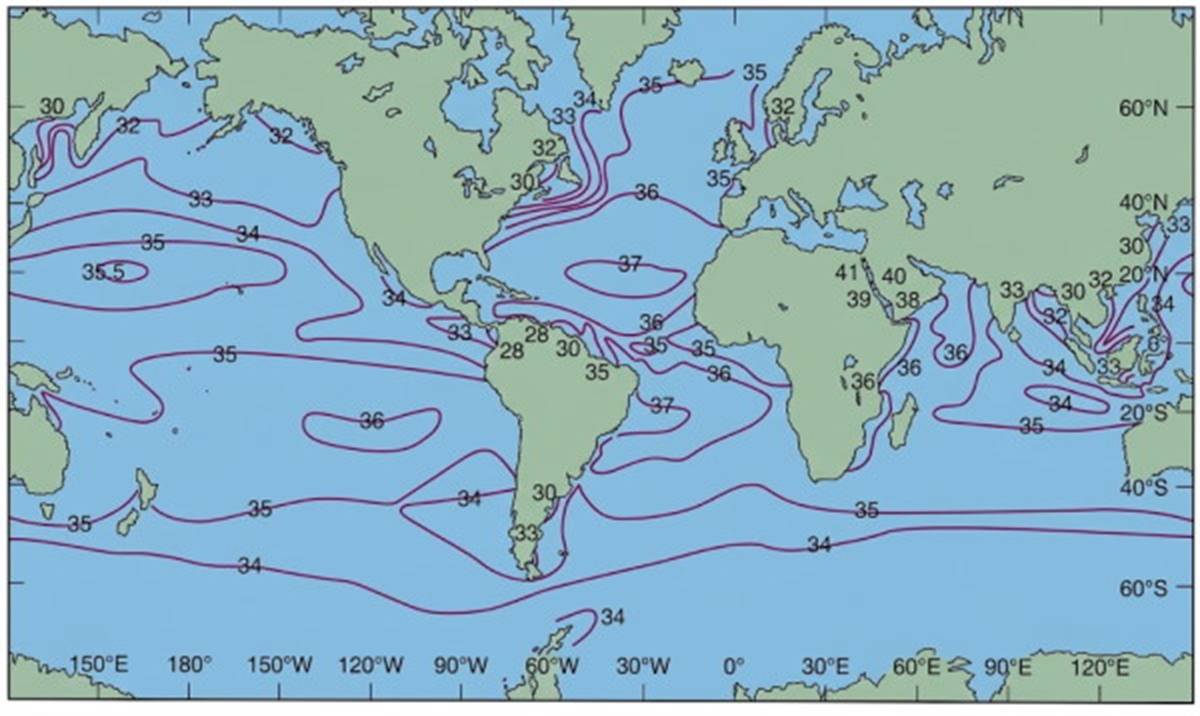
Fig. 5.2. Average sea-surface salinities in the Northern Hemisphere summer, given in parts per thousand (‰). High salinities are found in areas of high evaporation; low salinities are common in coastal areas and regions of high precipitation.
In coastal areas of high precipitation and river inflow, surface salinities fall below the average. For example, during periods of high flow, the water of the Columbia River lowers the Pacific Ocean’s surface salinity to less than 25‰ as far as 35 km (20 mi) at sea. Also, sailors have dipped up water fresh enough to drink from the ocean surface 50 miles from the mouth of the Amazon River.
In subtropical regions of high evaporation and low fresh-water input, the surface salinities of nearly landlocked seas are well above the average: 40 to 42‰ in the Red Sea and the Persian Gulf and 38 to 39‰ in the Mediterranean Sea. In the open ocean at these same latitudes the surface salinity is closer to 36.5‰. Surface salinities change seasonally in polar areas, where the surface water forms sea ice in winter, leaving behind the salt and raising the salinity of the water under the ice.
In summer a freshwater surface layer forms when the sea ice melts. Deep water samples from the mid-latitudes are usually slightly less salty than the surface waters because the deep water is formed at the surface in high latitudes with high precipitation. The formation of these deep-water types is discussed in chapter 6.
Dissolved Salts. When salts are added to water, the salts dissolve. The salt crystals dissociate (or break apart) into ions, which are positively or negatively charged atoms or groups of atoms. An ion with a positive charge is a cation; an ion with a negative charge is an anion. The salts in seawater are mostly present in their ionic forms as anions and cations.
For example, table salt (or sodium chloride) is the most common salt in seawater. When sodium chloride is added to water, the bonds between the atoms break and positively charged sodium ions and negatively charged chloride ions are formed. This reaction can be written as:
- sodium chloride → sodium ion + chloride ion,
or it can be written with chemical abbreviations as:
- NaCl → Na⁺ + Cl⁻.
Refer to chapter 4 for a discussion of the dissolving properties of salts in water. Six ions make up more than 99% of the salts dissolved in seawater. Four of these ions are cations: sodium (Na⁺), magnesium (Mg²⁺), calcium (Ca²⁺), and potassium (K⁺); two are anions: chloride (Cl⁻) and sulfate (SO₄²⁻).
Table 5.1 lists these six ions and five more; they are arranged in order of the amount present in seawater. The ions listed in table 5.1 are known as the major constituents of seawater. Note that sodium and chloride ions account for 86% of the salt ions present in seawater.
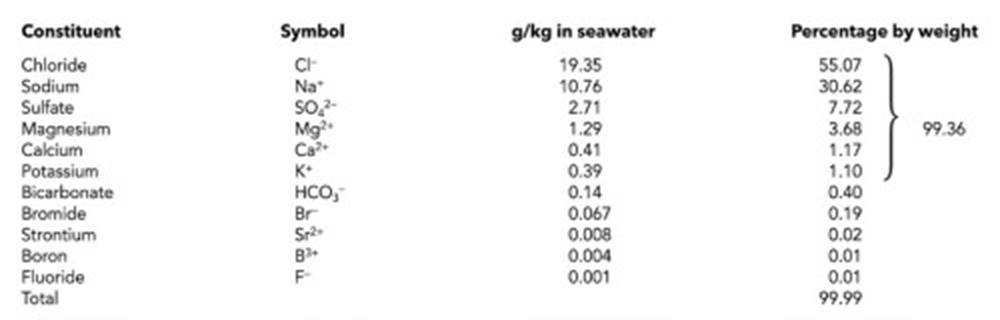
Table 5.1. Major Constituents of Seawater¹ (Source: From J. P. Riley and G. Skirrow, eds., Chemical Oceanography, Vol. 1, 2nd edition. Copyright 1975 Academic Press, Orlando, Florida. Reprinted by permission.) ¹Nutrients and dissolved gases are not included.
Trace Elements and Conservative Constituents. All the other elements dissolved in seawater are present in concentrations of less than one part per million and are called trace elements (table 5.2). Some of these elements are important to organisms that are able to concentrate the ions. For example, long before the presence of iodine could be determined chemically as a trace element of seawater, it was known that shellfish and seaweeds were rich sources for this element, and seaweed was harvested for commercial iodine extraction.
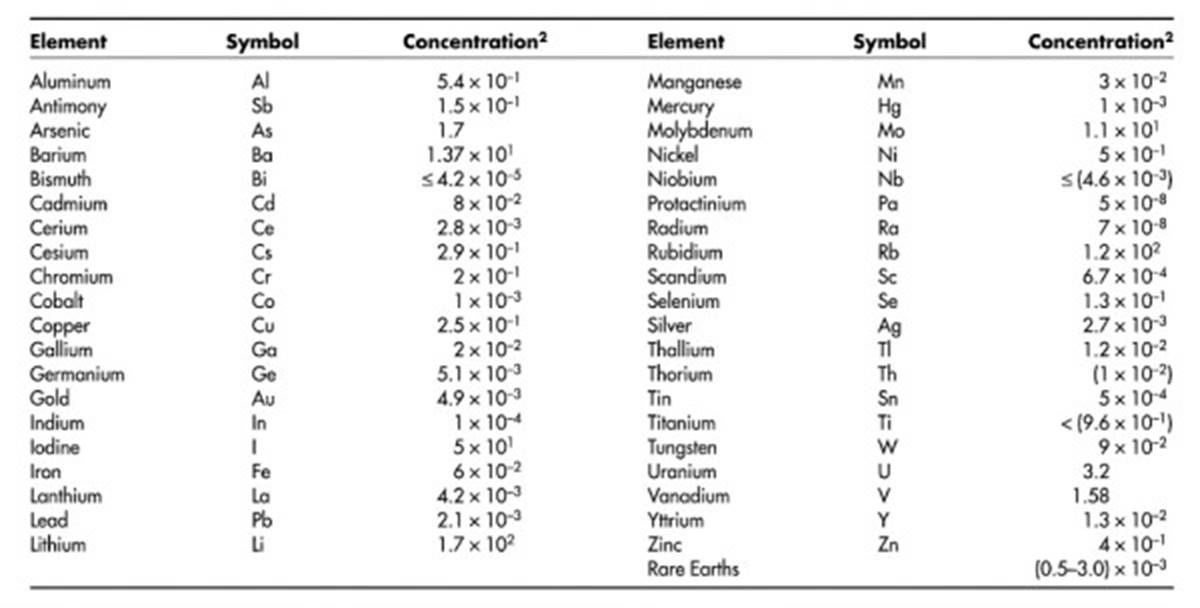
Table 5.2. Concentrations of Trace Elements in Seawater¹ (Source: From J. P. Riley and R. Chester, Chemical Oceanography, Vol. 8. Copyright 1983 Academic Press, Orlando, Florida. Reprinted by permission.)
¹Nutrients and dissolved gases are not included.
²Parts per billion, or μg/kg.
Parentheses indicate uncertainty about concentration.
Because the major constituents of seawater do not change their ratios to each other with changes in total salt content, and because these constituents are not generally removed or added by living organisms, the major constituents are termed conservative constituents. Certain of the ions present in much smaller quantities, some dissolved gases, and assorted organic molecules and complexes do change their concentrations with biological and chemical processes that occur in some areas of the oceans; these are known as nonconservative constituents.
Sources of Salt. The original sources of the seas’ salts include the crust and the interior of the Earth. The chemical composition of the Earth’s rocky crust can account for most of the positively charged ions found in seawater. Large quantities of cations are present in rocks that are formed by the crystallization of molten magma from volcanic processes.
The physical and chemical weathering of rock over time breaks it into small pieces and the rain dissolves out ions, which are carried to the sea by rivers. Anions are present in the Earth’s interior and may have been present in the Earth’s early atmosphere. Some anions may have been washed from the atmosphere by long periods of rainfall, but the more likely source of most of the anions is thought to have been the Earth’s mantle. During the formation of the Earth, gases from the mantle are believed to have supplied anions to the newly forming oceans.
Gases released during volcanic eruptions (for example, hydrogen sulfide, sulfur dioxide, and chlorine) dissolve in rainwater or river water and are carried to the oceans as Cl⁻ (chloride) and SO₄²⁻ (sulfate). Water carrying chloride ions and sulfur-containing ions is acidic and erodes and dissolves the rock over which it flows, helping to liberate the cations.
Tests show that the most abundant ions in today’s rivers (table 5.3) are the least abundant ions in ocean water, because the rivers have previously removed the most easily dissolved land salts and are now carrying the less-soluble salts. Exceptions to this pattern are found in rivers used for irrigation.
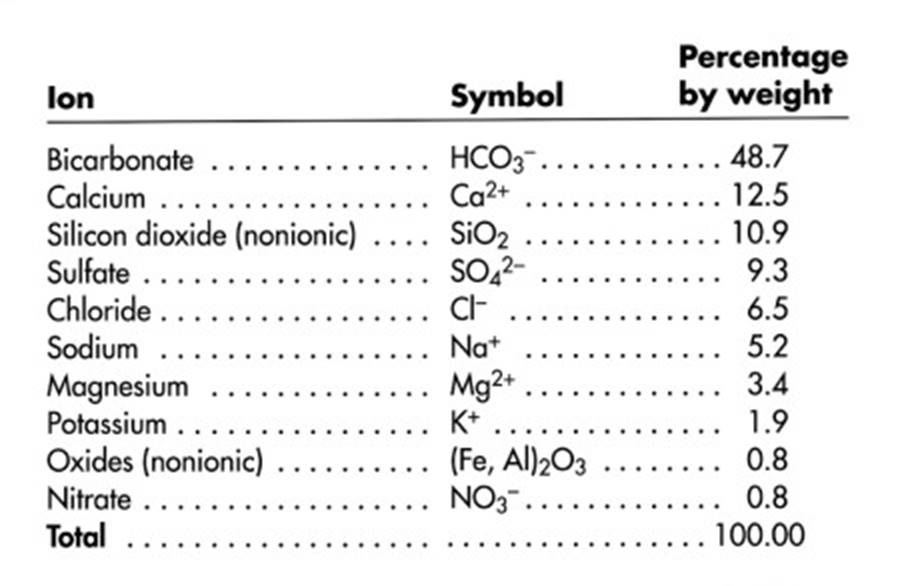
Table 5.3. Dissolved Salts in River Water (Data from U.S. Geological Survey. Average river salt concentration is 0.120‰.)
These rivers are flowing through arid soils that have not lost much of their salt content. The river water is frequently used several times and passes through a number of irrigation projects on its way downriver, causing the water to become increasingly salty and unfit for irrigation purposes downstream. This situation has produced years of continuous conflict between the United States and Mexico over the waters of the Colorado and Rio Grande rivers, which irrigate much of the agricultural land of the U.S. desert southwest before becoming available to the farmlands of Mexico.
In addition, we know that hot water vents located on the sea floor supply chemicals to the ocean water and also remove them. Hydrothermal activity found at the mid-ocean ridges and associated with hot spots and ridge formation may play an important role in stabilizing the ocean’s salt composition. When hot magma is introduced into the cold crust, it cracks and becomes permeable. Pressure from the water above the sea floor is high (1 atmosphere for every 10 meters of water depth), and it forces water into cracks and voids, where it is heated under pressure to extremely high temperatures. The salinity of seawater entering the hydrothermal system is relatively constant worldwide, but the water emerging from hydrothermal vents has a salinity that may be more than double its original value. The process controlling this salinity change and its role in the ocean’s total salt balance are unclear at this time.
Regulating the Salt Balance. We know from the age of older marine sedimentary rocks that the oceans have been present on the Earth for about 3.5 billion years. Chemical and geological evidence from rocks and salt deposits leads researchers to believe that the salt composition of the oceans has been the same for about the last 1.5 billion years. The total amount of dissolved material in the world’s oceans is calculated to be 5 × 10²² g for ocean water of 36‰ salinity. Each year the runoff from the land adds another 2.5 × 10¹⁵ g, or 0.00005% of total ocean salt. If we assume that the rivers have been flowing to the sea at the same rate over the last 3.5 billion years, more dissolved material has been added by this process than is presently found in the sea.
In order for the oceans to remain at the same salinity, the rate of addition of salt by rivers must be balanced by the removal of salt; input must balance output. Salt ions are removed from seawater in a number of ways; some are shown in figure 5.3. Sea spray from the waves is blown ashore, depositing a film of salt on land. This salt is later returned to the oceans by runoff from the land.
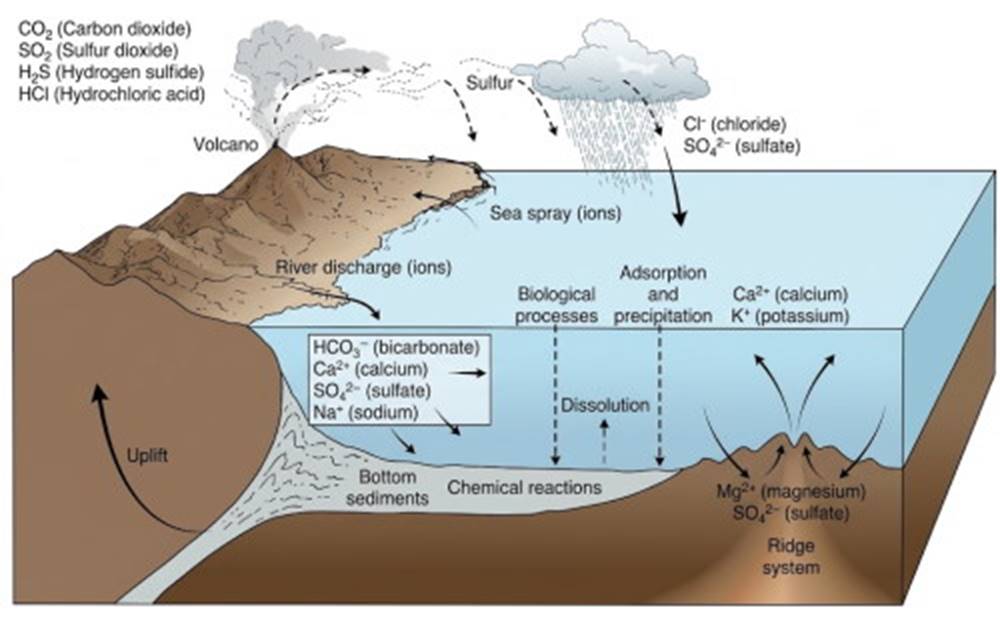
Fig. 5.3. Processes that distribute and regulate the major constituents in seawater. Salt ions are added to seawater from rivers, volcanic events, ridge systems, and decay processes. Salt ions are removed from seawater by adsorption and ion exchange, spray, chemical precipitation, biological uptake, and release at ridge systems.
Over geologic time, shallow arms of the sea have become isolated, the water has evaporated, and the salts have been left behind to become land deposits called evaporites. Salt ions can also react with each other to form insoluble products that precipitate on the ocean floor. Biological processes concentrate salts, which are removed from the water if the organisms are harvested or if the organisms become part of the sediments. Organisms’ excretion products trap ions, which are transferred to the sediments or returned to the seawater. Other biological processes remove Ca²⁺ (calcium) by incorporating it into shells, and silica is used to form the hard exterior coverings of certain planktonic organisms and animals. These hard parts are accumulated in the sediments when the organisms die. Chapter 3 discussed the sediments produced by biological processes.
Adsorption and Ion Exchange. A chemical process known as adsorption, the adherence of ions and molecules onto a particle’s surface, removes other ions and molecules from seawater. In this process, tiny clay mineral particles, weathered from rock and brought to the oceans by winds and rivers, bind ions such as K⁺ (potassium) and trace metals to their surfaces. The ions sink with the clay particles and are eventually incorporated into the sediments.
Strongly adsorbable ions replace weakly adsorbable ions in a process known as ion exchange. If the clay minerals and sediments adsorb and exchange with one ion more easily than with another, there will be a lower concentration of the more easily adsorbed ion in the seawater. For example, potassium is more easily adsorbed than sodium, so K⁺ is less concentrated than Na⁺ in seawater. Nickel, cobalt, zinc, and copper are adsorbed on nodules that form on the ocean floor. The fecal pellets and skeletal remains of small organisms also act as adsorption surfaces. In all of these cases the ions are removed from the water and are transferred to the sediments.
Hydrothermal Circulation. The process of forming the new Earth’s crust at the ridge system of the deep-ocean floor (chapter 2) participates in the input and output of the ions in seawater. Where molten rock rises from the mantle into the crust, magma chambers are formed. These chambers are found mainly along plate boundaries but have also been identified under volcanic hot spots in the middle of plates. Cold water seeps down several kilometers through the fractured crust at a spreading center. The seawater becomes heated by flowing near the magma chamber.
By convection, the heated water rises up through the crust and reacts chemically with the rocks of the crust. Magnesium ions (Mg²⁺) are transferred from the water to form mineral deposits in the crust. At the same time, hydrogen ions (H⁺) are released and the seawater solution becomes more acidic. Chemical reactions change sulfate (SO₄²⁻) to sulfur and then to hydrogen sulfide (H₂S). The acidic water releases and dissolves metals from the crust including copper, iron, manganese, zinc, potassium, and calcium. It has been estimated that a volume of water equivalent to the entire mass of the oceans circulates through the crust at oceanic ridges every 10 million years.
The most important process for the removal of most elements from seawater is still the adsorption of ions onto fine particles and their removal to the sediments. Ions deposited in the sediments are trapped there. They are not returned to or redissolved in the seawater; but geological uplift processes elevate some sediments from the sea floor to positions above sea level. Erosion works to dissolve and wash these deposits back to the sea.
Residence Time. The relative abundance of the salts in the sea is due in part to the ease with which they are introduced from the Earth’s crust and in part to the rate at which they are removed from the seawater. Sodium is moderately abundant in fresh water, but, because it reacts slowly with other substances in seawater, it remains dissolved in the ocean. Calcium is removed rapidly from seawater to form limestone and the shells of marine organisms, but it is also replaced rapidly by calcium ions moving down rivers and cycling in and out of the ridge systems on the sea floor (fig. 5.3).
The average, or mean, time that a substance remains in solution in the ocean is called its residence time (table 5.4). Aluminum, iron, and chromium ions have short residence times, in the hundreds of years. They react with other substances quickly and form insoluble mineral solids in the sediments. Sodium, potassium, and magnesium are very soluble and have long residence times, in the millions of years. If the concentration of an ion in seawater is constant, the rates of supply and removal are equal. If the total amount of an ion present in the ocean is divided by either its rate of supply or its rate of removal, the residence time for that ion is known.
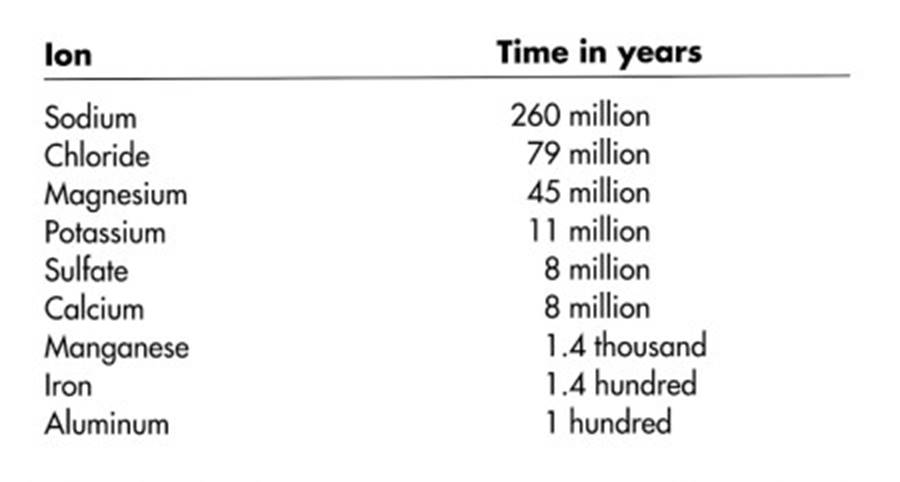
Table 5.4. Approximate Residence Times of Ions in the Oceans (After E. P. Goldberg in Chemical Oceanography, Vol. 1, J. P. Riley and G. Skirrow, eds. Academic Press, London, 1965.)
Constant Proportions. Seawater is a well-mixed solution; currents and eddies in both surface and deep water, vertical mixing processes, and wave and tidal action have all helped to stir the oceans through geologic time. Because of this thorough mixing, the ionic composition of open-ocean seawater is the same from place to place and from depth to depth. That is, the ratio of one major ion or seawater constituent to another remains the same. Whether the salinity is 40‰ or 28‰, the major ions exist in the same proportions. This concept was first suggested by the chemist Alexander Marcet in 1819.
In 1865 another chemist, Georg Forchhammer, analyzed several hundred seawater samples and found that these constant proportions did hold true. During the world cruise of the Challenger Expedition (1872–76), seventy-seven water samples were collected from different depths and locations in the world’s oceans. When chemist William Dittmar analyzed these samples, he verified Forchhammer’s findings and Marcet’s suggestion.
These analyses led to the principle of constant proportion (or constant composition) of seawater, which states that regardless of variations in salinity, the ratios between the amounts of major ions in open-ocean water are constant. Note that the principle applies to major conservative ions in the open ocean; it does not apply along the shores, where rivers may bring in large quantities of dissolved substances or may reduce the salinity to very low values. The ratios of abundance of minor nonconservative constituents vary, because some of these ions are closely related to the life cycles of living organisms. Populations of organisms remove ions during periods of growth and reproduction, reducing the amounts of these ions in solution. Later, the population declines, and decay processes return these ions to the seawater.
Determining Salinity. Seawater transmits, or conducts, electricity because it contains dissolved salts; the more ions there are in solution, the greater the conductance. Therefore, the salt content, or salinity, can be determined by using an instrument, called a salinometer, that measures electrical conductivity. Salinity readings in parts per thousand (S‰) are made quickly and directly on the water sample with an electrical probe (fig. 5.4). Because conductivity of seawater is affected by both salinity and temperature, a conductivity instrument must correct for the temperature of the sample if the instrument reads directly in salinity units. This correction is not necessary if the instrument reads conductance only. If conductance and temperature are measured separately, a computer program calculates the salinity. Other direct measurement techniques are discussed in chapter 6.
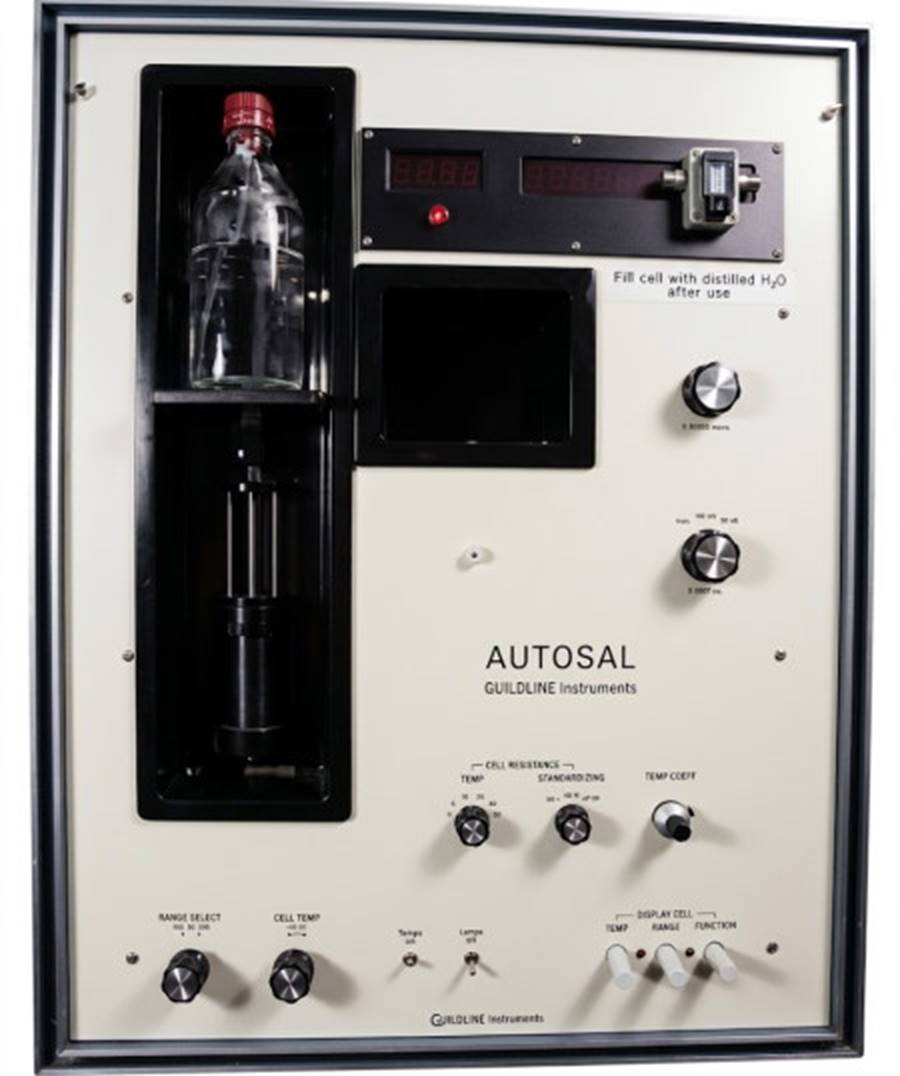
Fig. 5.4. The salinometer determines salinity by measuring the electrical conductivity of a seawater sample.
To be sure that all salinity determinations are equalized in the same way, the world’s oceanographic laboratories use a standard method of analysis and a standard seawater reference. At present, the Institute of Oceanographic Services in Wormly, England, is responsible for the production of standard seawater adjusted to both constant chloride content and electrical conductance to ensure standard calibration of laboratory instruments.
Historically, the quantity of chloride ions present in a water sample was measured to establish the salinity of the sample. To do so, standardized silver nitrate was added because the silver combines with the sample’s chloride ions. If the amount of silver required to react with all the chloride ions in a sample is known, the amount of chloride is known. The chloride concentration measured in this way is termed chlorinity (Cl‰) and is measured in parts per thousand or grams of chloride per kilogram of seawater. When the chlorinity of a sample is known, the concentration of any other major constituent can be calculated by using the principle of constant proportion. Chlorinity and salinity are related by the equation:
- salinity (‰) = 1.80655 × chlorinity (‰),
or
- S‰ = 1.80655 × Cl‰.
The practical salinity scale is defined as a conductivity ratio between a seawater sample and a standard potassium chloride solution; PSU follows the ratio number and no unit or ‰ sign is needed.
Date added: 2026-11-09; views: 2;