
Ocean Gases: Distribution, Carbonate Buffering, and Global Cycles
Gas Exchange and Atmospheric Interactions. Gases move between the sea and the atmosphere at the sea surface. Atmospheric gases dissolve in the seawater and are distributed to all depths by mixing processes and currents. The most abundant gases in the atmosphere and in the oceans are nitrogen (N₂), oxygen (O₂), and carbon dioxide (CO₂). The percentages of each of these gases in the atmosphere and in seawater are given in table 5.5. Oxygen and carbon dioxide play important roles in the ocean because they are necessary to life, and biological activities modify their concentrations at various depths. Nitrogen is not used directly by living organisms except for certain bacteria. Gases such as argon, helium, and neon are present in small amounts, but they are inert and do not interact with the ocean water, nor are they used by its inhabitants.
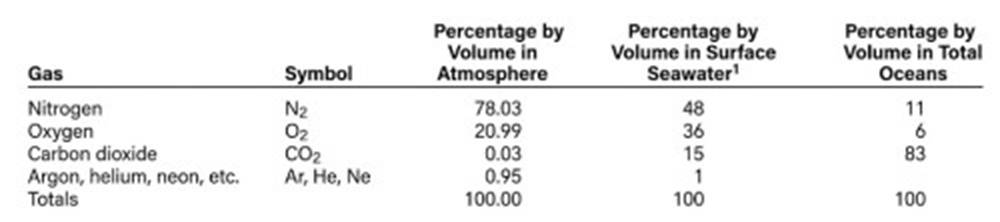
Table 5.5. Abundance of Gases in Air and Seawater. Salinity = 36‰, temperature = 20° C.
The amount of any gas that can be held in solution without causing the solution either to gain or to lose gas is the saturation value. The saturation value changes because it depends on the temperature, salinity, and pressure of the water. If the temperature or salinity decreases, the saturation value for the gas increases. If the pressure decreases, the saturation value decreases. In other words, colder water holds more dissolved gas than warmer water, less-salty water holds more gas than more-salty water, and water under more pressure holds more gas than water under less pressure.
Distribution with Depth. In the process known as photosynthesis, plants and plantlike organisms produce oxygen and use carbon dioxide to form organic molecules. Because plants require sunlight for photosynthesis, they are confined to the sea surface, on average the top 100 m (330 ft) of the water column, where sufficient light is available to energize the photosynthesis process. Therefore, oxygen is produced in surface water and carbon dioxide is consumed there. By contrast, respiration, which breaks down organic substances to provide energy, requires oxygen and produces carbon dioxide. All living organisms respire in order to produce energy in living cells, and therefore respiration occurs at all depths of the ocean. Photosynthesis and respiration are discussed in more detail in chapter 14.
Decomposition, the bacterial breakdown of nonliving organic material, also requires oxygen and releases carbon dioxide. Decomposition becomes the more important factor in the removal of oxygen from seawater at greater depths because usually the densities of living populations diminish with depth. The depth at which the rate of photosynthesis balances the rate of respiration by plants and plantlike organisms is called the compensation depth. Above the compensation depth, plants and plantlike organisms produce oxygen at the expense of carbon dioxide; below it, carbon dioxide is produced at the expense of oxygen. Oxygen can be added to the oceans only at the surface, from exchange with the atmosphere or as a waste product of photosynthesis. Carbon dioxide also enters from the atmosphere at the surface, but it is available at all depths from respiration and decomposition.
Dissolved oxygen concentrations vary from 0 to 10 milliliters per liter of seawater. Very low or zero concentrations occur in the bottom waters of isolated deep basins, which have little or no exchange or replacement of water. Such an area can occur at the bottom of a trench, in a deep basin behind a shallow entrance sill (as in the Black Sea), or at the bottom of a deep fjord (300 to 400 m; 900–1300 ft). If the deep water is stagnant, respiration and decomposition use up the oxygen faster than the slow circulation to this depth is able to replace it. The bottom water becomes anoxic, or stripped of dissolved oxygen; anaerobic (or non-oxygen-using) bacteria live in such water. This condition is shown in figure 5.5.
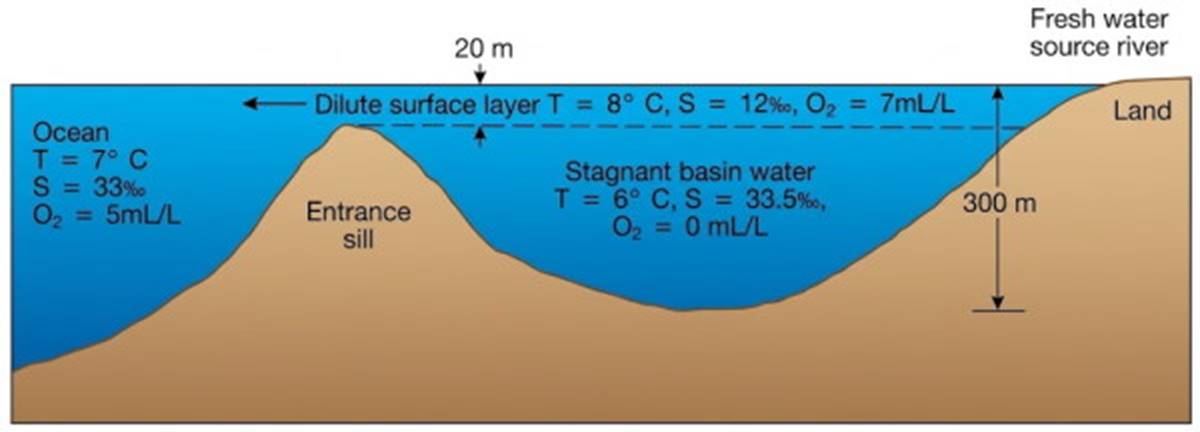
Fig. 5.5. High-density ocean water is trapped behind the sill. The trapped water becomes anoxic at depth owing to continual respiration and decomposition. At the surface, sunlight enhances photosynthesis and the production of oxygen.
Because oxygen is more soluble in cold water than in warm water, more oxygen is found in surface waters at high latitudes than at lower latitudes. If the water is quiet, the nutrients and sunlight are abundant, and a large population of plants is present, oxygen values at the surface can rise above the equilibrium (or saturation) value to 150% or more. This water is supersaturated. Wave action will tend to liberate oxygen to the atmosphere and return the water to its 100% saturation state.
Carbon dioxide levels range between 45 and 54 milliliters per liter of seawater throughout the oceans. The average concentration is not substantially affected by biological processes but tends to remain almost constant, controlled by temperature, salinity, and pressure. Figure 5.6 shows typical oxygen and carbon dioxide concentrations with depth. At the surface, the concentration of oxygen is high because of the available atmospheric oxygen and photosynthesis. Below the surface layer, oxygen decreases as animal respiration and the decomposition of organic material remove the oxygen; the oxygen minimum occurs at about 800 m (2600 ft). Below this depth, the rate of removal of oxygen decreases because the population density of animals and the abundance of decaying organic matter have decreased. The slow supply of oxygen to greater depths by water sinking from the surface gradually increases the oxygen concentration above that found at the oxygen minimum. The carbon dioxide graph in figure 5.6 shows almost the direct opposite effect. The CO₂ concentration at the surface is low, because it is used in photosynthesis. Below the surface layer the concentration increases with depth as animal respiration and decomposition continually produce CO₂ and add it to the water.
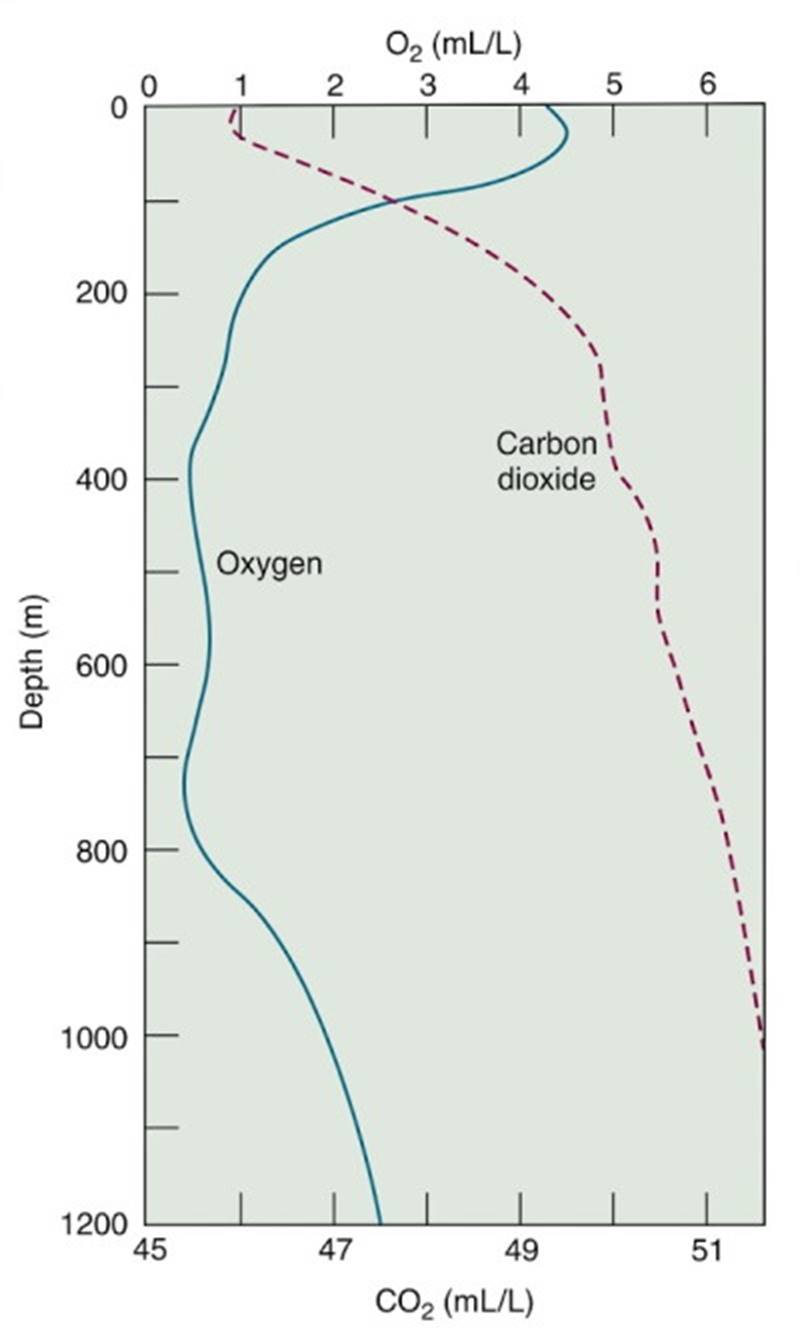
Fig. 5.6. The distribution of O₂ and CO₂ with depth. Changes in O₂ concentration may exceed 400% from the surface to depth, whereas CO₂ concentrations change by less than 15%.
Carbon Dioxide As a Buffer. When carbon dioxide dissolves in seawater, the CO₂ combines with the water to form carbonic acid (H₂CO₃). The carbonic acid dissociates to form bicarbonate (HCO₃⁻) and a hydrogen ion (H⁺) or carbonate (CO₃²⁻) and two hydrogen ions (2H⁺). The CO₂, H₂CO₃, HCO₃⁻, and CO₃²⁻ exist in equilibrium with each other and with the H⁺ ions, as shown in the following equation. The double arrows indicate that the reactions can move in either direction, either producing or removing hydrogen ions: CO₂ + H₂O ⇌ H₂CO₃ ⇌ HCO₃⁻ + H⁺ or CO₃²⁻ + 2H⁺.
This series of reactions allows CO₂ to play an additional and extremely important role in the ocean: it acts as a buffer. A buffer prevents sudden changes in the acidity or alkalinity of a solution. If some process causes the ocean’s pH to rise or fall below its average or mean, the buffering action of seawater returns the pH to the mean. This buffering capacity of seawater is important to organisms requiring a steady pH for their life processes and to the chemistry of seawater, which is controlled, in part, by pH. The pH scale indicates acidity and alkalinity by measuring the concentration of hydrogen ions in a solution. A pH of 7 indicates neutrality, neither acid nor alkaline. The pH values between 1 and 6 are acid, and the pH values between 8 and 14 are alkaline, or basic.
The pH range of seawater is between 7.5 and 8.5; an average pH value for the world’s oceans overall depths is approximately 7.8. The pH at the ocean surface may be as high as 8.5 if the water is warm and if large quantities of plant life are extracting CO₂ by photosynthesis. The pH scale is presented in figure 5.7. The concentration of hydrogen ions (H⁺) in the seawater controls the acidity or alkalinity. An increase in hydrogen ions shifts the reaction series to the left, removing hydrogen ions from solution. If the concentration of hydrogen ions decreases, the reaction moves from carbonic acid (H₂CO₃) to bicarbonate (HCO₃⁻), liberating hydrogen ions. Therefore, the removal of CO₂ by photosynthesis or the addition of CO₂ by respiration or decay has little effect on the acid-alkaline balance of seawater.
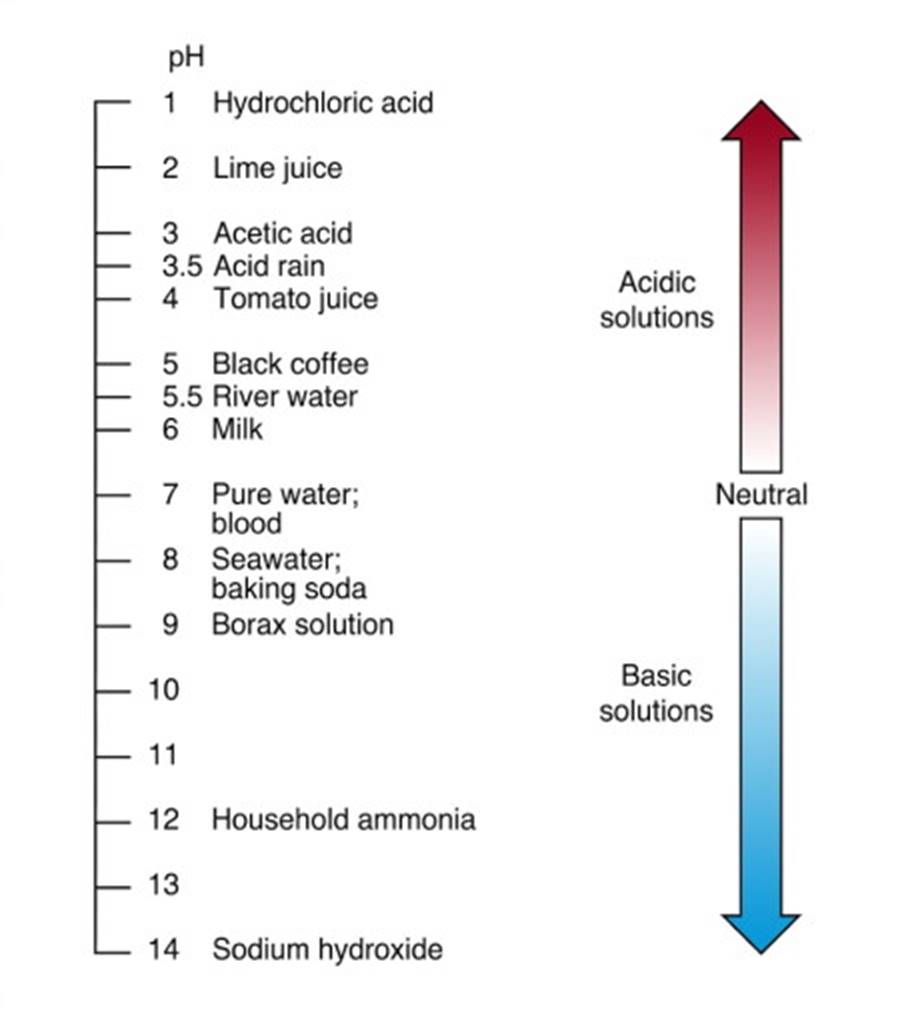
Fig. 5.7. pH scale values of common acidic and basic substances.
The Carbon Dioxide Cycle. At present, the annual ocean uptake of carbon as carbon dioxide (CO₂) from the atmosphere is calculated to be 1.4 billion metric tons per year. The rate at which the oceans absorb CO₂ is controlled by water temperature, pH, salinity, the chemistry of the ions (presence of calcium and carbonate ions), and biological processes, as well as mixing and circulation patterns of seawater that transfer CO₂ from the surface to the deep ocean (fig. 5.8).
The transfer of carbon from CO₂ to organic molecules by photosynthesis results in the addition of CO₂ to the deep-ocean water, when the organic material sinks and decays. This process is sometimes called the biological pump, because biological processes pump carbon to the deep ocean. Enormous quantities of carbon as CO₂ transferred to the ocean bottom in this way are fixed in marine sediments as calcium carbonate (CaCO₃) (refer to chapter 3). The rate at which this transfer occurs is not fully understood. Cold, dense surface water sinking in subpolar regions also transfers CO₂ from the surface to deep water; these transfers are slow, requiring a few hundred to more than a thousand years. At other latitudes, deep water returns to the surface and provides a return source of atmospheric CO₂. The storage of CO₂ in the Earth’s reservoirs and the effect of increased production of CO₂ by the burning of fossil fuels are discussed further in chapter 7.
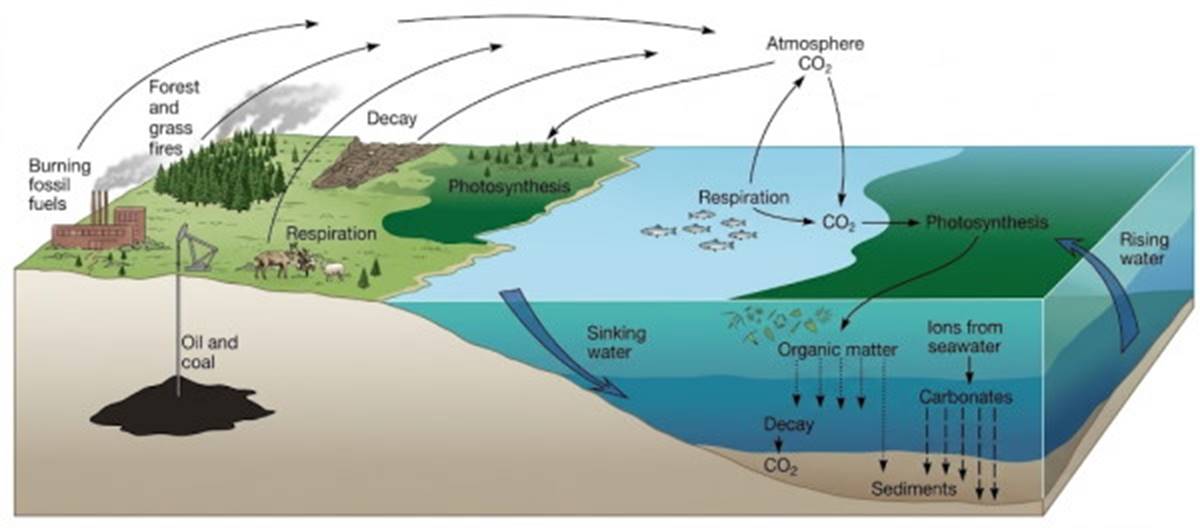
Fig. 5.8. Major carbon dioxide pathways through the Earth’s environment. Weathering and erosion of carbonate land deposits and volcanism also liberate CO₂.
The Oxygen Balance. The oceans also play a large role in regulating the oxygen balance in the Earth’s atmosphere. Photosynthesis in the oceans releases oxygen that is consumed by respiration and decay processes in the same way as on land. However, some organic matter is incorporated into the seafloor sediments, preventing the organic matter’s decay and decomposition. Therefore, oxygen is not consumed to balance the oxygen produced in photosynthesis, and 300 million metric tons of excess oxygen should be released into the atmosphere each year, resulting in an increase of oxygen over time.
This amount is not released because the marine sediments are formed into rocks by the Earth’s geological processes. Some of these rocks are uplifted onto land, and oxygen is eventually consumed in the weathering and oxidation of the materials in the rocks. This process balances the atmosphere’s oxygen budget. The mechanisms that link and control the process are not well understood.
Measuring the Gases. The amount of dissolved oxygen present in seawater samples can be measured by traditional chemical techniques in the laboratory. It is also possible to directly measure oxygen in the oceans, using specialized probes that send an electronic signal back to the ship or store the information in the testing unit. Carbon dioxide is rarely measured directly; rather, it is determined from the pH of the water, which can be measured directly.
Date added: 2026-11-09; views: 2;