
Paleoclimate Archives: The Messages Preserved in Polar Ice Cores
Historical Climate and Environmental Archives. The chemical history of the Earth’s climate for the last 200,000 years is trapped in the Earth’s polar ice sheets. Scientists are going back in time by drilling ice cores in Greenland and Antarctica to discover connections between climate and atmospheric chemistry and the impact of human activities on climate and atmospheric composition. The chemical composition of the ice preserves, layer by layer, a record of soluble substances (sodium, chloride, sulfate, and nitrate) and heavy metals (lead, cadmium, and zinc). Dust tells how stormy the atmosphere was and when volcanic eruptions occurred, and bubbles in the ice contain trapped air, tracing the natural changes of carbon dioxide and other atmospheric gases through time.
Global Ice Core Drilling Initiatives. A collaborative European program known as the Greenland Ice Core Project (GRIP) began in 1989 and ended in 1995. In 1992 GRIP reached 3,029 m (9930 ft), where the ice is 200,000 years old or more. A new hole, NGRIP, is being drilled by Denmark north of the GRIP position. Thirty-five kilometers (20 mi) away, the U.S. Greenland Ice Sheet Project (GISP2) spent five years drilling through the ice sheet and into bedrock to recover an ice core of 3053 m (10,014 ft) in July of 1993. The drilling operation has ceased, but there is ongoing research at the site.
Volcanic and Anthropogenic Records. Scientists analyzing these ice cores are looking back in history. The GISP2 ice core has identified some of the world’s major volcanic eruptions by deposits of sulfur as sulfate: Italy’s Vesuvius in 6955 B.C.; Oregon’s Mt. Mazama’s creation of Crater Lake in 5676 B.C.; Iceland’s Hekla in 2310 B.C.; and Alaska’s Aniakchak in 1623 and 1629 B.C. Sections of the GRIP ice core were analyzed to follow the history of human lead production. Samples taken from ice that formed 7760 years ago (depth of 1286 m [4000 ft]) in the pre-lead-production period were compared with samples from the times of the rise of Greek civilization, the Roman Republic and Empire, and the Medieval and Renaissance periods. Large-scale pollution from lead smelters during those periods contaminated even the Arctic, leaving the oldest recorded document of human pollution.
Comparison of ice layers deposited before and after the industrial revolution shows that the concentration of sulfate from sulfuric acid has tripled and that the concentration of nitrate from nitric acid has doubled during the last century. Lead continued to be a significant contaminant and increased dramatically as a by-product of leaded-fuel combustion tied to the world’s increased dependence on gasoline.
Rapid Climate Shifts and Atmospheric Dynamics. These ice cores tell us that climate changes have occurred more rapidly and more frequently than scientists had thought. Climate changes are recorded in the ice every few thousand years until the end of the last ice age, about 15,000 years ago. The climate warmed for the next two thousand years until a short period when Greenland temperatures decreased by 7°C, followed by very rapid warming, possibly over a period as short as three years, to the present interglacial stage that the Earth enjoys today. These rapid, recent shifts in climate are thought to have been coupled with large shifts in the circulation of both the oceans and the atmosphere.
GISP2 core samples show massive changes in the quantities of dust and sea salt from aerosols that occur with the onset of glacial periods. When the ocean ice cover expanded, the dusts and salts originated from more southern latitudes, requiring parallel, large-scale changes in atmospheric circulation to deliver the particles to the Arctic. Such events may have contributed to blocking incoming solar radiation and may partly explain the duration of the glacial periods.
Antarctic Drilling and CO₂ Records. In Antarctica, Russian scientists set up at the Vostok Antarctic Research Station in 1957 and began drilling ice cores in 1972. They were joined by a French team in 1984, and together they drilled more than 2000 m (6,600 ft) into the ice, capturing an ice record going back 160,000 years. In February of 1998 the Russians shut down their station, having drilled the world’s deepest ice core, 3623 m (12,000 ft). The bottom ice of the core dates back about 450,000 years. The Russians stopped their drilling just before reaching the surface of Lake Vostok, which is twice the size of Lake Ontario and lies between the ice sheet and bedrock.
Their findings show that carbon dioxide levels increased at the end of the next to the last ice age, 140,000 years ago, and decreased rapidly again about 100,000 years ago, the start of the last ice age. Ten thousand years ago carbon dioxide levels rose again (by almost 40%); the rising levels at that time may have played a role in ending the last ice age. The Vostok core shows a rise in carbon dioxide over the last 2000 years. Methods that compare Greenland and Antarctic ice cores against a common time line suggest that the Northern Hemisphere has a more changeable climate than the Southern Hemisphere and that the beginning and ending of ice ages in the north trigger changes in the south.
Future Directions in Ice Core Research. New ice core projects have begun in West Antarctica, conducted by the United States at Siple Dome (using the drill from the Greenland GISP2 hole) and by the European Union at Dome C. The snowfall at these sites is much heavier than at the Vostok site and produces a more detailed climate record of the last 100,000 years. Data from these new cores will help researchers interpret the Vostok data.
Visual Documentation of Ice Core Extraction. The physical process of retrieving and analyzing these paleoclimate archives is documented in the field and laboratory settings.
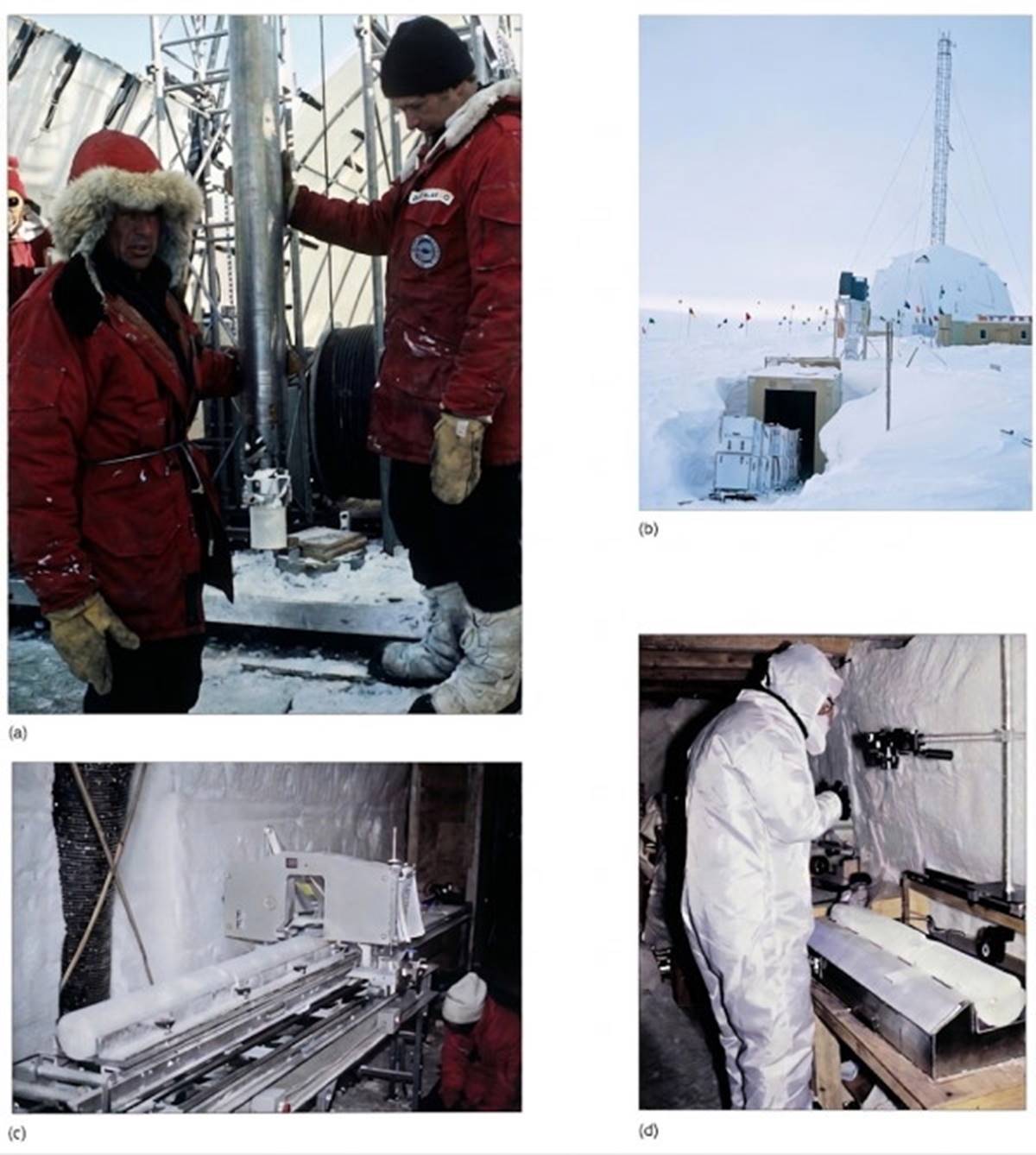
Box figure 5.1. (a) Scott-Amundsen Base, 90°S, November–December 1982. Cores 10 centimeters (4 inches) in diameter were drilled to 227 meters (745 feet) with a mechanical drill. The ice at the bottom of the core is approximately 2200 years old. (b) Greenland Ice Sheet Project 2 (GISP2) drilling station, summer 1990. The tunnel houses laboratories and leads to the drilling site. The boxes at the tunnel entrance hold core sections ready for shipment to cold storage at the scientists’ home laboratories. (c) A lengthwise slab is removed from a core section for analysis in the tunnel lab. (d) GISP2, July 1989. The layering of this ice core was inspected and photographed before it was analyzed for gas and particle content, chemistry, and conductivity. The core was 13 centimeters (5 inches) in diameter.
To Learn More about the Messages in Polar Ice. For further scientific context and foundational research regarding these findings, the following literature is recommended:
- Fiedel, S. J., Southon, and T. Brown. 1995. The GISP Ice Core Record of Volcanism Since 7000 B.C. Science 267 (5195): 256–58.
- Hong, S., P. Candelone, C. Patterson, and C. Boutron. 1994. Greenland Ice Evidence of Hemispheric Lead Pollution Two Millennia Ago by Greek and Roman Civilizations. Science 265 (5180): 1841–43.
- Mayewski, P. A., et al. 1994. Changes in Atmospheric Circulation and Ocean Ice Cover over the North Atlantic During the Last 41,000 Years. Science 263 (5154): 1747–51.
- Mayewski, P. A., et al. 1994. Record Drilling Depth Struck in Greenland. EOS 75 (10): 113, 119, 124.
- Stauffer, B. 1993. The Greenland Ice Core Project. Science 260 (5115): 1766–67.
- Stone, R. 1998. Russian Outpost Readies for Otherworldly Quest. Science 279 (5351): 658–61.
- Weiner, J. 1989. Glacier Bubbles Are Telling Us What Was in Ice Age Air. Smithsonian 20 (2): 78–87.
Date added: 2026-11-09; views: 2;