
Biophysics of Leaf Morphology, Energy Balance, and Paleoclimate Evolution
The structural diversity of plant foliage represents a dynamic evolutionary trade-off among water-use efficiency, heat exchange, and gas exchange mechanisms. Thermal regulation in leaves is maintained through energy exchange with the surrounding atmosphere, where sensible heat loss and transpirational cooling prevent tissue damage. Under high solar irradiance, effective heat transfer lowers leaf temperature relative to the ambient air, whereas impeded thermal dissipation leads to overheating. Because changing water from a liquid to a vapor state requires substantial energy, transpiration serves as a vital cooling pathway. Consequently, leaf size, leaf shape, and leaf margins directly govern the efficiency of these biophysical transport processes.
Boundary Layer Conductance and Biophysical Constraints. The exchange of heat and moisture between a leaf and the surrounding air is constrained by the boundary layer—a stagnant fluid layer resting adjacent to the leaf surface. Leaf dimension directly dictates the thickness of this layer and the corresponding boundary layer conductance.
Small leaves exhibit a low surface area relative to their perimeter length. This physical geometry yields a thin boundary layer and high boundary layer conductance to sensible and latent heat transfer. As a result, small leaves remain tightly coupled to ambient air conditions, keeping leaf temperatures close to air temperature even under intense solar exposure.
In contrast, large leaves feature a high surface area relative to perimeter length. This produces a thick boundary layer and low boundary layer conductance, which hinders convective heat dissipation. Large leaves become thermally decoupled from the surrounding air, often operating at temperatures several degrees above ambient levels. However, structural modifications such as deep leaf lobes effectively reduce the internal surface-area-to-perimeter ratio, thereby increasing boundary layer conductance relative to entire, unlobed leaves.
Optimization Models: Light, Temperature, and Moisture Gradients. Because leaf morphology mediates energy exchange and photosynthetic carbon gain, an optimal leaf size exists for any specific environmental niche, as demonstrated by Parkhurst and Loucks (1972), Givnish and Vermeij (1976), and Woodward (1993).
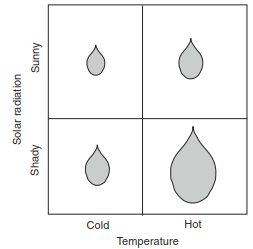
Fig. 15.4. Leaf size in relation to solar radiation and temperature. Adapted from Parkhurst and Loucks (1972).
Under the optimization premise that leaf morphology maximizes water-use efficiency (carbon gain per unit of transpirational water loss), Parkhurst and Loucks (1972) demonstrated distinct distribution patterns across light and thermal gradients:
- Warm to hot, low-light environments (e.g., forest understories) select for larger leaves.
- Sunny environments (e.g., forest overstories) and cold climates select for smaller or deeply lobed leaves to enhance convective dissipation and avoid overheating or freezing stress.
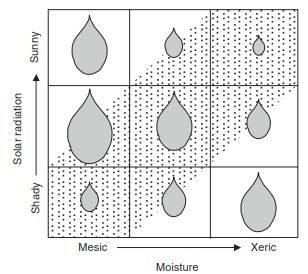
Fig. 15.5. Leaf size in relation to solar radiation and moisture. The stippled area shows the habitats likely in nature and between the forest understory and overstory. Adapted from Givnish and Vermeij (1976).
Givnish and Vermeij (1976) integrated moisture availability into this biophysical framework:
- Humid, shaded understories favor large leaves because low solar loading prevents excessive heat buildup.
- Sunny, arid overstories (xeric environments) demand smaller leaves to restrict water loss while maintaining boundary layer conductance.
- In high-radiation zones, large leaf sizes are only viable under mesic conditions where unrestricted transpiration can supply sufficient latent cooling.
Evolutionary Trajectories and Paleoclimatic Reconstructions. The fossil record reflects the historical impact of atmospheric CO₂ concentrations, energy exchange, and stomatal density on leaf evolution. Early land vascular plants (~425 million years ago) were leafless or bore small cylindrical structures. Flat, broad leaves did not evolve until approximately 40 to 50 million years later.
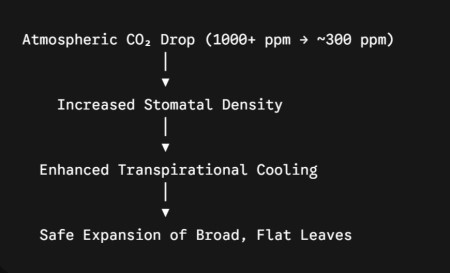
This macroevolutionary delay was driven by atmospheric composition. During the early Paleozoic, atmospheric CO₂ exceeded 1000 ppm. Between 400 and 350 million years ago, CO₂ levels dropped by ~90% down to ~300 ppm. In high-CO₂ atmospheres, plants required low stomatal densities to absorb necessary CO₂. However, broad flat leaves with low stomatal density could not generate sufficient transpirational cooling, leading to lethal thermal stress. As CO₂ declined, plants evolved higher stomatal density, enabling the latent cooling required for broad, planar leaves to survive without overheating (Beerling et al. 2001; Osborne et al. 2004; Beerling and Berner 2005).
Morphological adaptations have also driven major extinction events. Approximately 200 million years ago, a rapid rise in atmospheric CO₂ triggered global warming (McElwain et al. 1999; Beerling and Berner 2005). Fossil evidence indicates that plant species bearing large leaves with entire margins suffered high mortality due to lethal leaf temperatures. These taxa were selectively replaced by species exhibiting smaller sizes or dissected/serrated leaf edges, which maintained lower operating temperatures through higher boundary layer conductance.
Because leaf dimension, shape, and margin geometry (e.g., smooth, serrated, lobed) are constrained by thermal and hydrological regimes, fossil leaf assemblages serve as a key proxy for quantitative paleoclimate reconstruction (Wolfe 1995; Wilf 1997; Wolfe et al. 1998; Peppe et al. 2011).
Date added: 2026-09-24; views: 2;