
Molecular Biophysics and Energetics of Photosynthetic Light Reactions
Photosynthesis is the primary biological process by which autotrophic organisms capture solar energy and synthesize energy-dense carbohydrates from atmospheric carbon dioxide (CO₂) and water. However, because carbon acquisition requires stomatal opening, plants inevitably lose water vapor through transpiration. The cycling of terrestrial energy, water, and carbon dioxide between the land surface and the atmosphere is thus fundamentally coupled.
The overall chemical reaction governing oxygenic photosynthesis is defined by the following stoichiometry:
n CO₂ + 2n H₂O → (CH₂O)_n + n O₂ + n H₂O
In this system, n represents the number of CO₂ molecules that combine with water to produce one mole of carbohydrate building blocks (CH₂O)_n, simultaneously releasing n molecules of oxygen into the atmosphere. Carbohydrates—encompassing simple sugars, starches, and structural polysaccharides—serve as the foundational organic molecules supplying both metabolic energy and carbon skeletons for plant growth.
Photosynthetic operations take place inside specialized subcellular organelles known as chloroplasts. Typically disc-shaped structures measuring 5–10 µm in diameter, chloroplasts contain two distinct structural compartments:
1. Stroma: A gel-like fluid matrix rich in enzymes responsible for reducing CO₂ to carbohydrates during the Calvin cycle.
2. Thylakoids: An internal network of interconnected membranous sacs suspended within the stroma.
The thylakoid membranes harbor light-harvesting pigment complexes, including chlorophyll and carotenoid molecules, which drive the primary light-dependent reactions. A single leaf mesophyll cell can contain up to 50 chloroplasts, yielding densities as high as 500,000 chloroplasts per square millimeter of leaf tissue.
Photochemical Pigments and Absorption Spectra. The light-dependent stage converts radiant solar energy into stable chemical energy stored in the form of adenosine triphosphate (ATP) and reduced nicotinamide adenine dinucleotide phosphate (NADPH). Light absorption drives the oxidation of water molecules, extracting electrons to reduce NADP⁺ to NADPH while liberating molecular oxygen (O₂). Concurrently, electron transfer establishes a proton gradient across the thylakoid membrane, powering the phosphorylation of adenosine diphosphate (ADP) and inorganic phosphate (P_i) into ATP.
Light energy travels in discrete wave-packets termed photons or quanta. The photochemical yield of photosynthesis depends directly on the quantum flux (number of absorbed photons) rather than total radiant energy alone. Although a short-wavelength blue photon (~0.450 µm) carries higher energy than a long-wavelength red photon (~0.680 µm), both quanta exert an identical photochemical effect when absorbed. Plants selectively utilize a specific spectral region ranging from 0.4 µm to 0.7 µm, designated as photosynthetically active radiation (PAR).
Chloroplast pigments act in concert to capture PAR:
- Chlorophyll: The dominant light-harvesting pigment, which absorbs strongly in the violet, blue, and red wavebands while reflecting green wavelengths.
- Carotenoids: Accessory pigments (including carotenes and xanthophylls) that absorb blue-green light and appear yellow, orange, or red. Under normal conditions, high concentrations of chlorophyll mask the presence of carotenoids.
Photosystem Architecture and Quantum Efficiency. Within the thylakoid membrane, hundreds of chlorophyll and carotenoid molecules are organized into functional light-harvesting units called photosystems. Absorbed photon energy is funneled via resonance energy transfer across antenna pigments until it reaches a specialized chlorophyll complex known as the reaction center. Upon excitation, a reaction center chlorophyll boosts an electron to a high energy level, transferring it to a primary electron acceptor and initiating linear electron transport.
Oxygenic photosynthesis relies on two distinct photosystems operating in series:
- Photosystem II (PS II): Features a reaction center designated P680, with optimal absorbance at a wavelength of 0.680 µm.
- Photosystem I (PS I): Features a reaction center designated P700, with optimal absorbance at a wavelength of 0.700 µm.
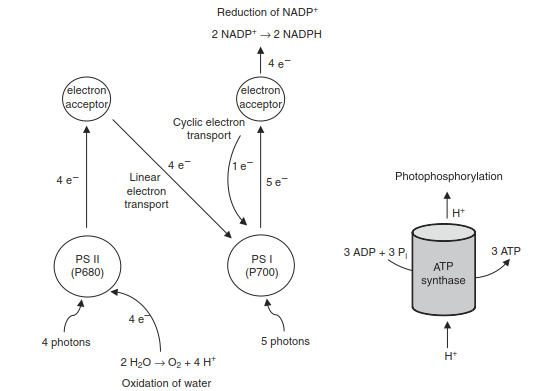
Fig. 16.1. Light-dependent reactions of photosynthesis showing the various processes that split two H₂O yielding one O₂ and producing two NADPH and three ATP: absorption of four photons by PS II; transfer of four electrons from PS II to an acceptor molecule; oxidation of two H₂O by P680 to obtain four electrons; absorption of four photons by PS I and transfer of four electrons from PS I to an exclusion acceptor; linear electron transport from PS II to PS I of four electrons; and reduction of 2 NADP⁺ to 2 NADPH using four electrons. Non-cyclic and cyclic photophosphorylation during linear electron transport and cyclic electric transport, respectively, produces 3 ATP from 3 ADP. Cyclic electron transport of one electron in PS I requires PS I absorb one additional photon.
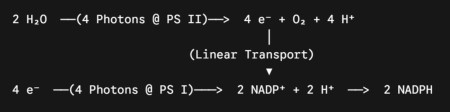
Linear and Cyclic Electron Transport Pathways. The photochemical sequence begins when photon absorption excites the P680 reaction center of PS II, causing it to lose an electron to a primary electron acceptor. The resulting oxidized P680⁺ state exhibits an exceptionally high redox potential, enabling it to extract electrons from water via the oxygen-evolving complex. Splitting one molecule of water (H₂O) yields two protons (2 H⁺), two electrons (2 e⁻), and half a molecule of oxygen (1/2 O₂):
2 H₂O → O₂ + 4 H⁺ + 4 e⁻
Extracted electrons pass down a linear electron transport chain from PS II to PS I. Simultaneously, photon absorption at PS I excites P700, driving the ejection of an electron to a separate electron acceptor. The electron arriving from PS II reduces the oxidized P700⁺, restoring its ground state for subsequent excitation cycles.
Reducing one molecule of NADP⁺ to NADPH requires two electrons. Because each electron transfer through the two photosystems requires two photons (one absorbed by PS II and one by PS I), four photons are required to process two electrons from a split water molecule to reduce one NADP⁺. Consequently, to fix one molecule of CO₂ in the Calvin cycle—which demands two NADPH—a total of four electrons must be moved. Splitting two H₂O molecules provides these four electrons, requiring the absorption of eight photons across PS II and PS I.
In addition to NADPH, carbon assimilation in the Calvin cycle requires 3 ATP molecules for every 2 NADPH reduced. Non-cyclic photophosphorylation during linear electron transfer produces a portion of this ATP via ATP synthase. To fulfill the remaining ATP requirement, plants engage cyclic electron transport. In this pathway, electrons ejected from PS I are routed back to the P700 reaction center via an intermediate acceptor rather than being passed to NADP⁺.
Cyclic photophosphorylation generates additional ATP without splitting water or forming NADPH. Driving one electron through the cyclic pathway requires one additional photon absorbed exclusively by PS I. Summing the primary non-cyclic flow (8 photons) and the auxiliary cyclic flow (1 photon) yields a overall quantum requirement of 8 to 9 photons absorbed per single CO₂ molecule fixed in the stroma. This coordinated regulation of photosystem excitation maintains the precise ATP/NADPH stoichiometry needed to maximize biological water-use efficiency under variable light environments.
Date added: 2026-09-24; views: 1;