
Leaf Energy Budgets and Biophysical Flux Dynamics
1. Theoretical Foundations of Plant Canopy Radiation and Energy Exchange. Individual leaves within a plant canopy play a vital role in terrestrial ecosystems by absorbing incoming solar and thermal radiation while continuously exchanging sensible heat and latent heat with the surrounding atmosphere. These biophysical processes govern leaf temperature, microclimate interactions, and overall plant water relations. The net radiation (Rₙ) absorbed by a leaf is balanced by sensible heat (H) and latent heat (λE) fluxes, expressed mathematically as:
Rₙ = Qₐ - 2εₗσTₗ⁴ = H + λE (Eq. 15.1)
This fundamental balance shares structural similarities with the surface energy budget of the broader land surface, albeit without soil heat storage terms. Here, Qₐ represents the radiative forcing, defined comprehensively as the sum of absorbed solar radiation and incident longwave radiation from the sky and surrounding canopy elements. The leaf itself emits longwave radiation from both its upper and lower surfaces, characterized by a typical leaf emissivity (εₗ) of approximately 0.98. The net radiation is thus determined by the precise difference between incoming radiative forcing and outgoing longwave emission.
2. The Leaf Energy Balance Equation and Thermal Equilibrium. To understand how plants maintain thermal equilibrium, biophysicists utilize advanced energy balance models that solve for leaf temperature (Tₗ). The complete energy balance equation for a leaf accounts for radiative, convective, and latent heat exchanges:
Qₐ = 2εₗσTₗ⁴ + 2cₚ(Tₗ - Tₐ)g_bh + (cₚ / γ) [e_*(Tₗ) - eₐ] / (g_bw⁻¹ + g_sw⁻¹) (Eq. 15.2)
In this formulation, sensible heat flux scales directly with leaf boundary layer conductance (g_bh) and occurs across both sides of the leaf. Latent heat flux is governed by the vapor pressure deficit between the leaf interior (assumed to be saturated with moisture) and the surrounding air, modulated in series by boundary layer and stomatal conductances.
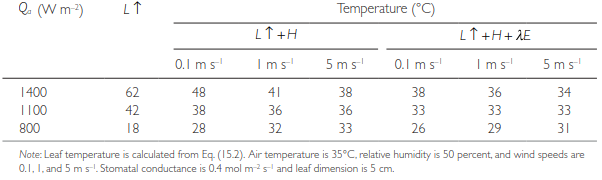
Table 15.1. Leaf temperature for radiative forcing of 1400, 1100, and 800 W m⁻² with (a) longwave radiation only (L↑), (b) longwave radiation and convection (L↑ + H), and (c) longwave radiation, convection, and transpiration (L↑ + H + λE).
As demonstrated in the empirical data of Table 15.1, when a leaf relies solely on longwave emission to dissipate high radiative forcing (such as 1400 W m⁻²), its temperature can soar to extreme levels (62 °C). However, the inclusion of convective heat loss (H) and transpirational cooling (λE) dramatically buffers leaf temperatures, lowering them to biologically viable ranges even under intense solar loads.
3. Electrical Network Analogy for Heat and Mass Transfer. To quantify the complex transfer of heat, water vapor, and carbon dioxide (CO₂) through plant canopies, researchers frequently employ an electrical network analogy. Analogous to Ohm's law in electrical circuits, the flux of materials through a biological pathway is directly proportional to the concentration or temperature gradient divided by the resistance to diffusion, or equivalently, multiplied by conductance.
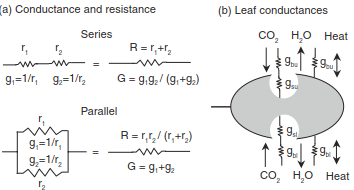
Fig. 15.1. Electrical network analogy for heat, water, and CO2 exchange by leaves. (a) Resistance (r) and conductance (g) for two resistors in series and parallel. Also shown is the total resistance (R) and conductance (G). (b) Heat, water vapor, and CO2 exchange as a network of leaf boundary layer (g_b) and stomatal (g_s) conductances for upper and lower leaf surfaces.
Plant physiologists heavily favor conductance—the mathematical inverse of resistance—because flux is directly proportional to conductance, and conductance shares convenient additive properties when pathways operate in parallel. When transport processes occur sequentially, such as water diffusing through the stomatal pore and subsequently through the boundary layer, the resistances sum directly in series, while total conductance is calculated harmonically.
4. Boundary Layer Conductance and Leaf Morphology. The leaf boundary layer is a thin layer of relatively stagnant air (typically 1 to 10 mm thick) adhering to the leaf surface, representing a primary transition zone for temperature and moisture gradients. Air moving across a leaf slows down significantly near the surface, creating a thermal and humidity gradient where the leaf transitions from a hot, moist interior to cooler, drier ambient air. The thickness of this boundary layer dictates the degree of coupling between the leaf and the surrounding atmosphere.
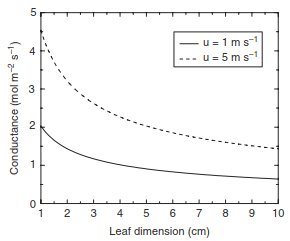
Fig. 15.2. Leaf boundary layer conductance (g_bh) in relation to leaf size for wind speeds of 1 and 5 m s⁻¹.
As detailed by classical fluid dynamics and micrometeorology research (Gates; Campbell and Norman; Monteith and Unsworth), boundary layer conductance for heat (g_bh) and water vapor (g_bw) for air moving smoothly across a flat plate is approximated per unit leaf area as:
g_bh = 0.203(u / ℓ)⁰ˑ⁵ (Eq. 15.3)
g_bw = 0.223(u / ℓ)⁰ˑ⁵ (Eq. 15.3)
where u represents wind speed in m s⁻¹, and ℓ represents leaf characteristic dimension in meters. Because water vapor possesses a higher molecular diffusivity than heat, water vapor conductance is consistently higher.
Leaf morphology closely mirrors climatic pressures. Small or deeply lobed leaves maintain thin boundary layers, high conductances, and strong coupling with ambient air, making them advantageous in sunny and cold climates where excessive heat retention is detrimental. Conversely, large leaves develop thick boundary layers and low conductances, promoting thermal decoupling that is favored in warm, low-light environments.
5. Stomatal Regulation and Transpiration Dynamics. Embedded within the leaf epidermis are microscopic pores known as stomata, flanked by specialized guard cells that actively regulate gas exchange and transpirational water loss. Stomatal conductance (g_sw) operates in series with boundary layer conductance (g_bw) to control the diffusion of water vapor and carbon dioxide.
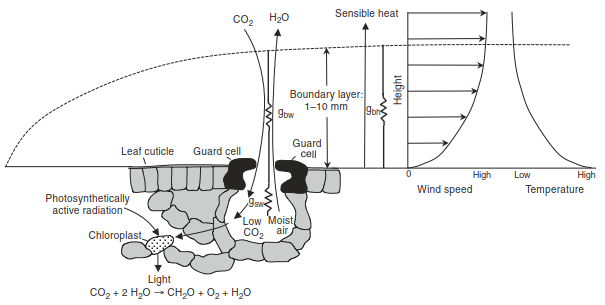
Fig. 15.3. Leaf boundary layer processes. Shown are stomata and associated CO2 and water fluxes. These fluxes are regulated by stomatal (g_sw) and boundary layer (g_bw) conductances. Also shown are boundary layer thickness and associated wind and temperature profiles. Sensible heat flux is regulated by g_bh.
Stomata open to allow the uptake of CO₂ for photosynthesis while simultaneously losing water vapor via transpiration from saturated internal cavities. Stomatal conductance varies dynamically, ranging from 0.4 mol m⁻² s⁻¹ or higher during peak opening to less than 0.04 mol m⁻² s⁻¹ when fully closed. Stomatal aperture responds to a multitude of environmental cues, including light intensity, atmospheric CO₂ concentration, soil moisture availability, and ambient humidity.
Depending on species and ecological adaptation, leaves can be hypostomatous (stomata restricted to the lower epidermis) or amphistomatous (stomata present on both upper and lower surfaces, operating in parallel). Understanding these intricate biophysical pathways allows scientists to model plant productivity, agricultural water use efficiency, and regional hydrological cycles under changing global climates.
Date added: 2026-09-24; views: 1;