
Soil Moisture and Surface Fluxes
Soil water influences the partitioning of net radiation into sensible and latent heat (Figure 14.5). Over the course of a typical summer day, the majority of net radiation is dissipated as latent heat for a well-watered site. In contrast, a dry site exchanges much less energy via latent heat and more as sensible heat. In general, a substantial portion of net radiation is dissipated as latent heat when water does not limit evapotranspiration, and the boundary layer is cooler and moister than in the absence of evapotranspiration. As soil dries, less water is available for evapotranspiration, and more energy is dissipated as sensible heat or stored in the ground; the lower atmosphere is likely to be warm and dry (Figure 26.1).
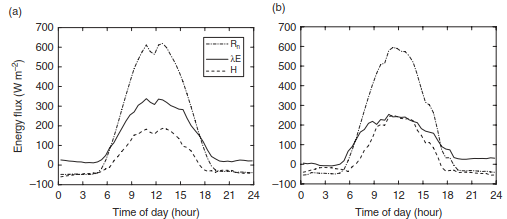
Fig. 14.5. Energy balance of (a) wet and (b) dry grassland on a typical summer day. Data are from figure 12.8
Figure 14.6 illustrates general soil moisture- evapotranspiration regimes. When soil moisture is greater than some critical water content, the rate of evapotranspiration is limited by available energy and is independent of soil water. Below this critical value, soil water availability limits evapotranspiration, and the rate decreases as the soil becomes drier. Changes in soil moisture only affect evapotranspiration in the water-limited regime, but at moisture contents below the wilting point, evapotranspiration is unaffected by soil water. Thus, there are three soil moisture-evapotranspiration regimes: wet and dry regimes, where soil moisture does not affect evapotranspiration, and a transitional regime, where soil moisture strongly regulates evapotranspiration (Seneviratne et al. 2010).
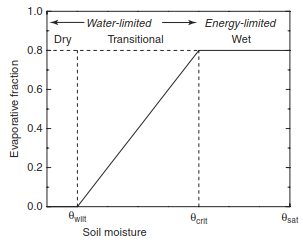
Fig. 14.6. Idealized relationship between soil water and evapotranspiration. evapotranspiration, as a fraction of available energy, increases with wetter soil up to a maximum value at some critical water content (θcrit ), beyond which evapotranspiration is energy-limited. Below some minimum value (θwilt), the soil is too dry to sustain evapotranspiration. Adapted from Seneviratne et al. (2010)
Data collected over a 15 km x 15 km region of grassland in Kansas during the First ISLSCP (International Satellite Land Surface Climatology Project) Field Experiment (FIFE) illustrate the spatial variability in surface fluxes that can arise from surface heterogeneity in vegetation and soil moisture (Figure 14.7).
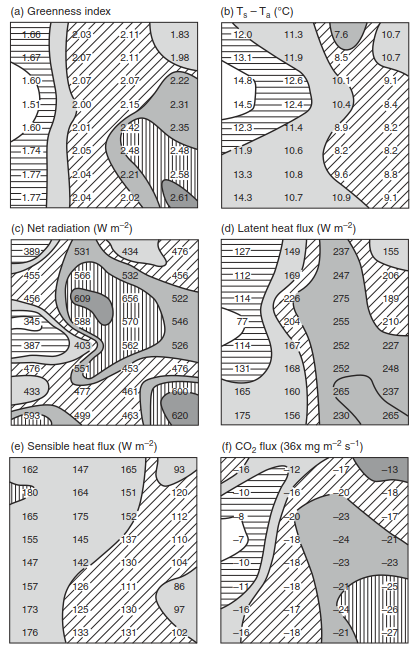
Fig. 14.7. Spatial variation of (a) greenness index, (b) surface temperature minus air temperature (Ts −Ta ), (c) net radiation, (d) latent heat flux, (e) sensible heat flux, and (f) Co2 flux over the 15 km × 15 km fife site near Manhattan, Kansas, on august 12, 1989 between 1150 and 1355 Central Daylight Time. Data shown are spatial averages for an 8 × 4 grid (1.9 km × 3.8 km grid cell size). a negative Co2 flux indicates uptake by vegetation. Redrawn from Desjardins et al. (1992)
On the particular day studied, the western region of the study site was warm and dry with high sensible heat flux, low latent heat flux, and low CO2 uptake. Vegetation activity as quantified by a greenness index was low in this region. The eastern region had cooler surface temperature, low sensible heat flux, high latent heat flux, and high CO2 uptake. Highest CO2 uptake and latent heat flux occurred in the southeast quadrant, where vegetation activity was highest. These surface fluxes were highly correlated with one another, with CO2 uptake increasing as latent heat flux increased and both fluxes increasing with greater vegetation greenness (Figure 14.8). Sensible heat flux increased as the surface temperature difference with air temperature increased.
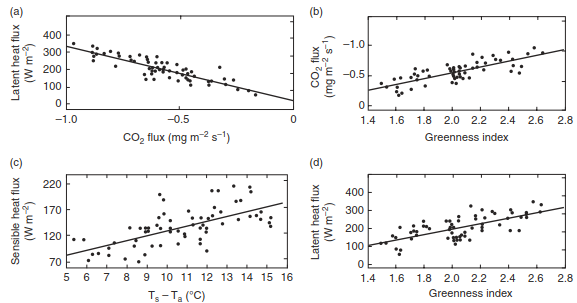
Fig. 14.8. Relationships among latent heat flux, Co2 flux, greenness index, and sensible heat flux over the fife site for august 12, 1989 between 1050 and 1255 Central Daylight Time. a negative Co2 flux indicates uptake by vegetation. Sensible heat flux is shown in relation to surface temperature minus air temperature (Ts −Ta ). Redrawn from Desjardins et al. (1992)
The changes in surface fluxes associated with soil moisture alter the atmospheric boundary layer and may create conditions that favor precipitation. Such a feedback, where it occurs, is understood in terms of the impact of soil moisture on boundary layer stability and precipitation formation (Betts and Ball 1995, 1998; Betts
| Fig. 14.7 |
| (b) Ts - Ta (°C) |
| (a) Greenness index |
et al. 1996; Eltahir 1998; Schar et al. 1999; Betts 2004, 2009; Seneviratne et al. 2010; Santanello et al. 2013). In general, wet soil has a lower Bowen ratio (H /λE) compared with dry soil, resulting in a shallower, moister boundary layer with lower height of cloud base. Additionally, higher soil moisture increases the net radiation at the surface by altering the balance of longwave and solar radiation.
The cooler surface temperature leads to lower emission of longwave radiation at the surface, and the higher water vapor in the boundary layer leads to greater downwelling atmospheric longwave radiation. Furthermore, soil albedo generally decreases with wetter soil so that net solar radiation at the surface increases, though this is offset by greater cloud cover that reduces incoming solar radiation. In general, net radiation at the surface increases with wetter soil so that there is more energy available to heat and moisten the boundary layer. The shallower boundary layer and greater total surface heat flux (sensible heat plus latent heat) increase the convective instability of the boundary layer and create conditions that can favor convective precipitation. Thus, there may be a positive feedback between soil moisture and precipitation in which wetter soils lead to increased precipitation, which produces still wetter soils. Such a feedback has been found in atmospheric models (Chapter 26).
The feedback between soil water and precipitation is understood in terms of the release of convective instability that builds up during the development of the boundary layer over the course of a day in response to solar heating. With dry soil, the net radiative energy at the surface is converted primarily into sensible heat, with a resulting deep, well-mixed boundary layer. With wet soil, the fraction of net radiation converted to latent heat increases, the boundary layer is not as deep, temperatures are cooler, and more moisture is input into the boundary layer. Wet soils, therefore, have a comparatively large flux of total heat into a shallow boundary layer. This increases the moist static energy per unit mass of boundary layer air. (Moist static energy is supplied by the total heat flux from the surface into the boundary layer. Moist static energy is the total energy in the boundary layer and is the sum of gravitational potential energy [gz ], sensible heat [cpT ], and latent heat [λw ], where g is gravitational acceleration, z is height, cp is specific heat at constant pressure, T is temperature, λ is latent heat of vaporization, and w is water vapor mixing ratio. It is unaffected by condensation processes, which simply redistribute energy between the sensible and latent terms.) Moist static energy plays an important role in the initiation of convective storms, and moist convection redistributes this energy in the vertical.
Data collected over grassland during FIFE have given important insights to the coupling between soil moisture and the atmosphere boundary layer (Betts and Ball 1995, 1998). When partitioned based on soil water content, it is evident that summer days with dry soil had a higher Bowen ratio, were less cloudy, and had about 20 W m-2 less available energy at noon (Table 14.1). Reduced cloud cover on days with dry soil increased the incoming solar radiation at the surface, but this was more than offset by the greater outgoing longwave radiation from the warmer surface. Dry soils also had a higher radiative skin temperature relative to air temperature and lower mean wind speed.
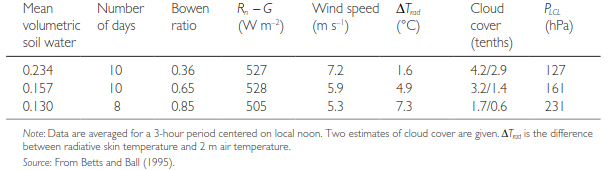
Table 14.1. Surface Bowen ratio, available energy (Rn −G), surface wind speed, ΔTrad, cloud cover, and lifting condensation level pressure (PLa) for 28 rainless days in July–August 1987 during FIFE partitioned by volumetric soil water content
Figure 14.9 shows the average diurnal cycle of net radiation, sensible heat flux, and latent heat flux for three categories of soil water content. Net radiation differed little with soil water, though the driest soil had about 20 W m-2 less available energy at noon, as discussed above. Differences among moisture categories in sensible heat and latent heat fluxes were small at night. However, daytime sensible heat flux increased and latent heat flux decreased with drier soil. The evaporative fraction, defined as λE /(H + λE), had a pronounced diurnal cycle, but systematically decreased with lower soil moisture.
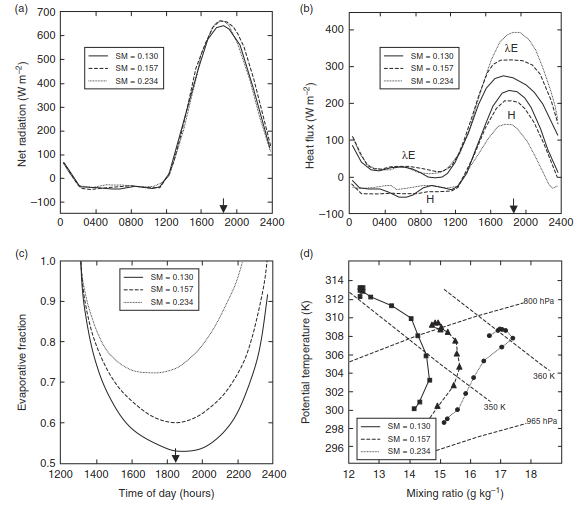
Fig. 14.9. Average diurnal cycle partitioned by volumetric soil moisture content (0.130, 0.157, and 0.234) for 28 rainless days in July–august 1987 during fife. The time axis is in universal Time (uT). Local noon is about 1820 uT and is marked by an arrow. Shown are (a) net radiation, (b) sensible heat (H) and latent heat (λE) fluxes, (c) evaporative fraction, λE / (H +λE), and (d) hourly potential temperature (θ) and mixing ratio (w) measured at a height of 2 m for the daytime period (1145 to 2345 uT). also shown are isopleths of equivalent potential temperature (θe) and saturation pressure (P * ). Redrawn from Betts and Ball (1995)
Plots of hourly potential temperature and mixing ratio show differences in the boundary layer related to soil moisture (Figure 14.9d). In general, mixing ratio increased over the course of a day from a morning minimum as surface evapotranspiration supplied water vapor to the boundary layer. It decreased in the afternoon as the growing boundary layer entrained drier air from above. This behavior is evident for wet soil (volumetric water content, 0.234), where the mixing ratio increased over the course of the day until about local noon; thereafter mixing ratio decreased. The air above the drier soils had lower mixing ratios throughout the day compared with the wet soil. The mixing ratio of dry soil (volumetric water content, 0.130) had a smaller diurnal range and decreased soon after sunrise because low soil water limited evapo- transpiration. Temperature increased from a morning minimum, reached a maximum in late-afternoon, and then decreased. The wet soil had a lower temperature and a smaller diurnal temperature range than the dry soil. However, equivalent potential temperature (a measure of the moist static energy) attained a higher afternoon maximum with wet soil (361 K) than with dry soil (353 K) and its diurnal temperature range increased.
The lifting condensation level is an indicator of the height of cloud base and the mixed layer depth. It can be defined as the difference in surface pressure (Ps) and saturation pressure of surface air (P*), PLCL = Ps - P'. (Saturation pressure, or lifting condensation level, is the pressure at which a parcel of moist unsaturated air lifted dry adiabatically reaches saturation.) The depth of the mixed layer at the FIFE site increased over the course of the day (Figure 14.10). The afternoon maximum mixed layer depth increased with drier soil and is linked to soil moisture through evapotranspiration.
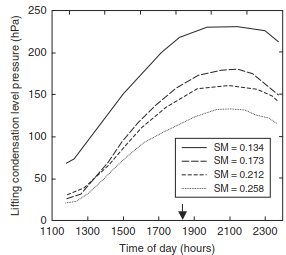
Fig. 14.10. Average diurnal cycle of lifting condensation level pressure (PLCL) partitioned by volumetric soil moisture content for 94 rainless days in the period May 26– September 30, 1987 during fife. The time axis is in universal Time (uT). Local noon is about 1820 uT and is marked by an arrow. redrawn from Betts and Ball (1995)
In general, the FIFE analysis shows that increasing soil moisture leads to a higher afternoon maximum of equivalent potential temperature (and a larger diurnal temperature range of equivalent potential temperature) and lower afternoon cloud base given the same net available energy. Higher moist static energy and lower afternoon cloud base create conditions favorable for convective precipitation. Dry soil reduces evapotranspiration, and the boundary layer is warmer, drier, and deeper with lower equivalent potential temperature and higher afternoon cloud base. A positive feedback may occur because precipitation increases soil moisture, producing a lower afternoon cloud base and higher equivalent potential temperature, which in turn favors convective precipitation.
Similar results are seen in analyses of climate model simulations (Betts 2004, 2009; Betts and Viterbo 2005). Wet soils have a lower cloud base, a cooler, moister atmospheric boundary layer, greater latent heat flux, and less sensible heat flux than dry soils. Clouds provide an important feedback on soil moisture and surface fluxes through their effect on solar and longwave radiation.
Date added: 2026-09-24; views: 1;