
Ocean Wave Dynamics: Generation, Anatomy, and Kinematics
Generating and Restoring Forces. Imagine that you are standing on the beach looking out across a perfectly flat, smooth surface of water. The production or generation of waves requires a disturbing force. You throw a stone into the water, or a large, naturally occurring landslide comes down into the water. A pulse of energy is introduced, and waves are produced; this disturbing force is called a generating force. The waves produced by the generating force move away from the point of disturbance. Of course, the magnitude of the disturbance and the resulting wave size are very different in these two examples.
In the case of the thrown stone, the stone strikes the surface of the water and displaces, or pushes aside, the water surface. As the stone sinks, the displaced water flows back from all sides into the space left behind, and as this water rushes back, the water at the center is forced upward. The elevated water falls back, causing a depression below the surface that is refilled, starting another cycle. This process sets up a series of waves, or oscillations, at the air-sea boundary that move outward and away from the point of disturbance until they are dissipated through friction among the water molecules.
In this example, the wave-generating force is the stone as it strikes the surface of the water. The force that causes the water to return to its undisturbed surface level is the restoring force. If the stone thrown into the water is small, the waves are small, and the restoring force is the surface tension of the water surface. (Surface tension, or the elastic quality of the surface due to the cohesive behavior of the water molecules, is discussed in chapter 4.) All very small water waves are affected by surface tension.
In the example in which the landslide is the generating force, the much larger waves are pulled back to the undisturbed surface level of the water by the restoring force of gravity. When waves are of sufficiently large size so that the restoring force of the Earth's gravity is more important than surface tension, the waves are called gravity waves. The most common generating force for water waves is the moving air, or wind. As the wind blows across a smooth water surface, the friction, or drag, between the air and the water tends to stretch the surface, resulting in wrinkles; surface tension acts on these wrinkles to restore a smooth surface. The wind and the surface tension create small waves, called ripples, or capillary waves (Fig. 9.1).
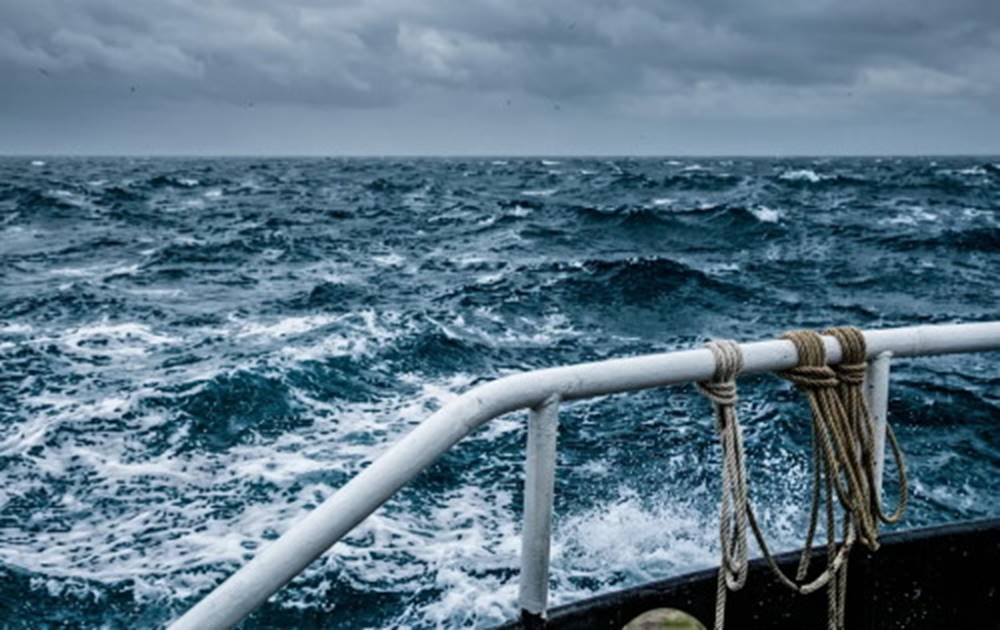
Fig. 9.1. Wind-generated capillary waves appear as wrinkles atop larger waves. Capillary wavelengths are measured in centimeters.
Patches of these very small waves are seen forming, moving, and disappearing as they are driven by pulses of wind. These patches darken the surface of the water and move quickly, keeping pace with the gusts of wind; sailors call these fast-moving patches cat's-paws. These waves die out rapidly because of friction while new ripples form constantly in front of each moving wind gust.
When the wind blows, energy is transferred to the water over large areas, for varying lengths of time, and at different pulse rates. As waves form, the surface becomes rougher, and it is easier for the wind to grip the roughened water surface and add energy. As the wind increases in speed, the waves become larger, and the restoring force changes from surface tension to gravity (Fig. 9.2).
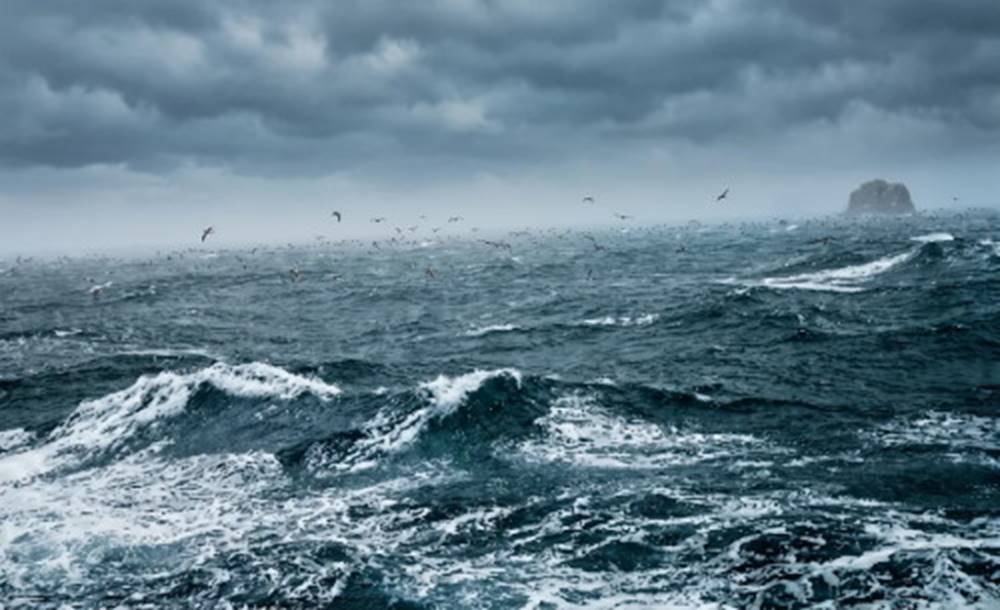
Fig. 9.2. Wind-generated gravity waves at sea.
Structural Characteristics and Terminology. In any discussion of waves, certain terms are used; refer to Fig. 9.3 during the explanation of these terms. The part of the wave that is elevated the highest above the undisturbed sea surface is called the crest; the part that is depressed the lowest below the surface is called the trough. The distance between two successive crests or two successive troughs is the length of the wave, or its wavelength. The wave height is the vertical distance from the top of the crest to the bottom of the trough. Sometimes the term amplitude is used.
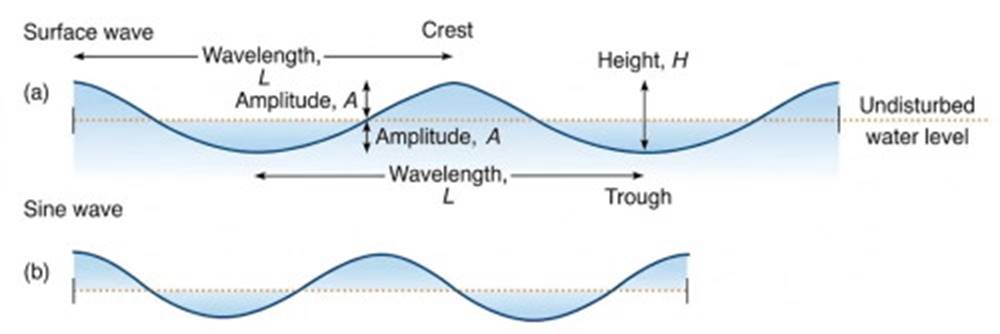
Fig. 9.3. The profile of an ideal sea surface wave (a) differs from the shape of a sine wave (b).
The amplitude is equal to one-half the wave height, or the distance from either the crest or the trough to the undisturbed water level, or equilibrium surface. The oceanographer characterizes a wave not only by its length and height (or amplitude) but also by its period. The period is the time required for two successive crests or two successive troughs to pass a point in space.
If you are standing on a piling and start a stopwatch as the crest of a wave passes and then stop the stopwatch as the crest of the next wave passes, the time you have measured is the period of the wave. The dimensions and characteristics of waves vary greatly, but the regularity in the rise and fall of the water's surface and the relationship between wavelength and wave period allow mathematical approximations to be made, which give us insight into the behavior and properties of waves. These calculations are done by relating real waves to simple model waves.
Fig. 9.3a has been drawn to show that real waves tend to have a trough that is flatter than the crest; by contrast, Fig. 9.3b is that of a symmetrical sine wave. This regular wave, which only approximates a water wave in nature, is one of the wave forms used by physical oceanographers and mathematicians to explore and explain wave motion. The relationships presented in sections 9.3 through 9.7 are based on this regular sine-wave form.
Orbital Kinematics of Water Particles. As a wave form moves across the ocean surface, particles of water are set in motion by the energy of the wave. Seaward, beyond the surf and breaker zone, where the surface undulates quietly, the water is not moving toward the shore. Such an ocean wave does not represent a flow of water but instead represents a flow of motion or energy from its origin to its eventual dissipation at sea or loss against the land. In order to understand what is happening during the passage of a wave, let us follow the motion of the water particles as the wave moves through them.
As the wave crest approaches, the surface water particles rise and move forward. Immediately under the crest the particles have stopped rising and are moving forward at the speed of the crest. When the crest passes, the particles begin to fall and to slow in their forward motion, reaching a maximum falling speed and a zero forward speed when the midpoint between crest and trough passes. As the trough advances, the particles slow their falling rate and start to move backward, until at the bottom of the trough they have attained their maximum backward speed and neither rise nor fall.
As the remainder of the trough passes, the water particles begin to slow their backward speed and start to rise again, until the midpoint between trough and crest passes. At this point the water particles start their forward motion again as they continue to rise with the advancing crest. This motion (rising, moving forward, falling, reversing direction, and rising again) creates a circular path, or orbit, for the water particles as the wave passes. Follow this motion in Fig. 9.4.
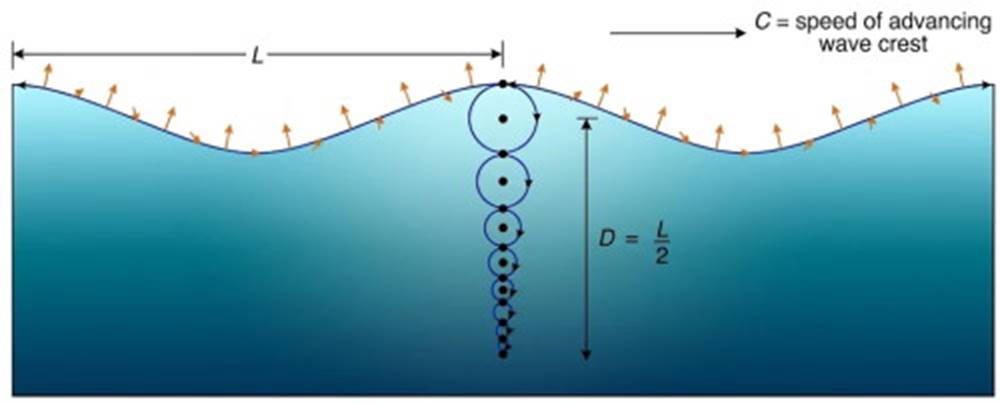
Fig. 9.4. The moving wave form sets the water particles in motion (note the arrows in the diagram). The diameter of a water particle's orbit at the surface is determined by wave height. Below the surface, the diameter decreases, and orbital motion ceases at a depth (D) equal to one-half the wavelength.
It is the orbital motion of the water particles that causes a floating object to bob, or move up and down, forward and backward, as the wave passes under it. This motion affects a fishing boat, swimmer, sea gull, or any other floating object on the surface seaward of the surf zone. The surface water particles trace an orbit with a diameter equal to the height of the wave. This same type of motion is transferred to the water particles below the surface, but less energy of motion is found at each succeeding depth.
The diameter of the orbits becomes smaller and smaller as depth increases. At a depth equal to one-half the wavelength, the orbital motion has decreased to almost zero; notice how the orbit decreases in diameter in Fig. 9.4. Submarines dive during rough weather for a quiet ride because the wave motion does not extend far below the surface.
The orbits just described are based on the sine wave (Fig. 9.3b), not on real sea waves (Fig. 9.3a). The water particles of actual sea waves move in orbits whose forward speed at the top of the orbit is slightly greater than the reverse speed at the bottom of the orbit. Therefore, each orbit made by a water particle does move the water slightly forward in the direction the waves travel. This movement is due to the shape of the real waves, whose crests are sharper than their troughs; again see Fig. 9.3a. This difference means there is a very slow transport of water in the direction of the waves in nature, but this motion is ignored in calculations based on simple wave models.
Celerity and Phase Velocity. A wave's speed across the sea surface is related to its wavelength and wave period. The speed of any surface wave (C) is equal to the length of the wave (L) divided by the period (T):
speed = length of wave / wave period
or
C = L / T
Once a wave has been created, the speed at which the wave moves may change, but its period remains the same (period is determined by generating force). In wave studies C stands for celerity, a term traditionally used to identify wave speed and to distinguish wave speed from the group speed of waves. Group speed is usually identified by V (section 9.5).
Date added: 2026-11-09; views: 5;