
Mauve Space Telescope: Private UV Astronomy and Subscription Data Model
This month, the Mauve space telescope, a compact instrument built by the startup Blue Skies Space, is scheduled for launch. Unlike traditional missions operated by government agencies like NASA, this private venture will sell optical-ultraviolet observations to researchers via an annual subscription. The satellite, a 16-unit CubeSat smaller than a standard microwave, houses a 13-centimeter telescope, representing a new, cost-effective class of astronomical mission. Its creators aim to establish a sustainable commercial precedent for space-based science, catering to specific unmet demands in the astronomical community.
The mission directly addresses a critical shortage of ultraviolet (UV) observation capabilities. Earth's atmosphere absorbs most ultraviolet light, making space-based telescopes essential for this wavelength. While instruments like the Hubble Space Telescope can perform such observations, the extreme oversubscription—with demand exceeding available time by six to one—limits access for many researchers. Mauve specifically targets the study of tempestuous young stars, whose violent variability and plasma eruptions are best studied in the UV. This niche focus provides a clear market opportunity for the startup's data services.
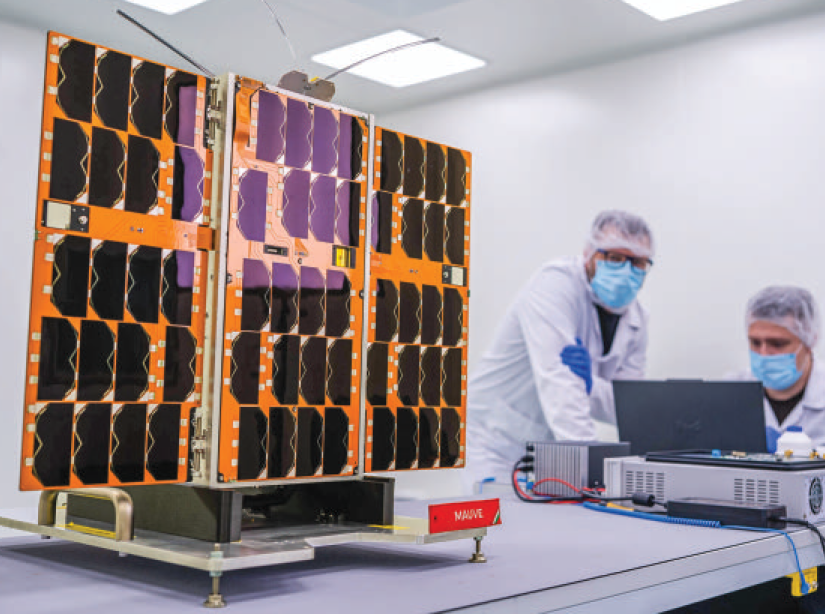
Blue Skies Space’s Mauve telescope will observe young, tempestuous stars in a package smaller than a microwave oven.
The shift toward smaller, privately funded missions is facilitated by dramatically lower launch costs and the standardization of satellite components. Platforms like CubeSats, modular 10-centimeter cubes that can be combined, have democratized access to space. These miniature observatories, often riding as secondary payloads on rockets carrying larger satellites, can be developed for a few million dollars rather than billions. Successful precedents include the NASA-funded Colorado Ultraviolet Transit Experiment (CUTE), a six-unit CubeSat launched in 2021 to study exoplanet atmospheres, proving that meaningful science can be conducted from such small platforms.
Blue Skies Space, a company spun out from University College London, developed Mauve with a ?1.2 million EU grant supplemented by prelaunch subscriptions and investor funding. An annual subscription to access all of Mauve's data costs roughly equivalent to a Ph.D. student's annual salary. Already, nine research groups have subscribed, including a team led by astronomer Emma Whelan of Maynooth University, who secured funding from Research Ireland to participate. This model allows researchers guaranteed, dedicated observation time for long-term monitoring campaigns, a flexibility often impossible on larger, oversubscribed telescopes.
The commercial approach mirrors established practices in ground-based astronomy, such as the global network of automated telescopes operated by the nonprofit Las Cumbres Observatory. According to Jon Morse, former NASA astrophysics head and current president of AstronetX, the transition of this user-pay model to space is a natural evolution. He notes that having more space assets funded through diverse mechanisms—philanthropy, subscriptions, grants—is a win-win, especially in constrained fiscal environments. This diversification could accelerate scientific discovery by deploying more specialized instruments.
If Mauve's subscription model proves financially sustainable, Blue Skies Space plans to reinvest profits into more ambitious projects. The next planned mission is Twinkle, a 0.5-meter space telescope designed to study exoplanet atmospheres. The success of these ventures could catalyze a broader movement, as outlined in a recent report from the Keck Institute for Space Studies. The report proposes a blueprint for a philanthropically funded, reusable mini-Hubble telescope with a 1-meter mirror, suggesting that repeated, cost-effective launches of capable observatories are within reach.
For early subscribers like Keivan Stassun of Vanderbilt University, the value lies in dedicated access. He plans to study how eruptions of hot plasma from young stars affect the atmospheres of nearby planets, a project requiring frequent observations. Similarly, Emma Whelan will use Mauve to observe young, variable stars daily for months, testing theories about accretion dimming and brightening linked to embryonic planets. This represents a paradigm shift from proposal-heavy cycles to direct, on-demand observation, making astronomy more responsive and exploratory.
The launch of Mauve on a SpaceX Falcon 9 rocket symbolizes a potentially transformative moment. It tests whether a market exists for direct, subscription-based scientific data from space. As hardware costs fall and satellite production becomes more streamlined, the era of large, decade-long flagship missions may be complemented by a vibrant ecosystem of focused, agile, and privately operated telescopes. This expansion of assets in orbit promises to unlock new scientific frontiers, particularly in time-domain and ultraviolet astronomy, by granting more researchers direct control over space-based instrumentation.
Date added: 2026-02-14; views: 443;