
Plant Functional Groups
A rather broad measure of functional richness is that of the number of plant functional groups, also often referred to as plant functional types. Plant functional types are groups of species with similar suites of co-occurring functional attributes, such as comparable physiological behaviour (e.g. C3 and C4 plants) (Sect. 12.1), similar morphology or growth forms (e.g. stem succulents, lianas) (Table 20.3), temporal niches (e.g. spring geophytes, pluviotherophytes, early or late seasonal species) or similar dispersal syndromes (e.g. anemochory, zoochory) (Sect. 18.2). In addition, functional response groups and functional effect groups are respectively species that show a similar response to a particular environmental factor (e.g. sprouters, being plants that are able to resprout after fire) (Sect. 13.5) or that have similar effects on ecosystem processes (e.g. nitrogen fixers, which exert a significant influence on biogeochemistry). One major reason for reducing the huge variety of different organisms into such functional groups is the need to simplify floristic complexity for global vegetation models (Sect. 22.4), for vegetation mapping, and for monitoring purposes. Methodologically, such functional groups are identified via a priori knowledge about functional attributes of species (e.g. C3 and C4 pathways) or by cluster analyses of trait values.
An important categorisation of functional groups in ecological and agronomic studies of grasslands is that of grasses—herbs—legumes, combining phylogenetic and above-ground architectural traits (grasses versus herbs and legumes) with physiological traits (nitrogen-fixing legumes versus non-fixing grasses and herbs). In forest ecology, the broadleaved/deciduous vs. evergreen/coniferous dichotomy is widely used. A generally applicable classification, however, is obviously not possible. Depending on the questions being posed, the same species may be classified into different groups. Many plants may belong to several functional groups; at the same time they may be “evergreen”, “zoochoric”, “deep rooting”, “nitrate storing”, and so forth, to name just a few (Fig. 20.7).
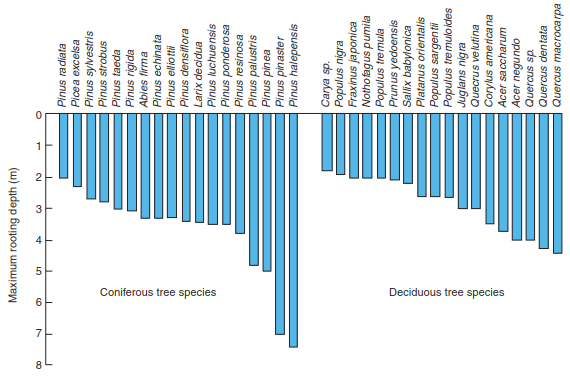
Fig. 20.7. Maximum rooting depth of temperate coniferous and deciduous tree species. Species within functional groups largely vary in trait expression, resulting in substantial overlap between both groups.
Problematic is the categorisation into functional groups when considering traits with high phenotypic plasticity, because the same species may then fall into different groups, depending on the specific trait expression. Another problem with classifications into functional groups is that the ecological roles of plants are not always fully understood. It is easy to understand the function of the group Leguminosae, for example, because of its members’ ability to symbioti- cally fix atmospheric nitrogen, which causes disproportionate effects on ecosystem biogeochemistry (Fig. 20.8) (Sect. 16.3), but note that the degree of N-fixation is also highly plastic and depends on soil N availability, among other factors (Sect. 7.4).
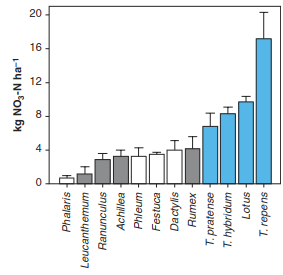
Fig. 20.8. Effects of different species on soil nitrate availability. Species were grown in monocultures under identical environmental conditions, so that differences in soil nitrate availability are only due to ecological differences among species. Legumes (blue) fix nitrogen, but to varying degrees, resulting in higher nitrate values than under forbs (grey) and grasses (white). Phalaris: P. arundinacea, Leucanthemum: L. vulgare, Ranunculus: R. acris, Achillea: A. millefolium, Phleum: P. pratense, Festuca: F. ovina, Dactylis: D. glomerata, Rumex: R. acetosa, Lotus: L. corniculatus, T.: Trifolium
However, for groups such as “grasses” or “herbaceous plants”, this applies only partially (e.g. position of leaves and meristems, capacity to form fine roots). It is thus questionable whether such a priori subdivision of plants is justified for understanding the ecological role of species within the plant community. Classification of species according to functional groups is thus rather difficult for general purposes but might be useful for specific research questions. For example, if one is interested in whether a leaf habit in temperate mixed forests affects litter decomposition rates, the two functional groups “deciduous” versus “evergreen” tree species may already explain a large proportion of the data variability, and it may make a difference whether only one or two of these groups are present.
Date added: 2026-04-26; views: 218;