
Basilica Apostolorum (S. Nazaro)
Milan, about 382-386. Nave with apse: min. L. 58 X 14.2 m. (190 ft. X 46 ft. 7 in.); crossarms each 18.5 x 14.2 m. (60 ft. 8 in. X 46 ft. 7 in.). The Basilica Apostolorum was one of three churches built by St. Ambrose (bishop, 374-397) in the extramural cemeteries ringing Milan. He dedicated it in 386 with relics of the apostles John, Andrew, and Thomas. Presumably brandea, cloths touched to the saints' remains, these relics were kept in a small silver box. Ten years later, when Ambrose discovered a local saint, Nazarius, buried unmarked in a garden, he transferred the body to the Basilica Apostolorum, which since then has been called S. Nazaro.
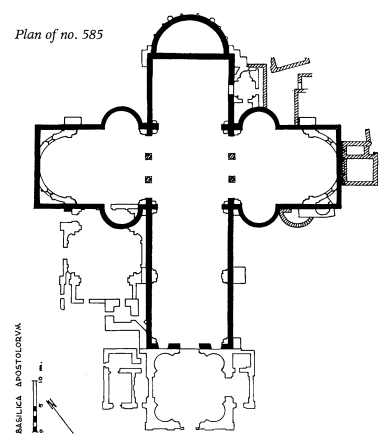
The rising walls of Ambrose's basilica were almost entirely lost to fires in 1071 and 1075, after which the church was rebuilt in its present vaulted, abbreviated form. Excavations have made it possible to reconstruct the primitive building. The nave was intersected by two crossarms, each with two semicircular exedrae near the nave and a rectangular projection at the opposite end. The projections were probably vestibules, though their doorways have not been found. The crossarms were screened from the nave by arcades standing under larger arches that sprang from stone piers embedded in the nave walls. The nave was presumably entered from the south, but the southern wall has not been uncovered. The north end opened in a wide apse, which may have been an addition associated with the translation of St. Nazarius; if so, the north wall was originally rectilinear. Nave, crossarms, and exedrae were covered with pitched roofs and flat wooden ceilings.
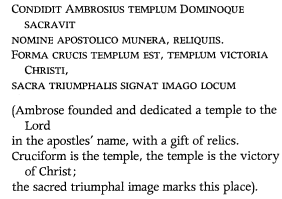
The Basilica Apostolorum may have been patterned on a like-named church in Constantinople, sponsored by Constantine, which also seems to have been cruciform. Like the Constantinopolitan church, the Milanese basilica was centralized in plan, with the nave and the crossarms being equal in width and approximately equal in total length. In elevation, to be sure, the centralization was much less apparent, for the lower, screened-off crossarms were clearly subordinate to the high, continuous nave. Nevertheless, the building was understood as a cross, rather than as a hall with annexes; witness the inscription made to accompany the relics of St. Nazarius:
The role of the Basilica Apostolorum was primarily symbolic; it was a victory monument, probably to the conquest of heresy and possibly also of paganism. Its commemorative nature may explain why no trace of an Early Christian altar has been found; in function, it was perhaps more like Old St. Peter's (no. 581) than an ordinary parish church. In execution, the Basilica Apostolorum is in poignant contrast to its neighbor S. Lorenzo (no. 584), There were no mosaic-covered vaults, few if any marble columns and capitals, and the masonry was a rough mixture of broken bricks, roof tiles, and other debris. Ambrose had no state purse, and he even contemplated melting down church plate to finance his buildings. His basilica was therefore somewhat austere; but it was also a forceful and unusual design, characteristic of its remarkable sponsor.
bibliography: Villa, 1963; Lewis (1), 1969; Lewis (2), 1969; Bovini (1), 1970, pp. 179-217; Tolotti, 1973, pp. 741-754.
Date added: 2026-07-14; views: 140;