
S. Lorenzo. Milan, about 355-374, or about 390
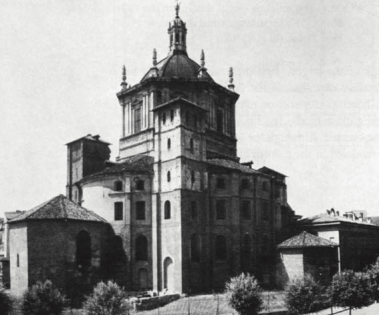
Church diameter, along central north-south axis 47.9 m. (157 ft.); atrium, internal dimensions 25X 28.4 m. (82X 93 ft.). One of the largest, best-preserved, and most impressive churches of the Early Christian period, S. Lorenzo can still be experienced under something close to the conditions prevailing when it was erected. Although the church was extensively remodeled in the twelfth and sixteenth centuries, the original structure is preserved in its main lines and in many of its details.
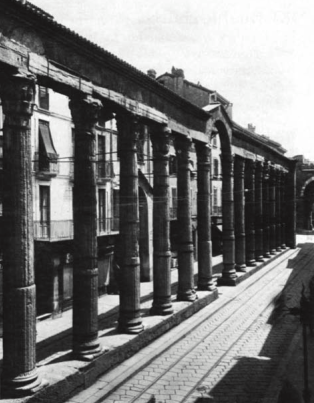
Situated over 650 feet to the south of the city walls along a major Roman highway, the church compound originally consisted of a center space 78 feet square that opened into ambulatories and galleries through double-storied curved columnar exedrae, perimeter walls that repeated the plan of inner quatrefoil, four tall corner towers and apsed narthex, a huge colonnaded (?) atrium, a monumental propylaeum consisting of sixteen reused Corinthian columns, and two projecting chapels. The octagonal chapels laid out to the east (S. Ippolito) and to the south (S. Aquilino) are original, while the Chapel of S. Sisto to the north was added under Bishop Lawrence (489-510/512).
From the outset, the straight walls of a drum rose above the roofs over the curved perimeter walls and enclosed a central covering; the exact form of this drum has not been firmly established. Although pyramidal and domical wooden roofs have been proposed, it is more likely that a groined vault covered the center space. Like the walls of the church, it would have been constructed of brick. The elaborately buttressed corner towers would have absorbed the directional thrusts of such a vault; a vault in the eleventh century is documented. The original silhouette of the church probably bore close resemblance to the north basilica of the double church at Trier, as it was remodeled about 380 by the emperor Gratian (no. 583).
The church was sumptuously decorated with a pavement, probably in opus sectile, marble wall plaques, stucco wall friezes, stucco ornaments in the window soffits, and, according to an eleventh- century source, a mosaic on the central vault. The interior walls of S. Aquilino carried porphyry slabs, and its semidomes contained figural mosaics, the earliest preserved in Milan.
The church was certainly erected in the second half of the fourth century. Since it goes unmentioned in documents of that time, its exact dating varies according to modern interpretations of the style of its masonry, structural techniques, decorative features, and ecclesiastical function or functions.
The specific functions of the church compound remain unresolved. Grabar (1943, I, p. 408) identifies the church as a martyrium, but no relic has been discovered at the site. The patrocinium of St. Lawrence dates from the sixth century. Other identifications of S. Lorenzo include an imperial palace church, a memorial church, a cathedral, and a church serving army units stationed in Milan. The size and opulence of the complex strongly suggest that an emperor subsidized the high cost of its construction and possibly provided the land for it, but this would not establish that the church was intended specifically or exclusively for use by that donor and his retinue. From the outset, S. Aquilino was probably planned as an imperial mausoleum, which would explain why the Laurentian complex was situated to the south of the city walls: Roman law required all burials to take place outside city walls. The function of S. Ippolito remains unknown.
The church is not unique. It is the earliest dated example of some twenty aisled tetraconchs that are known from the Early Christian and medieval periods. The others are located in Italy, North Africa, Greece and the Balkans, Asia Minor, Syria and northern Mesopotamia, Armenia, and Soviet Azerbaijan. Whether this type of building existed before the second half of the fourth century and whether it existed in pagan architecture (e.g., imperial palaces) and was subsequently assimilated into Christian architecture remain unsettled issues.
bibliography: Calderini, Chierici, and Cecchelli, 1951; Kinney, 1970—1971; Kinney, 1972; Lewis (2), 1973; Kleinbauer (2), 1976.
Date added: 2026-07-14; views: 161;