
Land Surface Modeling: Evolution and Coupled Climate Dynamics
Foundational Principles of Terrestrial Surface Modeling. Scientific understanding of land surface processes and terrestrial ecosystems strongly relies on numerical representations of surface energy fluxes, the hydrologic cycle, and biogeochemical cycles. Coupled with atmospheric models, land surface frameworks simulate radiation absorption, sensible and latent heat exchanges, soil heat storage, and canopy drag. Global climate models represent large-scale atmospheric and oceanic circulation alongside land-atmosphere boundary conditions to regulate global energy and moisture transport.
First-Generation Land Surface Frameworks and Aerodynamic Bulk Equations. Early land surface models utilized aerodynamic bulk transfer formulations alongside simple prescriptions for surface albedo, roughness, and soil moisture. Vegetation structures and explicit hydrologic processes were omitted.
The total energy balance at the land surface is expressed by the governing equation:
(1 - r)S↓ + εL↓ = εσTₛ⁴ + H + λE + G
In this formulation, the left side represents net incoming radiative forcing: (1 - r)S↓ is absorbed solar radiation (where S↓ is incoming solar flux and r is surface albedo), and εL↓ is absorbed atmospheric longwave radiation (where L↓ is incoming longwave flux and ε is surface emissivity). The right side balances emitted longwave radiation (εσTₛ⁴, where σ is the Stefan-Boltzmann constant and Tₛ is surface temperature), sensible heat flux (H), latent heat flux (λE), and soil heat storage by conduction (G).
Turbulent sensible and latent heat fluxes were parameterized using single aerodynamic conductances between the surface and atmosphere. Sensible heat flux is expressed as:
H = -cₚ (θₐ - Tₛ) gₐₕ
where cₚ is specific heat capacity, θₐ is atmospheric potential temperature, Tₛ is surface temperature, and gₐₕ is aerodynamic conductance for heat. Latent heat flux is expressed as:
λE = -(cₚ / γ) [eₐ - eₛ(Tₛ)] gₐw * β
where γ is the psychrometric constant, eₐ is vapor pressure, eₛ(Tₛ) is saturation vapor pressure at surface temperature, gₐw is aerodynamic conductance for water vapor, and β is a dimensionless soil wetness factor.
First-generation models simplified canopy radiation transfer and often assumed zero heat capacity for soil. The soil wetness factor β scaled potential evapotranspiration across dry (β = 0) to wet (β = 1) surface conditions. Hydrology was subsequently introduced using bucket models where soil water storage (w) was constrained by a maximum water-holding capacity (w₀):
β = 1 for w ≥ w₀
β = w / w₀ for w < w₀
When soil water w is less than w₀, runoff does not occur, and evapotranspiration decreases as soil moisture depletes. When soil water exceeds w₀, excess precipitation runs off.
Second-Generation Models and Biological Controls. Second-generation models introduced explicit single-layer canopy parameterizations to separate ground fluxes from foliage transpiration and intercepted water evaporation.
Canopy Thermodynamics and Force-Restore Soil Dynamics. Soil thermal and moisture dynamics were expanded using two-layer force-restore formulations. Upper soil layer temperature and moisture respond to rapid diurnal cycles, whereas deeper layers accommodate annual variation. Key second-generation implementations include the Biosphere-Atmosphere Transfer Scheme (BATS) and the Simple Biosphere Model (SiB).
Structural Properties and Hydrologic Controls. Canopy transpiration was explicitly linked to stomatal conductance influenced by solar radiation, ambient temperature, atmospheric vapor pressure deficit, foliage water status, and carbon dioxide concentration. Multilayered snowpack models and Richards equation variants were integrated to resolve soil moisture transport.
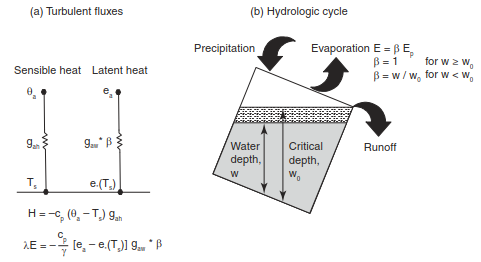
Fig. 25.1. Characteristics of a first generation land surface model illustrating (a) the bulk aerodynamic formulation of sensible and latent heat fluxes and (b) bucket model hydrology. These models represent latent heat flux in terms of an aerodynamic conductance (gₐw) modified by a soil wetness factor (β).
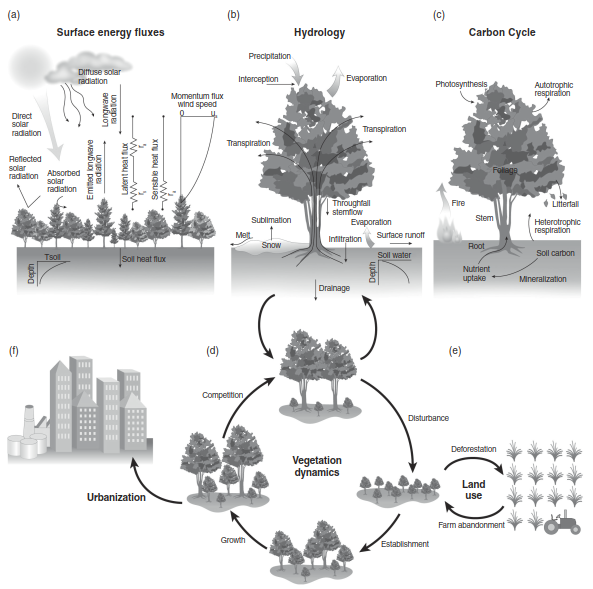
Fig. 25.2. Physical processes by which land affects climate and which are represented in the land surface models used with climate models include (a) surface energy fluxes and (b) the hydrologic cycle. The current generation of Earth system models additionally include biogeochemical and ecosystem processes governing (c) the carbon cycle and (d) vegetation dynamics. Some models also include (e) land use and (f) urbanization to represent human alteration of the biosphere.
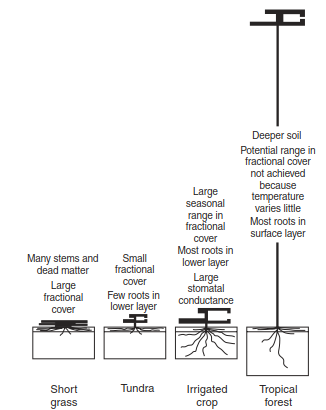
Fig. 25.3. Schematic representation of the morphology of vegetation in the Biosphere–Atmosphere Transfer Scheme.
Third-Generation Models and Coupled Photosynthesis Dynamics. Third-generation models directly coupled leaf photosynthesis with stomatal conductance by integrating the Farquhar-von Caemmerer-Berry photosynthesis model with the Ball-Berry stomatal conductance model.
Biophysical parameters such as maximum carboxylation capacity (V_(c,max)) and maximum potential electron transport rate (J_max) were incorporated to parameterize leaf traits. Canopy-scale integration evolved from simple scaling by leaf area index (LAI) to vertical canopy partitioning into sunlit and shaded leaves based on nitrogen profiles.
Land Cover Characterization and Spatial Heterogeneity. Numerical modeling domains require spatial parameters for vegetation cover, optical properties, roughness length, and leaf area index.
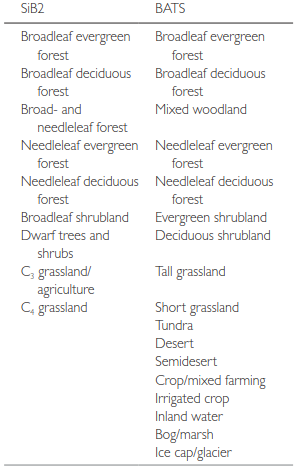
Table 25.1. Land cover types used in the Simple Biosphere Model (SiB2) and the Biosphere–Atmosphere Transfer Scheme (BATS).
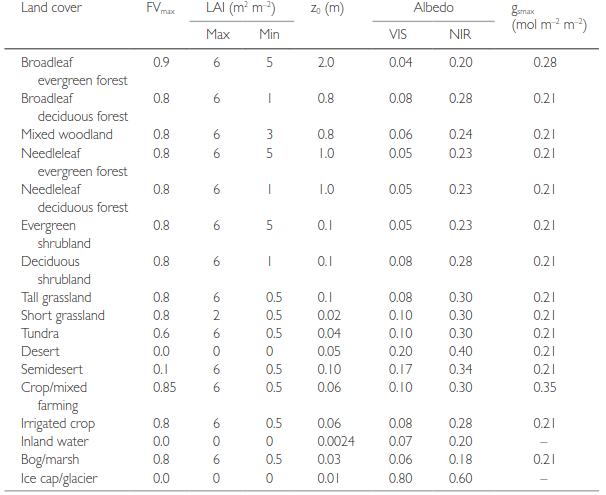
Table 25.2. Vegetation and land cover parameters in the Biosphere–Atmosphere Transfer Scheme (BATS).
Representation of Sub-Grid Heterogeneity. Spatial land surface heterogeneity within grid cells is represented either through statistical probability density functions or tile-based mosaic approaches. Mosaic representations divide individual model grid cells into distinct sub-patches of homogeneous vegetation and soil, computing area-weighted fluxes across patches to maintain surface mass and energy conservation.
Date added: 2026-09-24; views: 2;