
Harnessing Tidal Energy: Systems, Economics, and Ecological Impacts
Historical Context and Tidal Energy Potential. Tidal energy was used to turn mill wheels in the coastal towns of northern Europe during the nineteenth century. The possibility of obtaining large amounts of energy from the tides still exists where there are large tidal ranges or narrow channels with swift tidal currents. There are two systems for extracting energy from the rise and fall of the tides. Both require building a dam across a bay or an estuary so that seawater can be held in the bay at high tide.
Single-Action Ebb Generation. When the tide ebbs, a difference in water-level height is produced between the water behind the dam and the ebbing tide. When the elevation difference becomes sufficient, the seawater behind the dam is released through turbines to produce electrical power. The reservoir behind the dam is refilled on the next rising tide by opening gates in the dam. This single-action system produces power only during a portion of each ebb tide (fig. 10.17a). A tidal range of about 7 m (23 ft) is required for this system to produce power.
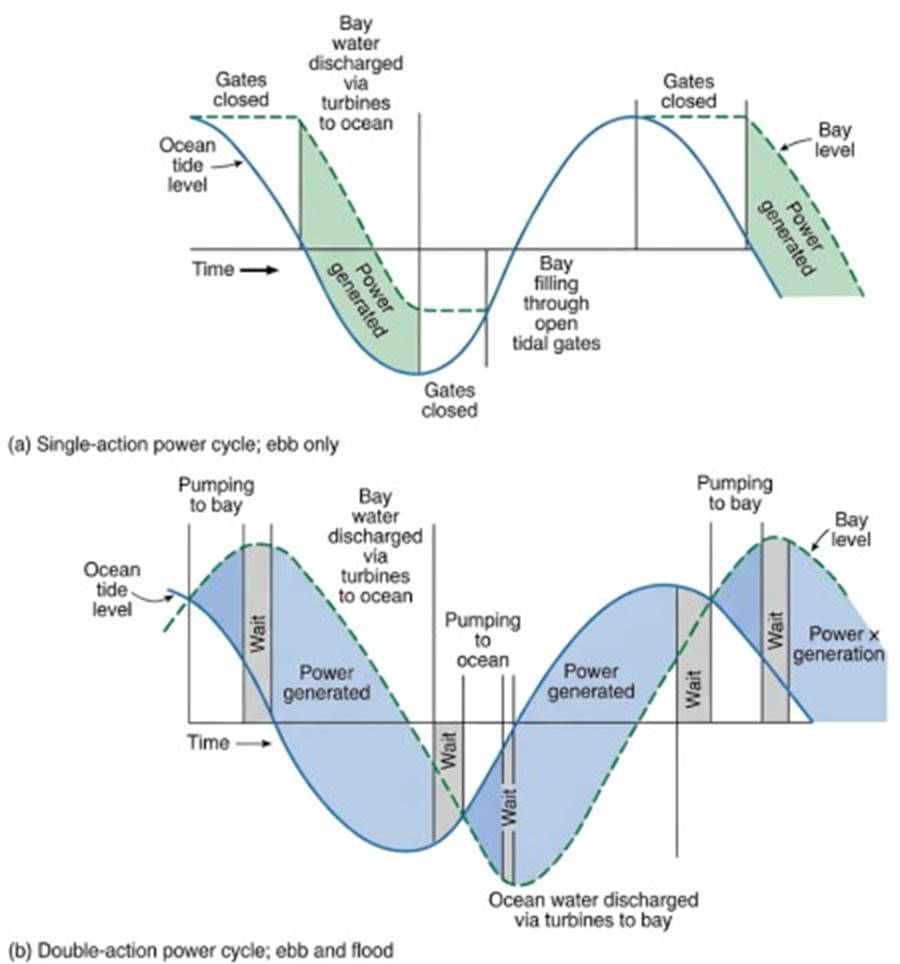
Fig. 10.17. Periods of power generation related to ocean tidal heights and water storage levels. (a) A single-action tidal power system. Power is generated on the ebb tide. (b) A double-action tidal power system. Power is generated on the ebb and flood tides.
Double-Action Flood and Ebb Generation. This same arrangement can be used as a double-action system. In this system, power is produced on the ebbing tide. At the end of this power cycle, when the level behind the dam is not sufficient to produce power, the gates are opened and the last of the water in the reservoir is spilled out to sea. The gates are then closed and some of the remaining water in the bay is pumped seaward to further decrease the water level. Although the pumps consume power, this expenditure of energy is worthwhile if the pumping period occurs when power demands are low and if the additional increase in height between water levels allows more power to be produced on the next cycle.
The gates are kept closed and the tide rises on the seaward side of the dam while the reservoir level remains low. When the difference in height is great enough, the incoming water is released through the turbines into the reservoir to produce power. At the end of the rising tide the dam is sealed, and water is pumped into the reservoir to raise the reservoir to its maximum level; when the tide drops on the seaward side, the cycle is repeated. This system requires very specialized turbine systems because the water moves through the turbines in two directions, and the turbines must be able to generate power on both the flood and ebb tides. A sketch of the power cycle of such a double-action system is presented in figure 10.17b.
Economic and Geographic Constraints. This system appears to be a simple and cost-effective method for producing electrical power, but there are few places in the world where the tidal range is sufficient and where natural bays or estuaries can be dammed at their entrances at reasonable cost and effort. Moreover, the appropriate tides and bays are not necessarily located near population centers that need the power. Installation and power-distribution costs in addition to periodic low power production because of the changing tidal amplitude over the tide's monthly cycle make this type of power more expensive than other sources.
There is a thirty-year-old commercial tidal power installation on the La Rance River Estuary in France that produces 5.4 × 10¹⁰ watt-hours per year. Present global energy demands could be satisfied by 250,000 plants of this capacity, but there are only about 255 sites that have been identified around the world with the potential for tidal energy development.
Tidal power has been under consideration for the Bay of Fundy since the 1930s. Canadian and American interest was casual because of the expense of the project, until the rising cost of fossil fuels focused interest on alternative energy sources. Nova Scotia is currently actively pursuing the development of sites in the Minas and Cumberland basins at the head of the Bay of Fundy. The Minas Basin site would have a capacity of 5300 megawatts and the Cumberland Basin site would produce 1400 megawatts.
Ultimately, the development of one or both of these sites will depend upon obtaining financing for the multimillion-dollar projects, securing markets in the northeastern United States for excess power, coordinating intermittent tidal energy with other, more conventional methods of producing electrical power, and mitigating potential environmental effects of the project. On the U.S. side of the bay, Cobscook Bay and Half-Moon Cove in Maine are being considered as potential power-generating sites.
The U.S. Army Corps of Engineers is interested in the Cobscook Bay site, and the Passamaquoddy Indian Tribe has proposed a 12-megawatt development at Half-Moon Cove.
The province of Nova Scotia commissioned a power station in the tidal estuary of the Annapolis River in 1984 (fig. 10.18). The world's largest straight-flow-rim type turbine generator has been used to produce power in a single-basin-single-effect scheme. Tidal ranges at the Annapolis site vary from 8.7 m (29 ft) during spring tides to 4.4 m (14 ft) during neap tides. The unit generates up to 20 megawatts of power, from the head of water developed between the upstream basin and the sea level downstream at low tide.
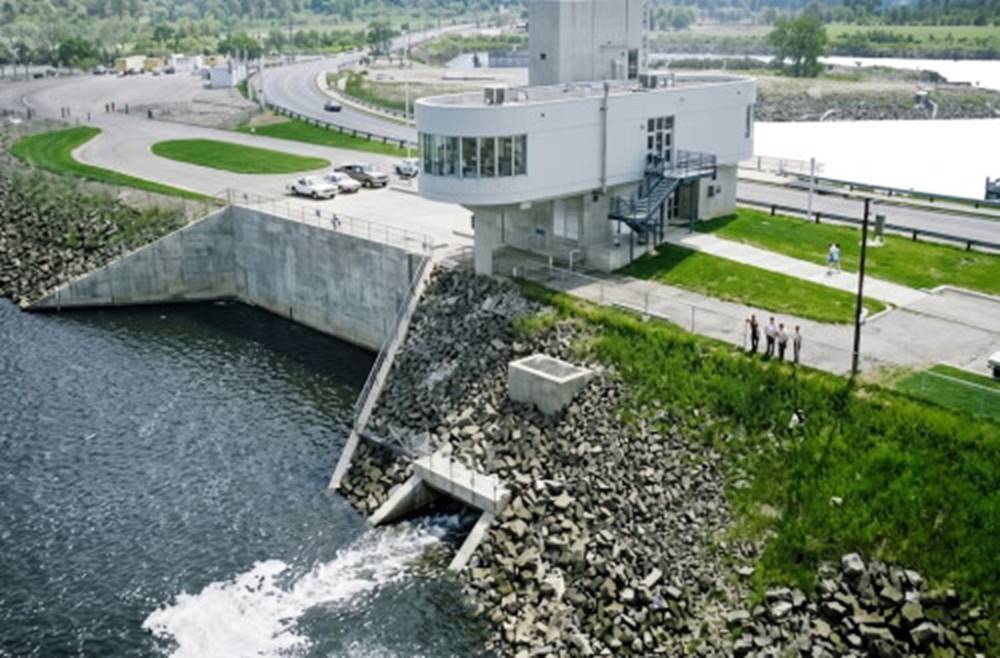
Fig. 10.18. The Annapolis River tidal power project is the first tidal power plant in North America.
Initially, this project was intended as a pilot project to demonstrate the feasibility of a large-scale straight-flow turbine in a tidal setting. The station has now been added to the province's principal electrical utility's hydro-generating system. Annual production from the unit is 3–4 × 10¹⁰ watt-hours. Power availability has been in excess of 95%.
Ecological and Environmental Impacts. Although tidal power does not release pollutants, it is not without environmental consequences. The dams isolate the bay from the rivers and estuaries with which it was previously connected. At present, the natural period of oscillation of the Bay of Fundy is about thirty minutes longer than the tidal period; these periods are sufficiently alike to resonate with the tides. Damming the bay will shorten the period of oscillation and increase the resonance in the bay.
It is estimated that this may increase tidal ranges by 0.5 m (20 in) and tidal currents by 5% along the coast of Maine. Coastal residents fear increased erosion and changes affecting the shellfish populations. The damming of a bay or estuary interferes with ship travel and with port facilities. The dams are barriers to migratory species and alter the circulation patterns of the isolated basin.
Tidal Current Energy Extraction. Swift tidal currents in inshore channels represent another possible energy source. Flowing water has been used for several centuries to turn the equivalent of windmills or water wheels for limited power. Because the tidal currents reverse with the tide, these “water mills” must be installed to operate with the current flowing in either direction (fig. 10.19).
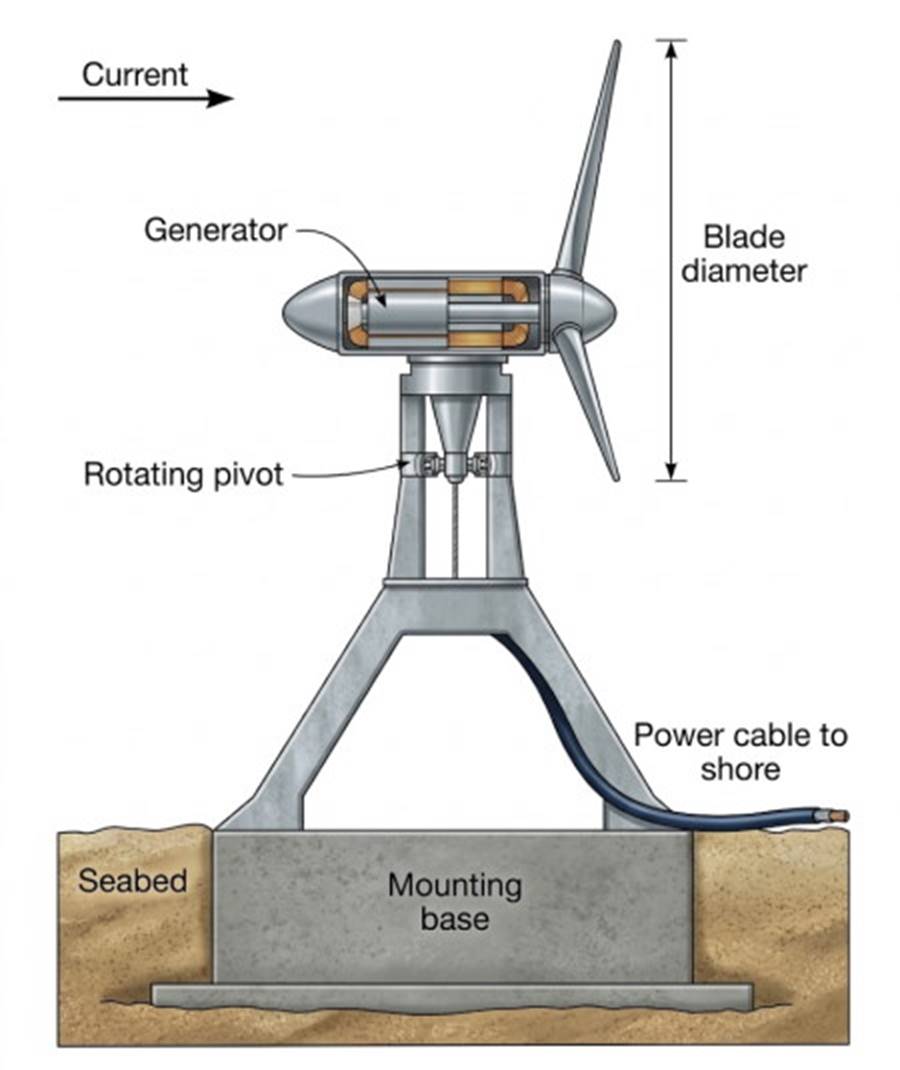
Fig. 10.19. A water mill designed to utilize tidal current energy. Power production is related to blade size and current speed.
Power generated by windmills is dependent on the density of the air, the blade diameter, and the cube of the wind speed. Water mills with a similar design are dependent on the density of the water, the blade diameter, and the cube of the current speed (see table 10.4). A windmill in a 20-knot wind will produce about the same power as a water mill with blades of the same diameter in a 2-knot current, because the density of water is about 1000 times the density of air:
- 0.001 g/cm³ × (20 knots)³ = 1 g/cm³ × (2 knots)³
- air density × (speed)³ = water density × (speed)³.
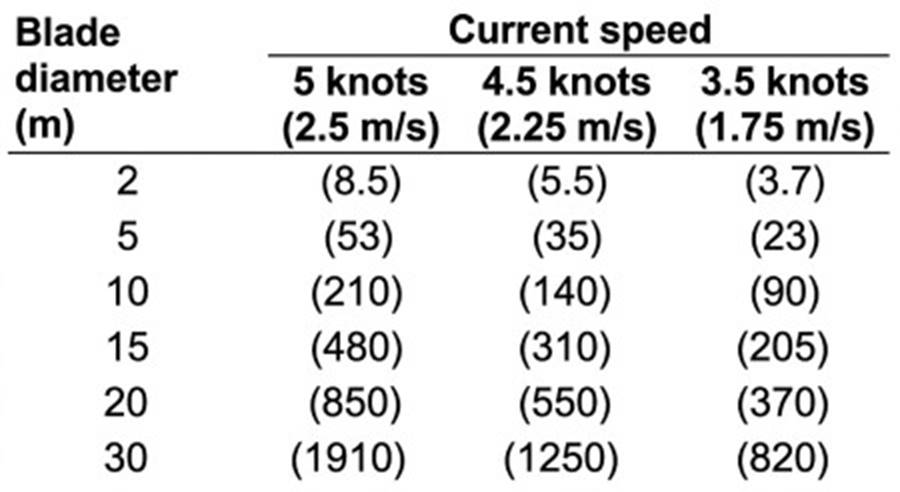
Table 10.4. Estimated Power Generation (in kW) for Water Mills at Various Current Speeds
A 2 × 10⁶ watt wind-generating unit installed on land has a blade nearly 210 feet in diameter mounted on a 120-foot tower. Installation costs are around $1.6 million. The cost of installing and maintaining a similar-sized unit in a tidal channel submerged in seawater would be much greater, and such a unit would still suffer from periodic loss of power production during slack water. These enormous units could be navigation hazards, and channels of sufficient depth with currents of the required speed are few and not easily accessible.
A submerged current turbine has been tested in England. The turbine has a 4-m (13-ft) rotor and is designed to drive a generator producing a maximum of 10 kW of power. The power directly generated by the currents will be stored in batteries to be used at a lower rate over a longer period of time. Perhaps this device could be useful in remote areas that are difficult to supply with electrical power from land sources.
Summary of Tidal Dynamics. Diurnal tides have one high tide and one low tide each tidal day; semidiurnal tides have two high tides and two low tides. A semidiurnal mixed tide has two high tides and two low tides, but the high tides reach different heights and the low tides drop to different levels. For diurnal and semidiurnal tides, the greatest height reached by the water is high water, and the lowest point is low water. Mixed tides have higher high water, lower high water, higher low water, and lower low water. The zero depth on charts is referenced to mean low water or mean lower low water; low tides falling below these levels are minus tides. Rising tides are flood tides; falling tides are ebb tides.
Equilibrium tidal theory is used to explain the tides as a balance between gravity and an apparent centrifugal force. An equatorial tide is a semidiurnal tide, or a tide wave with two crests and two troughs. Because the Moon moves along its orbit as the Earth rotates on its axis, a tidal day is twenty-four hours and fifty minutes long. The period of the semidiurnal tide is therefore twelve hours and twenty-five minutes.
The Sun's effect is less than half that of the Moon's, and the tidal day with respect to the Sun is twenty-four hours. Because the tidal force of the Moon is greater than that of the Sun, the tidal day is still considered to be twenty-four hours and fifty minutes. Spring tides have the greatest range between high and low water; they occur at the new and full Moons, when the Earth, Sun, and Moon are in line. Neap tides have the least tidal range; they occur at the Moon's first and last quarters, when the Moon is at right angles to the line of centers of the Earth and Sun.
When the Moon or Sun stands above or below the equator, equatorial tides become more diurnal. Diurnal tides are often called declinational tides. The elliptic orbits of the Earth and Moon also influence the tide. The dynamic approach to tides investigates the actual tides as they occur in the ocean basins. The tide wave is discontinuous, except in the Southern Ocean. It is a shallow-water wave that oscillates in some ocean basins as a standing wave, and its motions persist long enough to be acted on by the Coriolis effect. The tide wave is reflected, refracted, and diffracted along its route.
Because a point on the Earth moves eastward faster at the equator than the tide wave progresses westward as a free wave, the tide wave moves as a forced wave, and its crest is displaced to the east of the tide-raising body. Above 60°N and 60°S latitudes, the crest is more nearly in line with the Moon, because the speeds of Earth and the tide wave match more closely. In large ocean basins, the tide wave can move as a progressive wave. The Coriolis effect causes a rotary tidal current.
Standing wave tides can also form in ocean basins; they rotate around an amphidromic point as they oscillate. Cotidal lines mark the progression of the tide crest, and regions of equal tidal range are identified by corange lines. The tidal range increases with the distance from an amphidromic point. Standing wave tides in narrow open-ended basins oscillate about a node at the entrance to the bay or basin; the antinode is at the head of the basin, as in the Bay of Fundy. There is no rotary motion when a bay is very narrow. A rapidly moving tidal bore is caused when a large-amplitude tide wave moves into a shallow bay or river.
Tidal heights and currents are predicted from astronomical data and actual local measurements. NOAA provides data for annual tide and tidal current tables. Single- and double-action dam and turbine systems extract energy from the tides. Tidal power plants are in use in France, the former Soviet Union, and Canada. Few places have large enough tidal ranges and suitable locations for tidal dams. Tidal power has environmental drawbacks as well as high developmental costs. Tidal currents are another energy-producing possibility, but installation and service costs are considered high.
Date added: 2026-11-09; views: 6;