
Expanding the Scope: The Ecology and Biogeography of Soil Fungi and Archaea
While the previous section focused on bacteria, the soil microbial world is fundamentally tripartite, encompassing bacteria, fungi, and archaea. Traditional studies of soil fungi paralleled early bacterial ecology, relying on culturing or observing fruiting bodies like mushrooms. Both methods present a heavily biased view, as only a minor fraction of fungi are cultivable, and many do not produce macroscopic reproductive structures. Consequently, initial research disproportionately focused on these observable subsets, neglecting the vast, uncultivated majority of fungal diversity within the soil.
The methodological evolution for studying fungal communities closely mirrors the timeline for bacteria, as indicated in Fig. 7.1. A persistent paradigm, even with advanced molecular tools, is the dominance of a few common species alongside a "long tail" of rare species. The primary change has been in the resolution of detection and the vastly increased estimates of total species richness. Cutting-edge molecular analyses now suggest a single gram of forest soil may contain over 1000 fungal species. Historically classified by reproductive morphology, fungi are now identified by comparing environmental DNA sequences to databases populated from morphologically identified specimens, though these repositories remain incomplete for the estimated 95% of fungal species yet to be formally described.
Functionally, soil fungi are diverse. Most act as saprotrophs, decomposing dead organic matter. A significant minority are parasites causing important plant and animal diseases. Furthermore, many engage in symbiosis, such as forming mycorrhizas for nutrient exchange or living as asymptomatic root endophytes. Fungi exhibit two primary growth forms: unicellular yeasts and filamentous hyphae that branch to form extensive networks called mycelia. Mycelial systems can be immense; fairy rings in grasslands, representing advancing mycelial fronts, are visible evidence of large individual fungi (see Fig. 7.2). Some individuals cover hundreds of hectares, potentially living for millennia, with soil hyphal biomass reaching 700-900 kg per hectare in forest systems.
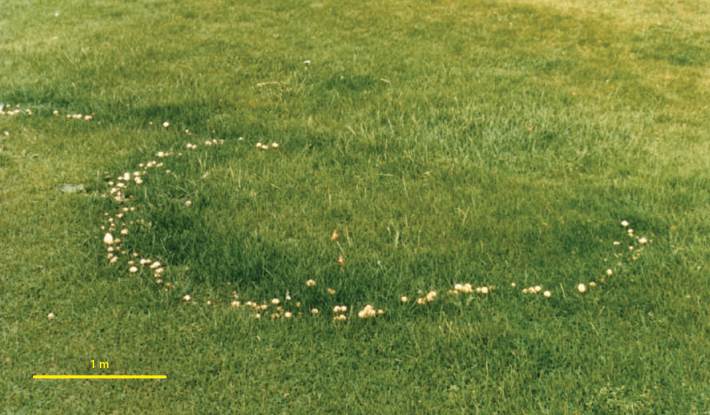
Fig. 7.2: A fairy ring with fruiting bodies growing at the advancing mycelial front
The Biogeography of Fungi. Fungal spores are physically adapted for dispersal, leading to a long-held assumption that their distribution adhered to the "everything is everywhere" hypothesis, making them poor biogeographic indicators. This view is now being challenged by molecular tools revealing clear geographic genetic patterns. Studies document post-glacial migrations, such as the northward expansion of the Perigord truffle (Tuber melanosporum) from glacial refugia. Even older distribution patterns, linked to continental drift and population fragmentation between Eurasia and North America, suggest genetic isolation and speciation, contradicting the idea of universal dispersal.
Archaeal Diversity and Significance. The third microbial domain, archaea, comprises single-celled, nucleus-lacking organisms superficially similar to bacteria. However, fundamental differences in genetics, metabolism, and cellular structure reveal an independent evolutionary history. Notably, archaeal cell membrane lipids differ drastically from bacteria and eukaryotes, and similar lipids found in 3.5-billion-year-old sediments suggest this lineage may be Earth's most ancient. These distinctions necessitated a taxonomic revision, leading to the three-domain system of life: Bacteria, Archaea, and Eukarya.
Originally characterized as extremophiles inhabiting environments like hot springs, archaea are now known to be ubiquitous, including in soils, and may constitute up to 20% of Earth's biomass. They play crucial roles in global biogeochemical cycles, including carbon, nitrogen, and sulfur transformations. Importantly, some archaea exhibit restricted species ranges, with community structures varying even between adjacent hot springs. This provides evidence against universal microbial dispersal, even at relatively small spatial scales, further refining our understanding of microbial biogeography.
Date added: 2025-12-15; views: 420;