
Soil Fauna Classification: Geobionts, Geophiles, and Vertebrate Impacts on Soil Ecology
The interactions between soil organisms and the soil matrix exhibit significant variability across different taxa and depend substantially on the specific life cycle stages spent within the soil environment. Based on morphological adaptations and ecological functions, soil fauna can be classified into four primary functional groups: temporary inactive geophiles, temporary active geophiles, periodical geophiles, and geobionts (Fig. 7.10). This classification system is based on life strategies rather than taxonomic relationships, providing a crucial framework for understanding the ecological roles and vulnerabilities of soil invertebrates. The degree of dependence on the soil habitat directly influences an organism's contribution to soil processes and its resilience to environmental disturbances.
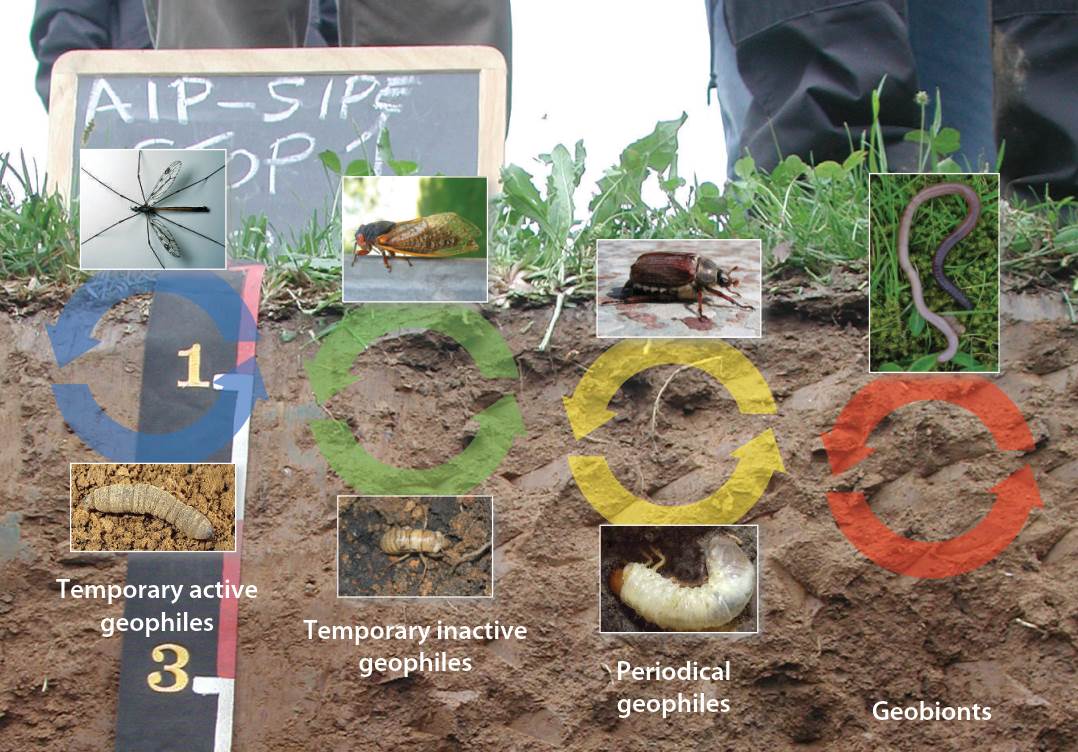
Fig. 7.10: The main four groupings that can be formed of soil invertebrates, depending on their life strategies and how closely they are linked with soil. The image contains examples of organisms from each group, showing both the larval and adult stages of each organism where applicable. Alternative terminology that is also used refers to temporary, transient and permanent edafon. The meanings are synonymous with those listed above
Temporary inactive geophiles are organisms that utilize the soil only for specific, often dormant, life phases such as overwintering or metamorphosis. During these periods, the soil provides critical protection from climatic extremes like temperature fluctuations and desiccation. Due to their inactive state and transient presence, these organisms exert a relatively weak direct influence on soil ecological functions. However, they can play an important indirect role as a prey resource for more permanent soil-dwelling predators, thereby integrating into the soil food web.
In contrast, temporary active geophiles reside in the soil in a stable manner for a large portion of their life cycle, typically during one or more developmental stages, and emerge as adults. This group is predominantly composed of insects, including cicadas, Neuroptera, Diptera, Coleoptera, and Lepidoptera. Their ecological impact is largely dictated by their life stage; the larval phase is often profoundly important, especially at high population densities, where larvae may act as detritivores or predators. The pupal stage, however, is usually metabolically inactive and thus contributes minimally to soil processes during that period.
Periodical geophiles spend a defined developmental phase, generally as larvae, within the soil but maintain a lifelong facultative relationship with it. As adults, they periodically return to the soil for activities such as hunting, oviposition (laying eggs), or seeking refuge from danger. Many Coleoptera families, including Carabidae (ground beetles), Scarabaeidae (scarabs), and Cicindelidae (tiger beetles), exemplify this strategy. They utilize the soil as a multifaceted resource—a nursery for juveniles, a hunting ground, and a shelter—maintaining a continuous ecological link with the edaphic environment.
The most soil-adapted group are the geobionts, organisms so specialized that they cannot survive outside the soil habitat, even temporarily. Their physiological and morphological adaptations, which may include a lack of protection against desiccation, sensitivity to temperature extremes, and underdeveloped sensory organs for surface navigation, bind them permanently to the soil. This group encompasses many species of Myriapods, Isopods, Acari (mites), Molluscs, and the vast majority of Collembola (springtails), Diplura, and Protura. Their entire existence is intertwined with soil processes.
These distinct relationship types determine differential vulnerability among groups to soil disturbances. For instance, a contamination event would most severely impact geobionts, which cannot escape the affected medium and must spend their entire lifecycle within it. Conversely, temporary inactive geophiles would experience the lowest direct impact due to their limited and intermittent exposure. This principle is applied in bioindication tools, such as the QBS (Soil Biological Quality) index developed by the University of Parma, Italy, which uses soil microarthropod communities to assess ecological soil health.
The Relationship Between Soil and Vertebrates. While often overlooked in soil food web analyses, vertebrates can significantly influence soil ecosystems through various engineering activities. Many vertebrates, including birds, rodents, lizards, anurans (toads and frogs), and mammals like foxes and badgers, create dens or nests in the soil. These structures typically have a limited direct impact on soil communities but can form mini-ecosystems for other fauna. The accumulation of organic debris within them promotes fungal growth, which supports insects and mites, thereby creating a localized food resource for the vertebrates themselves.
Vertebrates that are dedicated burrowers, such as moles, prairie dogs, and many rodents, exert a more substantial impact on soil communities and structure. Their bioturbation activity—bringing subsurface mineral material to the surface—initiates critical processes. This excavated material is weathered, incorporated with organic matter, and redistributed by wind and water. This mixing alters the texture, composition, and aeration of the topsoil, enhancing its fertility and heterogeneity. Furthermore, vertebrates contribute organic inputs through faeces, urine, and carcasses, which are rich sources of nutrients like nitrogen and phosphorus.
However, vertebrate associations with soil are not universally beneficial. Intensive burrowing can destabilize soil structure, increasing susceptibility to erosion and hindering natural revegetation, potentially leading to a decline in certain soil species. Similarly, the trampling and compaction caused by livestock can have severe detrimental effects. Soil compaction reduces porosity, leading to waterlogging, increased surface runoff, and ultimately, accelerated erosion. This degradation diminishes habitat quality for soil fauna and compromises essential ecosystem services.
In summary, the classification of soil fauna from geobionts to various geophiles provides a functional understanding of their ecological integration and vulnerability. Concurrently, vertebrate activities, from burrowing to compaction, represent powerful top-down forces that can either enhance or degrade soil habitat complexity. Recognizing these intricate relationships is fundamental for comprehensive soil ecology studies, effective conservation planning, and the accurate application of biological indicators for soil health monitoring.
Date added: 2025-12-15; views: 564;