
Pleistocene Glaciations and Climate Cycles: Evidence from Ice Core Records
Orbital-Scale Glacial Cycles in the Northern Hemisphere. Over the past several hundred thousand years, the Northern Hemisphere has experienced cyclical glacial advance and retreat with a dominant periodicity of approximately 100 kyr. Each complete glaciation-deglaciation cycle typically requires about 90 kyr for ice sheet buildup, followed by relatively rapid deglaciation occurring over roughly 10 kyr. These climatic oscillations represent fundamental responses to changes in Earth's orbital parameters, which modulate the distribution of solar radiation received at high latitudes. The systematic nature of these glacial cycles demonstrates the complex interactions between cryospheric processes, atmospheric circulation patterns, and global energy balance that characterize Earth's climate system on geological timescales.
Ice Core Proxies as Archives of Paleoclimate. Deep ice cores extracted from the Greenland and Antarctic ice sheets preserve comprehensive records of Earth's climatic history, providing direct evidence for recurring ice ages. As glaciers accumulate, atmospheric gases become trapped within the ice matrix, creating time capsules that archive both the temperature conditions and atmospheric chemical composition prevailing during ice formation. The analysis of trapped air bubbles, along with isotopic composition of the ice itself, enables paleoclimatologists to reconstruct past environmental conditions with remarkable precision. These frozen archives represent the most continuous and high-resolution records available for understanding Quaternary climate variability, offering insights into natural climate forcing mechanisms before anthropogenic influence.
The Vostok ice core from Antarctica, extending to 2,755 meters depth, documents climate evolution over the past 250 kyr BP with exceptional clarity. This record identifies two distinct cold intervals: the first commencing approximately 190 kyr BP and persisting until 140 kyr BP, followed by a second glacial period beginning about 115 kyr BP and continuing until 18 kyr BP (Figure 8.1). During these glacial phases, global temperatures stood several degrees below pre-industrial levels, with corresponding adjustments in atmospheric circulation and ecosystem distribution. The Vostok record equally captures interglacial warmth between approximately 140-125 kyr BP and the current Holocene interglacial beginning about 15 kyr BP, when temperatures warmed substantially. These temperature reconstructions demonstrate the natural amplitude of climate variability inherent in the Earth system prior to significant anthropogenic forcing.
The European Project for Ice Coring in Antarctica (EPICA Dome C ice core) extends the climate record considerably further, spanning 800 kyr across eight complete glacial cycles (Figure 8.2). This longer perspective reveals consistent relationships between climate state and atmospheric composition, with glacial periods characterized by substantially reduced concentrations of carbon dioxide (CO₂), methane (CH₄), and nitrous oxide (N₂O) . The covariance between greenhouse gas concentrations and temperature across multiple glacial-interglacial transitions indicates powerful biogeochemical feedback mechanisms linking the carbon cycle with climate dynamics. As noted by Masson-Delmotte et al. (2013), these ice core records establish beyond reasonable doubt the close coupling between atmospheric greenhouse gas levels and global temperatures throughout the late Pleistocene.
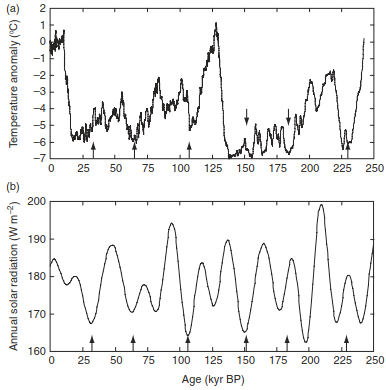
Figure 8.1 presents the reconstructed climate history for the past 250 kyr from the Vostok ice core, showing temperature deviation from present conditions (Jouzel et al. 1996) alongside annual solar radiation at 60° north latitude (Berger 1978; Berger and Loutre 1991). This latitude receives particular attention because summer insolation at high northern latitudes critically influences glacier mass balance through its control on summer melt rates. Arrows highlight periods of reduced solar radiation corresponding to glacial initiation. Data availability through the National Geophysical Data Center (National Oceanic and Atmospheric Administration, Boulder, Colorado) ensures these fundamental paleoclimate records remain accessible for continued scientific investigation.
Initiation and Maximum Extent of the Last Glacial Period. The onset of the Last Glacial Period commenced approximately 115 kyr BP, characterized by rapid temperature decline of several degrees across high-latitude regions. This initial cooling marked the transition from the last interglacial (Eemian) warmth to increasingly glacial conditions. A particularly severe cold phase beginning around 75 kyr BP accelerated ice sheet growth, ushering in the main phase of glacial development. Ice accumulation continued progressively until reaching maximum extent during the Last Glacial Maximum (LGM) , dated to approximately 18-21 kyr BP (Figure 8.3). The LGM represents the most recent interval when global ice volume reached its peak, providing a benchmark for understanding fully glaciated Earth system conditions.
At glacial maximum, massive ice sheets covered extensive portions of the Northern Hemisphere continents. The Cordilleran ice sheet blanketed western North America, while the Laurentide ice sheet—the largest ice mass—covered the eastern and central portions of the continent. Greenland, Iceland, and substantial areas of northern Europe and Russia lay beneath thick ice cover. These continental-scale ice masses attained thicknesses exceeding one kilometer across most of their extent, with central regions reaching two or more kilometers deep. The immense weight of these ice sheets depressed the underlying crust, while their high albedo modified regional and global climate patterns through enhanced reflection of incoming solar radiation.
Subsequent climate warming initiated rapid deglaciation, with ice retreat occurring over approximately 6 kyr. As glaciers withdrew, previously ice-covered terrain became available for ecological succession. Plants colonized the freshly exposed soils, and vegetation communities that had persisted in southern refugia migrated northward to occupy newly deglaciated landscapes. This vegetation migration tracked the shifting climatic zones, though with inevitable lags that produced transient ecosystem configurations without modern analogues. The transition from glacial to interglacial conditions represents one of the most dramatic environmental transformations in Earth's recent geological history.
Insolation Forcing of Glacial-Interglacial Transitions. The deglacial warming following the LGM originated primarily from changes in insolation driven by Earth's orbital variations (Kutzbach and Guetter 1986; COHMAP 1988; Huntley and Webb 1988; Wright et al. 1993). At 18 kyr BP, Northern Hemisphere solar radiation receipt approximated modern values. Over subsequent millennia, however, summer insolation in the Northern Hemisphere progressively increased while winter radiation correspondingly decreased (Figure 8.4). This enhanced seasonality—warmer summers coupled with colder winters—resulted from changes in orbital parameters including eccentricity, obliquity, and precession that modify the Earth-Sun geometry through time.
The increased summer radiation proved critical for deglaciation through its direct effect on ice sheet ablation. Warmer summer temperatures intensified melting at ice sheet margins and lower elevations, while the accompanying reduction in winter radiation had minimal effect on ice accumulation because cold winter temperatures already limited snowfall. This asymmetric response to seasonal insolation changes explains why summer radiation increases drive deglaciation while winter decreases have limited impact. The greatest enhancement of Northern Hemisphere summer radiation occurred between 12 and 6 kyr BP, when seasonality reached its postglacial maximum. Summer solar radiation exceeded present values by approximately 8% (equivalent to 30 W m⁻²), while winter radiation fell below modern levels by comparable magnitude.
These insolation changes produced significant climatic responses across the Northern Hemisphere. Continental interiors experienced warmer-than-present conditions during the early to middle Holocene, while monsoon regions exhibited enhanced precipitation. Northern Africa, in particular, received substantially greater rainfall than today, supporting expanded lakes and more extensive vegetation cover in what is now the Sahara Desert. This "Green Sahara" period demonstrates the sensitivity of monsoon systems to insolation forcing. Since the mid-Holocene, summer radiation has decreased and winter radiation increased, gradually approaching present orbital configuration with corresponding adjustments in global climate patterns.
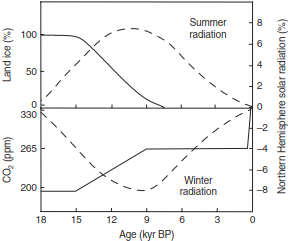
Figure 8.4 illustrates the coordinated changes among solar radiation, atmospheric CO₂ concentration, and glacier volume over the past 18 kyr. Land ice appears as percentage of the ice volume present at 18 kyr BP, showing progressive decline through the deglaciation. Northern Hemisphere solar radiation (dashed lines) appears for summer (June–August) and winter (December–February) expressed as percentage difference from present values. The close correspondence among these records demonstrates the coupled nature of orbital forcing, greenhouse gas responses, and cryospheric change during glacial-interglacial transitions (adapted from Kutzbach and Guetter 1986, COHMAP 1988, and Kutzbach and Webb 1993).
Abrupt Climate Events During Deglaciation. Ice core records and complementary paleoclimate proxies reveal that deglacial warming did not proceed monotonically but instead included abrupt climate changes of considerable magnitude (Alley et al. 2002, 2003; Masson-Delmotte et al. 2013). Temperature shifts of several degrees occurred repeatedly throughout the Northern Hemisphere, with transitions completed in periods as short as years to decades. These rapid changes demonstrate the existence of threshold behavior in the climate system, where gradual forcing can trigger abrupt reorganization when critical thresholds are crossed. The mechanisms underlying such events typically involve changes in ocean circulation, particularly the Atlantic Meridional Overturning Circulation (AMOC) , which transports heat northward in the Atlantic basin.
The most prominent of these deglacial events was the Younger Dryas cold period, which extended from approximately 12.8 to 11.5 kyr BP. Following substantial warming that had largely ended the ice age, temperatures abruptly declined across North America and Europe, returning to near-glacial conditions. Newly established forests retreated, replaced by tundra vegetation characteristic of cold environments. Glaciers, which had been in retreat, advanced southward and down mountain valleys. This cold reversal persisted for roughly 1300 years before equally rapid warming resumed, marking the final transition to Holocene conditions. The Younger Dryas demonstrates that deglaciation can be interrupted by major climate reversals when freshwater inputs to the North Atlantic disrupt deep water formation and poleward heat transport.
A second significant cold event occurred approximately 8.2 kyr BP, recorded most clearly in Greenland ice cores where temperatures cooled by 2-6°C (Alley and Agustsdottir 2005; Masson-Delmotte et al. 2013). This 8.2 kyr event extended its influence to North America and Europe, though with reduced amplitude compared to Greenland. The event resulted from the final drainage of glacial lakes Agassiz and Ojibway, which released enormous volumes of freshwater into the North Atlantic and temporarily suppressed AMOC strength. The 8.2 kyr event represents the largest abrupt climate event of the Holocene and provides a valuable analogue for understanding the potential impacts of future freshwater forcing on ocean circulation.
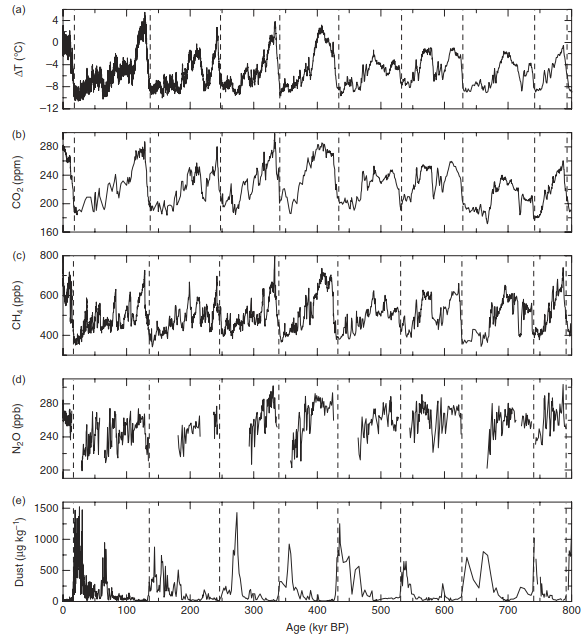
Figure 8.2 presents the extended EPICA Dome C record showing eight glacial cycles with their associated variations in temperature, greenhouse gases, and dust concentration. Panel (a) shows temperature deviation (Jouzel et al. 2007); (b) CO₂ concentration (Lüthi et al. 2008); (c) CH₄ concentration (Loulergue et al. 2008); (d) N₂O concentration (Schilt et al. 2010); and (e) dust concentration (Lambert et al. 2008). Dashed vertical lines indicate approximate glacial terminations, demonstrating the recurrent pattern of glacial-interglacial transitions. Data provided by the National Climatic Data Center Paleoclimatology program (National Oceanic and Atmospheric Administration, Boulder, Colorado) ensures these foundational records remain available for ongoing research.
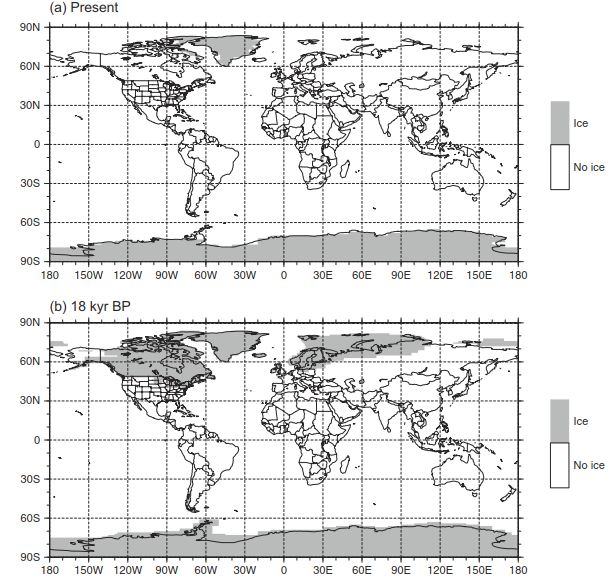
Figure 8.3 compares the geographic distribution of glaciers between (a) present-day and (b) 18 kyr BP conditions. The contrast illustrates the extraordinary extent of LGM ice cover compared to modern glaciers restricted primarily to Greenland, Antarctica, and high mountain regions. Data from Peltier (1994) and provided by the National Geophysical Data Center (National Oceanic and Atmospheric Administration, Boulder, Colorado) underpins these reconstructions of past ice sheet geometry.
Late Holocene Climate Variability. Climate also varies over shorter, centennial to millennial timescales during interglacial periods (Masson-Delmotte et al. 2013). Figure 8.5 depicts Northern Hemisphere temperature reconstructions for the past 1500 years, revealing significant pre-industrial climate variability. The Medieval Warm Period (approximately AD 950-1250) featured relatively mild conditions across many regions, though with substantial spatial heterogeneity in the magnitude and timing of warmth. This interval allowed agricultural expansion into higher latitudes and elevations, with documented impacts on human societies.
Following the Medieval Warm Period, climate entered a more variable regime characterized by alternating cold and mild winters. Beginning around AD 1550, conditions deteriorated into the prolonged cooling known as the Little Ice Age, which persisted until approximately AD 1850 with its most intense phase from 1550-1700. During this interval, winters extended longer and grew colder while summers shortened. Alpine glaciers advanced to lower elevations, overrunning farmland and villages in some cases. The Little Ice Age represents the most recent natural climate oscillation before the industrial era, with causes including reduced solar irradiance, increased volcanic activity, and associated feedbacks involving sea ice and ocean circulation.
After approximately AD 1700, temperatures began an erratic recovery from Little Ice Age conditions. This warming proceeded unevenly, with substantial interannual to decadal variability superimposed on the longer-term trend. Since the mid-1800s, temperatures have increased substantially, though not continuously, with the most pronounced warming occurring in recent decades. This most recent warming differs from previous natural fluctuations in its global synchrony, its rate of change, and its clear relationship with increasing greenhouse gas concentrations from human activities.
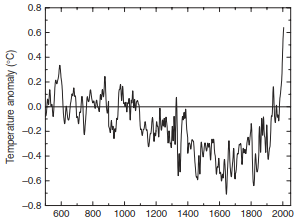
Figure 8.5 (referenced in the original text though not shown here) illustrates these temperature variations for the Northern Hemisphere over the past 1500 years, contextualizing recent warming within the longer record of natural climate variability. The figure demonstrates that while pre-industrial climate varied significantly, the magnitude and rate of recent temperature increase appear exceptional in the context of the past millennium.
Summary: Glacial Cycles as Context for Contemporary Climate Change. The ice core records spanning multiple glacial cycles provide essential context for understanding contemporary climate change. These archives demonstrate that Earth's climate system possesses the capacity for substantial natural variability, driven by orbital forcing and amplified by internal feedbacks involving greenhouse gases, ice albedo, and ocean circulation. However, they also reveal that current atmospheric CO₂ concentrations exceed any level observed during at least the past 800 kyr, and that the current rate of greenhouse gas increase is unprecedented in the ice core record. The close coupling between greenhouse gases and temperature evident throughout glacial-interglacial cycles implies that continued anthropogenic emissions will drive further warming, with consequences for ice sheet stability, sea level, and global climate patterns. Understanding the natural operation of the climate system through studies of past glacial cycles remains essential for predicting future climate trajectories and distinguishing anthropogenic impacts from natural variability.
Date added: 2026-09-24; views: 1;